Yalobusha Historical Society Minutes – May 17, 2012

Bill Breidinger
Fifty-three attendees at May’s Yalobusha Historical Society meeting learned about the four periods of pre-historic man during a presentation from Bill Breidinger.
Breidinger, accompanied by his grandson, Parker Collins, presented a “show and tell” on artifacts from four periods of Native Americans. Breidinger, lives in Decatur and works for MDOT
He serves as president of the Magnolia State Archaeological Society and has been collecting Indian artifacts for about 20 years.
Artifacts from four periods of prehistoric man were displayed. Paleolithic Man entered North America around 16,000 B.C. There are two theories on how they migrated across the Americas. One is that they traveled down the west coast by water and entered what is now South America. Other archaeologists think that there was a glacial thawing and that they entered from the north.
The next prehistoric people lived during the Archaic period or from 8000 BC to 1000 BC. They were the hunters and gatherers. Dogs were domesticated. The presence of the mortar and grinding stone suggest that seeds, nuts, and berries were consumed. Many well-made tools were produced during this period. They were first pecked out into a general shape, and then were smoothed by rubbing it against an abrasive stone. This made the object ready for the final step which was polishing.
The Woodland period covers from 1000 BC to about 800 AD. These people were the “mound builders.” Pottery and increased agriculture were the main changes to the woodland people. Now soups and broth could be boiled for better utilization of fish and meat scraps. However, the main importance of the pottery was for storing foods for the lean times of winter and to protect it from insects and spoilage.
The Mississippian period was from around 800 AD to 1650 AD. and marked the end of prehistoric times. These were the farmers. They were solidly centered around village and town life. Permanent dwellings were now possible because much food was grown in nearby fields.
Another characteristic was the growth of a huge pottery industry. Many styles and shapes from storage jars to water bottles to fine effigy forms depicting animals and people were made. Hoes and spades were used in great numbers and were both typical of the Mississippian culture. They also made large ceremonial objects that are highly sought after today.
Other business discussed at the meeting included:
• Heartfelt sympathy was expressed to the families of Betty Hughes and Margie Clay.
• Carl Vick, headquarters chairman, reported that the new roof was completed and commended members of the roofing committee.
• Julia Fernandez commended Don Roberson for “going the extra mile” in completion of the new roof.
• The speaker for the June 21 meeting will be Lloyd L. Caulfield, and his topic will be the Appalachian Trail.
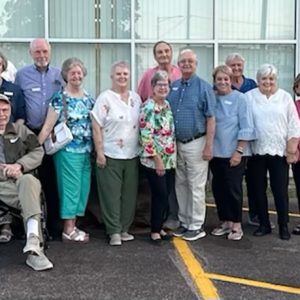
Attending the May meeting were Vernon Allen, Helen Jones, Bessie Allen, Bobby Hutchins, Bobbie Hutchins, Jon Jones, Buddy Lyles, Helen Lyles, Herbert Hayward, Dave Hovey, Emma Hovey, Cliff Chand-ler, Betty Baker Thomas, Sarah Saucier, Debby Hughes, Mike Worsham, Frank Fernandez, Jr., J. C. Collins, Bill Breidinger, Parker Collins, Tom Moor-man, Opal Wright, Hugh Bill McGuire, Alice McGuire, Gilbert Sullivan, Calvin Schmitz, John E. Perkins, Kay McCulley, Ronnie H. Coleman, Diane Coleman, Betty Miller, Mae Vick, Carl Vick, Jimmie Pinnex, Francine Pinnex, Thelma Roberts, Dollie Smith, Jean Fly, Sue T. Fly, Mike Ayers, Ann Garland Russell, Sarah Williams, Sandra Ebutonski, Harold Spraberry, Dot Criss, Lawrence Litten, Bettie Litten, Joy Tippit, Clyde Wood, Mary Wood, Kathryn Tierce, James Person and Julia Fernandez.