Chicken Plant Under Scrutiny By DEQ
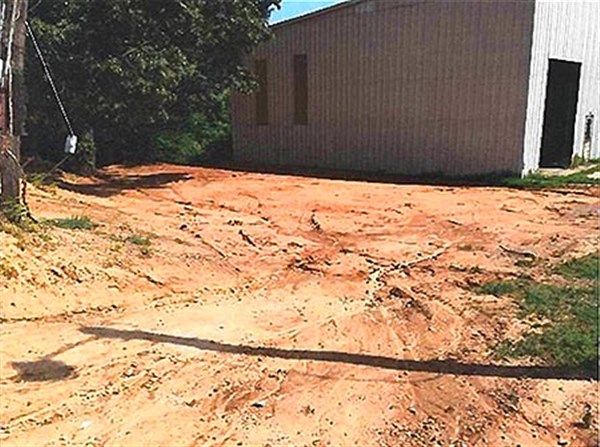
This photograph from the Mississippi Department of Environmental Quality complaint investigation report shows the spot where the burial “of an undetermined amount of chicken parts” took place on June 4.
Staff Report
WATER VALLEY – The poultry processing plant on Lafayette Street is under investigation for allegations of illegal dumping by the Mississippi Department of Environmental Quality.
The Clarion-Ledger news-paper in Jackson reported over the weekend that an investigator with MDEQ visited the plant in June after receiving a complaint that 40,000 pounds of chicken parts were buried at the facility.
According to the story by reporter Kate Royals, there were concerns about the waste floating into nearby Otouchalofa Creek.
Royals quoted the MDEQ report, which stated that Water Valley Poultry Manager James Waits said he decided to bury the waste after a spill on June 4. He said he followed a process he read about in an online manual.
The reporter contacted Waits, but he would not answer questions. And, a message left for city alderman Phillip Tallant, former manager of Water Valley Poultry, was not returned.
Mayor Larry Hart told the Clarion-Ledger that he was not aware of the pending complaint, but that he trusts the agency to regulate as it should.
“From time to time with poultry plants, you run into situations. But they’ve always been able to work that out,” Hart was quoted in the newspaper. “We all work together and do our best to keep the state of Mississippi and MDEQ and EPA happy, and we want the plant to be here.”
Royals wrote that in the initial complaint Waits said it was his decision to bury the waste on the site and that “this has happened many times before over the years at Water Valley Poultry.”
“Mr. Waits said that the parts were placed in a trench measuring 15 feet in length and 5 feet in depth. The parts were moistened with water and thoroughly covered with lime. The parts were then buried using dirt from the trench,” the newspaper quoted from the report.
Illegal dumping is often done to avoid paying for disposal and can cause significant environmental repercussions, according to MDEQ.
The reporter wrote that Lester Friedlander, a former inspector for the U.S. Department of Agriculture’s Food Safety Inspection Service, said the practice of burying chicken waste is dangerous because the antibiotics used as growth promoters for chickens can find their way into water.
“There’s a possibility there are people who will get sick or have allergic reactions because of the antibiotics found in there,” Friedlander explained.
Chris Sanders, the division chief of environmental compliance and enforcement division for MDEQ, told the Clarion-Ledger that the agency wouldn’t know whether any environmental damage had occurred until it completed its investigation.
“If there were any potential impacts, it would be to ground water. Most communities’ water is supplied to them from the local water district … True drinking water source is probably not threatened,” Sanders explained. “But nonetheless, the waste should not have been buried in that manner without some sort of approval.”
Sanders said MDEQ asks companies to transport those materials to a permitted landfill.
Sanders said if the agency finds the waste was buried underground, the plant will be subject to enforcement actions and a monetary penalty of up to $25,000 per day per violation.
The plant is owned by the California-based Global Food Innovations Inc. When reached by The Clarion-Ledger on Friday, no one was available to comment.
Royal wrote that this is not the first time the plant has come under scrutiny. In April, MDEQ fined the plant $45,500 for violating ammonia discharge limitations in its wastewater during several months in 2014.
The wastewater the plant produces is sent to the city’s treatment plant.
High levels of ammonia, a pollutant that can be harmful to aquatic life and humans, can cause a treatment system to fail, resulting in potential fines for the city, said Dennis Traux, chairman and head of the department of civil engineering at Mississippi State University.
“The second issue would be that in the failure of the treatment plant, it would likely create offensive odors that would be objected to by nearby residents. The impact on human health from these odors would likely be minimal other than those individuals who suffer from respiratory distress or allergies,” Traux explained to the Jackson newspaper.
Royal wrote that ammonia levels deviated up to 92 percent on one occasion in 2013, though MDEQ took no action at that time since the plant had hired a consultant to address the problem.
But the problem continued into the first six months of 2014, she added. In April 2014, a water sample showed ammonia levels of 46 milligrams per liter, more than double the allowable level of 21 milligrams per liter.
MDEQ issued the fine for the ammonia levels, to be paid in two payments of $22,750, after determining the plant was “not making any substantial progress” toward fixing the problem.
It also required the plant to hire a professional engineer to evaluate its wastewater treatment system. The plant must be in compliance with ammonia levels by March of next year or be subject to further actions, according to the Clarion Ledger story.
Fifteen years ago a fatal accident at the plant prompted a $105,500 fine by U.S. Department of Labor’s Occupational Safety and Health Administration.
According to Clyde Payne, OSHA’s Jackson area director, one worker was found dead at the bottom of the plant’s “feather whipper” on the morning of Jan. 22, 2000. Payne explained that the victim may have entered the “feather whipper” to remove a jam or may have fallen in through the opening at the top of the device.
Following an inspection of the facility, OSHA cited Yalco Processing with 22 serious safety violations with penalties totaling $105,500. An unsecured guard over the “feather whipper” was the cited violation related to the fatality.
Other serious citations included by OSHA included:
• unguarded machinery;
• fall hazards from open-sided platforms and stairs without railings;
• uncovered floor holes and drains;
• obstructed exits;
• confined space standards violations;
• failure to develop “lockout/tagout” procedures which render machinery inoperable during maintenance and repair;
• failure to train workers about using portable fire extinguishers;
• failure to have a hazard communication program, and
• wet and unsanitary floors.
A serious violation is defined by OSHA as one in which there is substantial probability that death or serious physical harm could result and the employer knew, or should have known, of the hazard.
Yalco Processing Com-pany employed approximately 16 workers to process waste and by-products from Valley Fresh, the company operating the poultry plant at the time.