Tax Assessments Face Scrutiny During Hearing

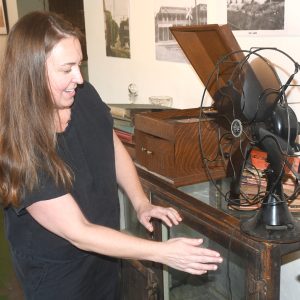
Speaking at Monday’s supervisor meeting, Kagan Coughlin (left) questioned tax assessments for Main Street buildings. His inquiry fueled a 30-minute discussion about the issue. – Photo by David Howell
Tax Assessments Face Scrutiny During Hearing
By David Howell
Editor
WATER VALLEY – A Main Street property owner questioned what he described as a huge variance in property assessments after examining tax records on two blocks of commercial buildings in Water Valley.
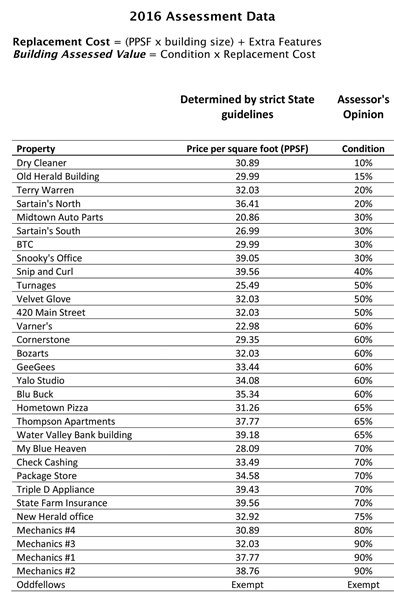
Speaking at Monday’s public hearing regarding the tax rolls, Kagan Coughlin initially questioned the assessment at 420 Main Street,one of muliple buildings he owns on Main. But Coughlin pointed to a bigger issue, presenting a spreadsheet using information Tax Assessor/Collector Linda Shuffield provided that showed a large swing in the assessed value of the buildings based on the assessor’s opinion of the condition of each building.
Coughlin explained that each building’s assessment is determined by determining a square foot value based on state guidelines Tax Assessor/Collector Linda Shuffield uses. The square foot value is then multiplied by the number of total square feet in the building, which determines the replacement cost value. The replacement cost value is then multiplied by the assessor’s opinion of the condition of the building, which ranged from 10 percent to 90 percent on his spreadsheet, to determine the assessed value. Coughlin added that while the price per square foot ranged from a low of 20.86 to 38.76 on the buildings he compared, the bigger factor is Shuffield’s opinion of the condition of the building, based on her observation.
“The variation between businesses that are functioning on very similar properties is huge, I don’t understand why,” Coughlin told county officials. Citing an example, Coughlin pointed to a print shop located between an auto parts store and a hardware store.
“The print shop’s condition is 60 percent. The other two businesses are 30 (percent), so effectively the print shop is being taxed at twice the rate of the neighbors on either side,” Coughlin said.
Coughlin also pointed to the newspaper building, which had one of the highest condition ratings set by Shuffield at 75 percent.
“For some reason that building is in the best condition on Main Street except for the bank buildings,” Coughlin said about the newspaper office, adding that the back of the building is mostly original and has little improvements. The improvements made to the front of the building came after the first of the year and were not reflected in the condition set by Shuffield.
“I could have come here and asked about my building. But the bigger picture is in terms of new businesses starting or businesses trying to maintain and pay their bills, this doesn’t feel like a level playing field. We just looked at two blocks,” Coughlin added.
Shuffield explained that the conditions change from year to year as improvements are made.
“There are several on the list that are in the process of making improvements now. It will change next year. It is done on a year-to-year basis and we are audited on it,” Shuffield explained.
Supervisor’s Response
Board President Cayce Washington first answered that supervisors have to trust Shuffield’s expertise in assessing the buildings.
“For me, I have to trust her (Shuffield), first and foremost,” Washington explained. “But this is a very valid concern. The only thing that I know that we could do to give the taxpayers some level of comfort is if you guys brought in an outside appraiser or maybe looked at an insurance value,” Washington added about taking a second look at the assessments of the buildings.
“But even with an outside opinion about the assessment, there still could be differences in opinion and the tax office ultimately signs off on the assessment,” Washington added. “I feel your pain, I am one of the highest tax payers in the county. I want something that is fair for all the taxpayers and the county, both sides. This is a very valid concern, but I don’t know how to alleviate it.”
Coughlin said he had requested some type of documentation from the tax office about how the condition is determined.
“The condition has so much power, more than the tax rate. I understand the challenge for the county, especially for a small tax base,” Coughlin said, adding that the solution is probably not lowering the assessment for some of the property owners with higher assessments.
“But at the same time I don’t know if some of these businesses on the low tax end could afford to operate in our county if they were brought up to a fair level,” Coughlin continued. “I don’t enjoy bringing this topic to you, it is complicated. But I have 10 years experience in the appraisal industry and this is not something that makes me comfortable as a homeowner or as a business owner.”
More Input
“I would like to see if we could develop something with Linda. I would like to think we are as equal as we can be across the board. I don’t think anyone minds paying their share, as long as it is equal. But finding that condition being equal I guess is where it gets a little gray,” Washington continued. “It is a tremendous concern of mine because I see our community on the cusp of some very positive things. You have been very much a part of that, as have other people in our downtown area. We don’t want to pencil-whip people out of town,” Washington said. “I don’t have an answer for you today.”
“But still we can agree that the condition is based on an opinionated feeling of good, bad or average. And that rests in the hands of Ms. Linda. We are depending on her, she is the most educated person in our county from the appraisal standpoint.
Coughlin then noted that the majority of counties in the state use an outside appraiser to set the property assessments in the county.
Washington said the topic of using an outside appraiser has surfaced before, but said the cost would be significantly higher and the assessments could still fluctuate.
“The assessor is responsible for the value, regardless of who gathers the information. If you have a company that came in and you paid them a quarter-million dollars to do it, it would still be my job to look at the final assess-ments,” Shuffield explained.
More Input
Responding to a question from District 3 Supervisor Lee McMinn, Coughlin said he would like to see “a clean process” for the entire county. He cited an example, explaining that a house with little improvements and no ownership change for multiple decades may have a much lower assessed value than a home valued the same if it were on the real estate market, but has undergone an ownership change or improvements.
“I think this disparity has grown over a natural process of 30 or 40 years,” Coughlin added. “We need to look at every property in the county and bring everybody up to today’s assessed value.”
Coughlin also said this would not mean a tax increase in the county because the cost to run the county would not change. Instead the field would be leveled for all taxpayers.
“I think that is a reasonable request,” Washington answered, before agreeing for the board to revisit the issue with Coughlin at a future date.
“But we can’t hold up the tax process,” Washington also said about addressing the matter immediately, as supervisors must approve the assessments in order to set the tax levy as part of the budget process for the new fiscal year that starts October 1.
Final Comments
“This is a larger concern,” Coughlin explained, pointing to the entire county and not just his property. “I don’t like to be here. I am disappointed at how many folks who told me that it has always been that way, don’t bring it up. The examples I picked out were not myself. I picked out other businesses that are having to pay twice the tax rate as their neighbors. That is a problem that may be county-wide… We are hurting some of our business owners and we may be underfunding everything in our county because some assessments are low and not collecting taxes that are due. And we may be forcing people out of our county by taxing them far higher than anybody else. That seems like a huge problem that supervisors would want to address,” he continued.
“I want to address it, Kagan, but I can’t do it in one board meeting,” Washington countered.
“I am not asking you to do it today, I am asking you to take this seriously and have a real strategy,” Coughlin said.
“That it what I am saying, I am asking Linda right now, in front of the newspaper and entire public body, I want her to evaluate this and come back to this board and help us understand how you get a condition for this building for 30 percent and this building for 60 percent,” Washington said.
“I will do that,” Shuffield answered.
McMinn then cited real estate experiences where the value of property was determined using comparisons of similar property and a “gut feeling,” explaining that realtors don’t always get it right and the property stays on the market for an extended period of time.
“Sometimes we hit it right on the head, the property is sold and everybody is happy. Sometimes they linger on the market for months and months,” McMinn said, reiterating that determining the value property will always reflect some opinion.
“Linda has lots and lots of experience and education in knowing what she is looking at. So I think we should try to come up with some type of criteria that can be reduced to writing, if we can, to give an explanation of the opinion,” McMinn recommended. “But in the end it will be one person’s opinion over another, ultimately what it is going to come down to.”
Shuffield also noted that McMinn was talking about a fee appraisal dealing with a single property when determining value for real estate.
“Your county assessment is done by regulations from the Department of Revenue. You are doing mass appraisal, this is not centralized fee appraisal. So your opinion has to be part of that because you are looking at a massive amount of property versus one house,” Shuffield explained.
“I think the answer is, we are not going to let it go away. You are assessing on a daily basis, are you not?” Washington asked Shuffield.
“Yes, we are actually watching the condition as it changes, it has to be done after January 1,” Shuffield answered, referring changes reflected in each year’s assessment.
“Since this has been brought to our attention, is it possible that you can meet with those owners. They just want to have an understanding about one versus another,” Washington continued.
“I understand, but when you compare properties, you also have to make sure they are the same age, same condition, same refurbish date, same type of property, same use of property,” Shuffield answered.
“I think if that is documented, there is not reason that can’t answer the question,” Washington concluded, reiterating that Coughlin’s concern would be addressed.