Shearer’s Tale Of Five Pianos
PROTECTED CONTENT
If you’re a current subscriber, log in below. If you would like to subscribe, please click the subscribe tab above.
Username and Password Help
Please enter your email and we will send you a password reset link.

By Jim Shearer
When you grow up in the newspaper business, one of the important lessons you learn is to never bury the lead, so here it is: five pianos available free to good homes. This is not a scam. There is, however, much more to the story, which leads us to “A Tale Of Five Pianos.”
Life is often full of unintended consequences. For months you are helping care for your sick mother, and then one day you wake up parentless, an only child and executor of your family estate, and, at least in my case, the dubious owner of five pianos, two pump organs, and two accordions. Yes, you read that correctly. Many people over the course of their lifetimes find themselves in situations where they inherit things they weren’t expecting, but does one ever anticipate FIVE pianos? How does one even prepare for such a thing?
In all honesty, I knew this was coming, and I’ve known it for some time. These were not topics mother wanted to discuss, so we just let the five elephants sit in their respective rooms. Now I find myself doubly conflicted, as, first, I wish to honor my parents and their life choices, of course, and second, I’m a working professional musician who fully understands the need for respect of historic and other instruments. But five, really?
There are three instruments with direct family ties. The oldest is a 19th Century black lacquer square grand piano. My father and both of my uncles learned to play on that instrument. Even I played that instrument as a child. Frankly, it was never very good as a piano, but when you closed the lid, it was a perfect space for granny’s Christmas village, complete with a fake snow blanket.
Today, on that side of the family only my Uncle Tommy is left, and neither of us are completely sure where the instrument came from. We think it came into the family from my grandmother Shearer’s people in the Delta. Some of them were monied folks, and this is the kind of instrument they might have had. It came out of my grandmother’s house on Clay Street to where it sits now on my mother’s sunporch many, many years ago. And there it sits. It’s quite sturdy, and mother used it as a base for stacking a Tetris-like pile of other things on top of it. Other than a massive table-top, it’s pretty useless now, but it is pretty.
There’s also a tall upright grand piano that I’ve heard called “Ludie’s piano” and also “grandmother’s piano,” but no one seems to know if it was Ludie’s grandmother or one of my great-grandmothers. (Old Water Valley folks, please explain to the newcomers who Ludie was…that’s a whole other column or two at the very least!)
I know it was over at the First Methodist Church for many, many years. I also know it went through the great flood of 1984 a few weeks after the historic Water Valley tornado. One of the problems with someone like my mother owning a building as big as the old Herald Office is stuff can just get pushed around to be dealt with “later.”
Well, when she sold the building, “later” turned into piling everything into an outbuilding on her property, and there it sits. Did I mention it once had about four feet of water in it? You can image how good it plays now… The wooden case is still kind of pretty though, and you just don’t see woodworking like it anymore.
The closest thing to a functional instrument is a late 1930s/early 1940s baby grand piano made by the Star company. A moderate instrument at its best, this was truly the piano I grew up with and didn’t practice on near enough because Mrs. Ludie always let me get away with too much slop and improvisation in my playing!
It came from Pope High School, and my father won it in a sealed auction when he bid $50.50. We’ve never learned if it was the magic extra 50 cents that put him over the top and won him the instrument, but either way it makes for a good story. The piano tuner who cared for it died many years ago. It’s been sitting alone ever since. It would cost several thousand dollars to bring it back to life, but it’s the one that could actually live again. It would also make a very pretty bar and serving piece! It’s a nice piece of wood, just a lousy piano in its current state.
The worst piano is not even a full piano anymore; it’s just a wooden carcass at this point. Here’s the story. Daddy and the aforementioned piano tuner who died found it cheap, and it needed a lot of work. It’s a seven-foot Knabe grand piano, and in its day, it was a wonderful instrument. When they found it, it was total junk, but they knew they could fix it. Their ultimate goal was to make a magnificent instrument for Woodland Hills Baptist Church, and it would have been too, had they finished it. The piano tuner took the keyboard back to his shop to work on it over 20 years ago. Did I mention he died?
Daddy took the massive lid off to work on the wood. We don’t know where it went. And, as most of you who have bothered to read this far know, he died too! Almost 20 years ago. So, what’s left now is a massive seven-foot hulk of a wooden case, with absolutely no chance to live again as a working instrument. Mother put it on the same porch next to the big black square grand piano mentioned above. I guess she didn’t want the first piano to be lonely. With the big curve in the grand piano body, mother found it much more difficult to stack stuff on top of this instrument, but, ever the trooper, she did manage.
And that brings us to the Chickering square grand piano, perhaps the saddest story of the lot. I honestly don’t know exactly where this piano came from. I know it came out of a historic home from a family in Water Valley, but that’s about it.
Celeste and I first saw it in the back of the old Herald Office in the mid-2000s, where mother had it delivered once she bought it. Celeste, a gifted and trained classical pianist herself, played it early on during its time with mother and deemed it “excellent.” In fact, we almost packed it up and brought it back to New Mexico, but that’s when our 1919 Ivers & Pond grand piano fell into our lives very unexpectedly, and it was already in Las Cruces, which was a MUCH easier move! (Imagine what a piano on the Titanic would look like; that’s our piano.)
After we decided not to take the instrument off mother’s hands, I’m honestly not sure what she was thinking, or if she even was. Next time I saw the instrument, it was covered in green mold, as mother had some deferred water maintenance issues at the back of the old Herald Office. This piano sat in a shallow swamp for quite some time. Oops. Then it got packed up and moved to the previously mentioned outbuilding, where the case actually cleaned up very nicely. Truly beautiful mahogany wood. But the inside, well, let’s just say “yikes!” Rats and various other critters decided to make the instrument their home for a number of years. I think you can picture that… When I started cleaning the outbuilding last year, this piano was near a possum carcass so desiccated it didn’t even smell anymore. The outbuilding had truly become a place where things came to die, I guess? This piano did, for sure.
Finally, just this year, for a little insult to injury, a tree split the outbuilding roof open during a recent windstorm, and a big limb fell right on that piano. The water did seem to drown the rats though, so I guess that was something positive. Believe it or not, the case is still a really pretty piece of furniture.
Now it’s time to sell mother’s house, and the pianos have to go. As a son, and as a musician, I’m just morally opposed to simply tossing these instruments on the trash heap, even in their current questionable shapes. It feels disrespectful somehow, but what is one to do?
Personally, I don’t have the skill (and I’m living 1,700 miles away), but a good woodworker could turn the square grands and the tall upright into very cool bar and serving pieces. I’ve also seen people hang an empty curved body of a grand piano on the wall, add nice shelves, and bingo, instant bookcases like no one else has! Do be warned, however, piano deconstruction is not the easiest thing in the world, and did I mention these things are all really massive pieces of wood?
I leave their fate to the good people reading this long confession of a column. I’m announcing these are all free to a good home, but we do not deliver. Contact me via email at jshearer.nmsu.edu or bug current Herald owner David Howell for a tour. David is helping take care of mother’s house until it sells. He’s a good soul. But, mother did make it very clear several times before she died he was her favorite “son” anyway, so I’m going to let this be his problem. (This last sentence was placed simply to see if David actually read all the way to the end of my submitted column before placing it in his paper.)
The moral of this story: clean out your stuff before you dump five pianos on your family’s head. You clearly don’t need them anymore.
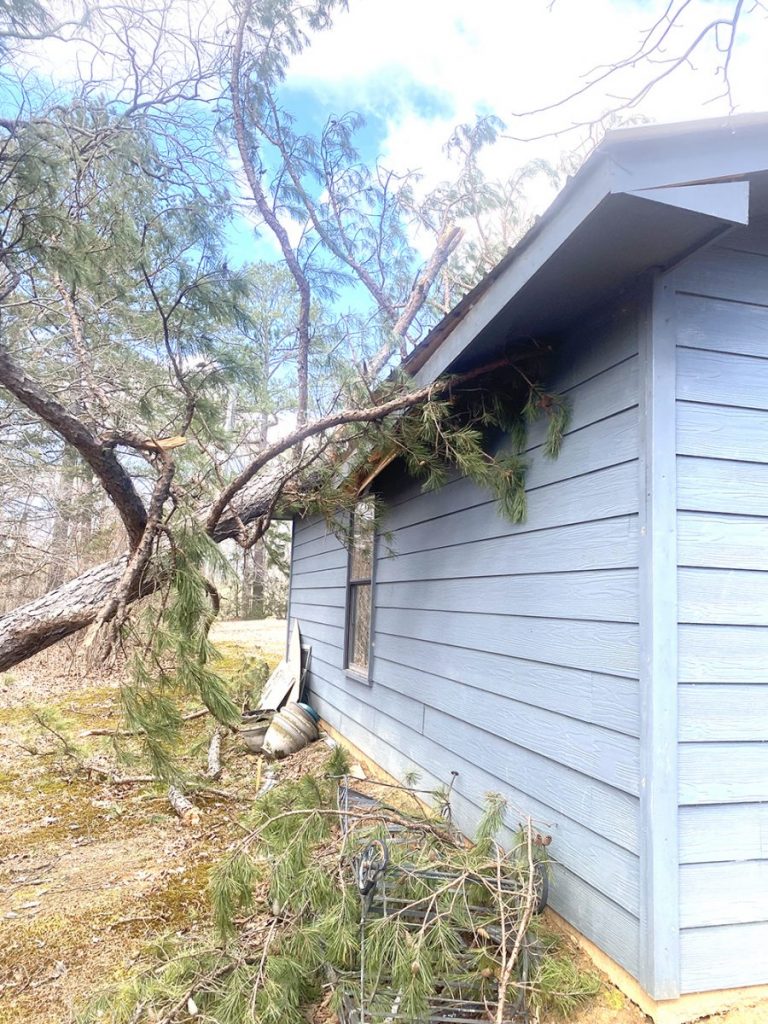
A pine tree fell and damaged an outbuilding at Betty Shearer’s house, and a big limb poked a hole directly above one piano stored inside.