Vengeance Is Historically Marked
PROTECTED CONTENT
If you’re a current subscriber, log in below. If you would like to subscribe, please click the subscribe tab above.
Username and Password Help
Please enter your email and we will send you a password reset link.

A historical marker was erected in Enid on April 18 honoring an ace pilot, John William Mitchell, who led the mission to shoot down Japanese Admiral Isoroku Yamamoto during World War II. The hero’s son,
John William “Billy” Mitchell Jr. spoke about his father’s mission during the dedication.
ENID – Mid-morning, April 18, 1943: A squadron of American P-38G fighter aircraft, heavily laden with extra fuel, wave-hops through hundreds of miles of South Pacific vastness, bent upon the longest fighter-intercept mission of the entire Second World War.
At 9:34 a.m. the radio silence is broken after 430 ocean-skimming miles. “Bogeys, 11 o’clock high!” called out a fighter pilot, using the slang term for hostile aircraft, alerting the crews on his 17 fellow aircraft. The focus of their needle-in-a-haystack attack was in sight: aboard one of the enemy planes was Isoroku Yamamoto, the Japanese admiral credited with conceiving and commanding the infamous surprise attack on Pearl Harbor on Dec. 7, 1941.
The radio transmission carried the first indication of the successful interception of the admiral’s plane. Just minutes later, the bomber carrying Admiral Yamamoto was shot down over Bougainville, crashing into the island jungle. There were no survivors on his plane.
Sixteen months had passed since the deadly Pearl Harbor attack and finally there was a measure of vengeance. The account of the historic mission remains an often and deeply studied episode in World War II history, and was revisited in 2020 after American fighter jets flew long-distance to execute Iranian General Qasem Soleimani.
The Mississippi pilot who led Operation Vengeance, the late Col. John William Mitchell, was honored last week with the dedication of a historical marker near his childhood home in Enid in a ceremony held April 18, exactly 80 years since Operation Vengeance. An ace fighter pilot, Col. Mitchell shot down 11 Japanese planes during World War II. But he was hardly done with successful enemy air engagements. Mitchell took flight again during the Korean War, flying 110 missions in the American F-86 Sabre and was credited with four more kills during that conflict, shooting down four Mig jets between January and May 1953. He flew a total of 240 combat missions in the two wars, but will long live in military history for his lead role in Operation Vengeance.
“The odds were unbelievable, my dad always gave credit to a higher power, to God,” son Billy Mitchell told the crowd assembled for the dedication. “It really was finding a needle in a haystack, right from the get-go.”
Billy Mitchell explained how, five days before the mission, Japanese messages were intercepted and given to Navy code breakers. The code-breakers, mostly second-generation Japanese-Americans, were able to decipher enough of the coded messages to determine the admiral’s probable itinerary, and a plan was formulated for the daring mission. Fuel tanks were attached to the bottom of the P-38s to extend their range.
“My dad had them put a ship’s compass in his plane. He had his wristwatch, an altimeter and a speedometer. Radio silence the whole way,” Billy Mitchell said. For almost 600 miles, the planes flew a mere 30 feet over the ocean waves to avoid detection by Japanese radar. “One of the pilots started falling asleep and his propeller grazed the water. He didn’t fall asleep again,” he continued.
Billy Mitchell added that two rounds from a .50-caliber gun struck Yamamoto.
“He was deceased before his plane hit the ground. They found him with his samurai sword. My dad didn’t actually shoot down Yamamoto, it was Rex Barber who shot him down.”
Col. Mitchell’s military career spanned 24 years. After World War II, he was assigned to direct training and operations at Keesler Field as the United States Army Air Forces became the United States Air Force. He later served as base commander at Goodman Air Force Base and as commander of the 57th Fighter Interceptor Group at Eielson Air Force base from November 1950 to June 1952. He retired from the military in 1958 as a full Colonel. He died Nov. 15, 1995, in San Anselmo, California at the age of 81 and is buried in the Golden Gate Cemetery.
Long Time Coming
More than a year in the making, the idea for the Mississippi Department of Archives and History historical marker originated with former Enid Depot restaurant owner David Howard. Howard credited Yalobusha resident Don Dalrymple for coordinating the effort that included raising funds to purchase the marker.
“Don spearheaded this, he knew who to call and what to do,” Howard added.
Pointing across the parking lot of Enid Depot restaurant, Billy Mitchell said his father was born in an old house adjacent to the Enid store, the building that now houses the restaurant. He also explained that his father, who died in 1995, would have been surprised to see the marker erected in his honor.
“He was a very humble man, very quiet, very simple and very intelligent,” Billy Mitchell said. “People he played tennis with after he retired, they didn’t even know that he had done any of this. He rarely talked about Operation Vengeance.”
State Representative Tommy Reynolds, the keynote speaker for the dedication, also affirmed the war hero’s strong qualities. Reynolds noted that Col. Mitchell was valedictorian of his graduating class at Enid High School. He received a $500 scholarship to attend Columbia University in New York before joining the military.
“The reason we are here today in Enid, Mississippi, enjoying our freedom is because of John W. Mitchell and people like him,” Reynolds said. “He is an example that we ought to emulate and never, never forget.”
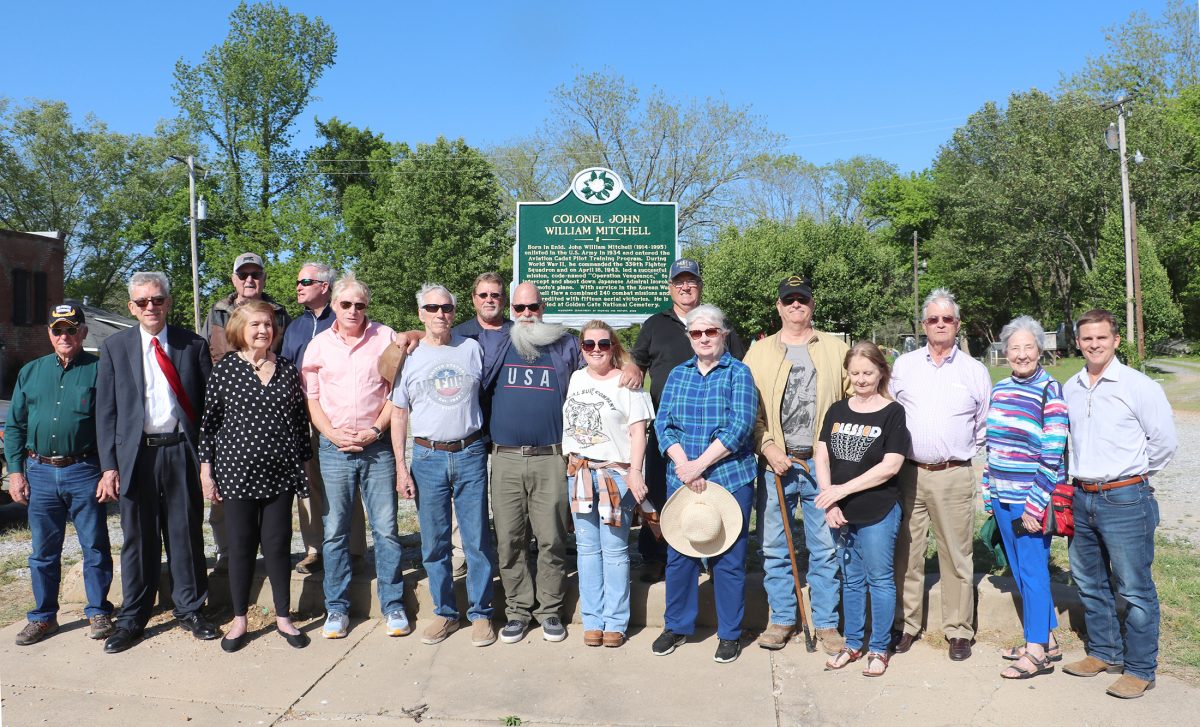
Attendees at the historical marker dedication ceremony included (front row, from left) John Wood, Representative Tommy Reynolds, Faye Dalrymple, David Howard, Don Dalrymple, Billy Mitchell, Stacy Mitchell, Susan Vick, Yvonne Hughes, Barron Caulfield, Lucia Holloway and Representative Brady Williamson; and (back row, from left) Bill Cossar, Ike Sayle, Kenneth Rowland, Andy Estridge and Kenny Hughes. The marker was erected adjacent to the Enid Depot restaurant, only a couple hundred yards from Mitchell’s childhood home.