County Commits To Assist With Road
PROTECTED CONTENT
If you’re a current subscriber, log in below. If you would like to subscribe, please click the subscribe tab above.
Username and Password Help
Please enter your email and we will send you a password reset link.
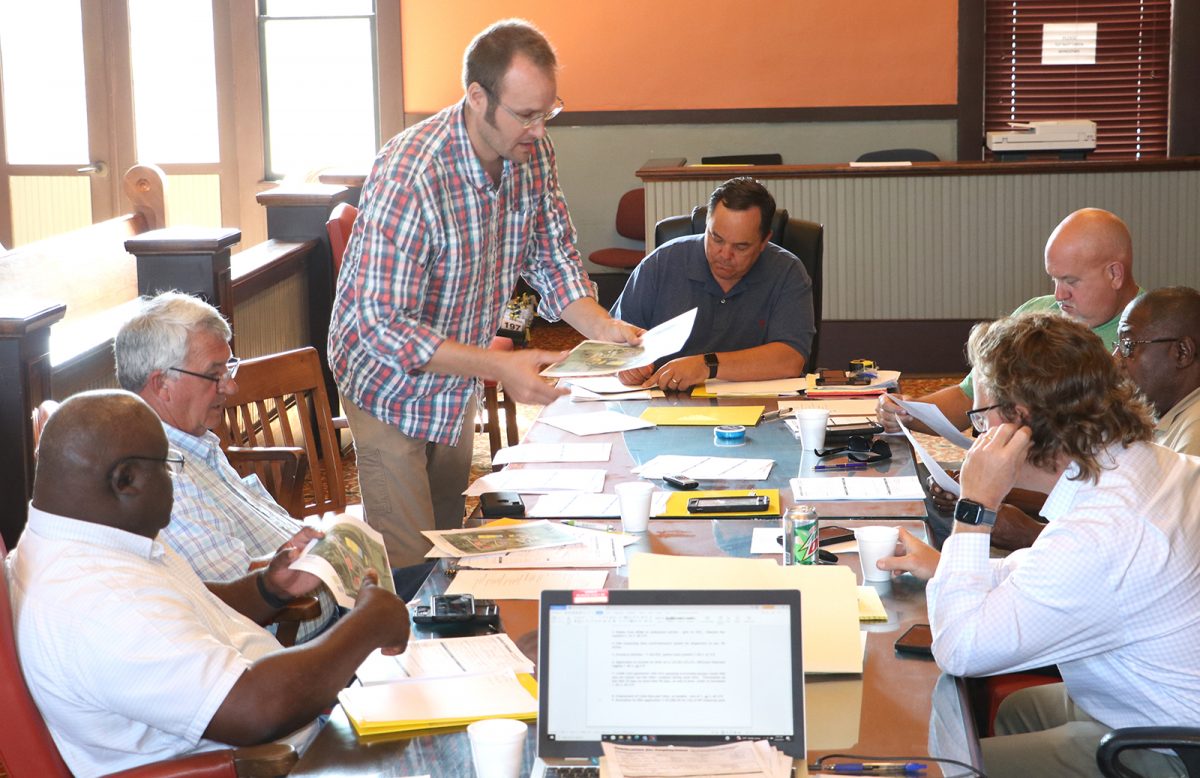
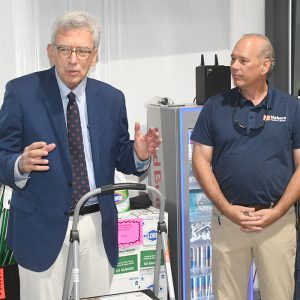
Yalobusha County Economic Development and Tourism District Director Kagan Coughlin (standing) handed out maps to county officials showing the location of a proposed road in the Water Valley industrial park.
WATER VALLEY – Yalobusha County supervisors passed a resolution to provide $75,000 worth of county labor and equipment use toward a proposed million-dollar road project in the W.C. Gardiner Industrial Park in Water Valley.
Though not lengthy, the road would go a long way toward drawing new businesses and jobs to the county. The third-of-a-mile road would connect the existing road in the industrial park, which runs from Hwy. 32, with a new entrance along Hwy. 7.
Yalobusha County Economic Development and Tourism Director Kagan Coughlin explained that the road will help when talking with prospective businesses about locating in the industrial park. “Right now our industrial park does not allow for trucks to go in and out,” Coughlin told supervisors during a recession of the June supervisors meeting. “If they go past the Warehouse 72 driveway, the truck has to back out. They can’t even do a three-point turn.”
Coughlin added that when inquiries are received from businesses looking for potential locations, one of the first questions includes a checkbox asking if there is “an entrance and an exit.”
“We don’t get to check that. That means it gets kicked out of consideration,” Coughlin said.
The county’s commitment follows several months of discussion. During the June 26 meeting, supervisors initially balked at the request, questioning both the request for an immediate commitment from the county and the legalities of spending county money on city property. The City of Water Valley owns the 127-acre industrial park and has likewise committed providing $75,000 in funding for the project.
Coughlin explained that the local matching funds necessary to secure grant funding need to amount to $150,000.
“I asked the city and county to split this, not in cash but in-kind work,” Coughlin said. He said the engineer’s estimate for the road includes just over $150,000 for clearing the road bed and dirt work – work that can be done using city and county equipment.
Coughlin also said that District 33 Representative Tommy Reynolds also secured $100,000 in state funding during the 2023 Legislative Session for the project. Coughlin is working to secure the remaining $750,000 from grant funding, and he reported that $325,000 has already been committed from one grant. The list of entities he is seeking grant funding from includes Delta Regional Authority, Appalachian Regional Commission, Tennessee Valley Authority and the United States Department of Agriculture.
“What we are pledging with this resolution is if we get $850,000, we will close the gap,” he said.
Supervisors also discussed how the in-kind commitment would work using county equipment and manpower.
“How are we going to determine $75,000?” District 5 Supervisor Gaylon Gray asked. “My only problem with it, we all share and share alike, but I am not going to spend a whole lot of my road fund from the south end of the county up here.”
Chancery Clerk Amy McMinn explained that hourly rates will be established for equipment and labor.
“And we will keep track of the hours worked,” McMinn said.
McMinn also shared Gray’s hesitation about using funds appropriated for maintenance of the county’s roads in the five supervisory districts for the $75,000 matching in-kind contribution, using the beat she lives in as an example.
“Because my road funds are my road funds, and I like to see that spent on my roads,” she added.
“They do in Beat 5 too, I promise you that,” Gray agreed.
McMinn recommended another option, pulling $75,000 from the county’s industrial operations fund instead of using county equipment and manpower for the in-kind match. Revenue for the county’s industrial fund is generated from the county-owned water system that sells water to Ajinomoto Foods in Oakland and has been used in the past for industrial projects.
“That is the best thing the board could do,” Gray agreed about tapping the industrial operations fund. “Because it would be county-wide and we wouldn’t be fussing because one (supervisor) spent $10,000 out of his road funds and another spent $2,000 out of his road funds. That is the fairest way to do it.”
Coughlin said later in the meeting that the county would have the option to provide the matching funds directly or in-kind.
Tight Timeline For The County Commitment
With Coughlin reporting the county’s commitment was needed immediately, he was questioned by supervisors about the necessity of an immediate commitment for the $75,000. Coughlin explained he fielded a call from North Central Planning and Development District on Thursday, June 22 requesting the county’s resolution to proceed with the grant applications. The request was shared with Board President Cayce Washington the following day, and a decision was needed when the board met on Monday, June 26.
“This turned into a fire drill, because we have talked about it. But suddenly they need resolutions,” Coughlin said. “This is not like to operate, I thought we were on track. North Central is helping with the paperwork and I got a call on Thursday that we needed these resolutions by today.”
Supervisors voted 4 – 0 in favor of adopting the resolutions following the discussion. Board President
Cayce Washington recused himself from the vote as he owns property in the industrial park.