Longtime Carnival Record Is In Jeopardy
PROTECTED CONTENT
If you’re a current subscriber, log in below. If you would like to subscribe, please click the subscribe tab above.
Username and Password Help
Please enter your email and we will send you a password reset link.
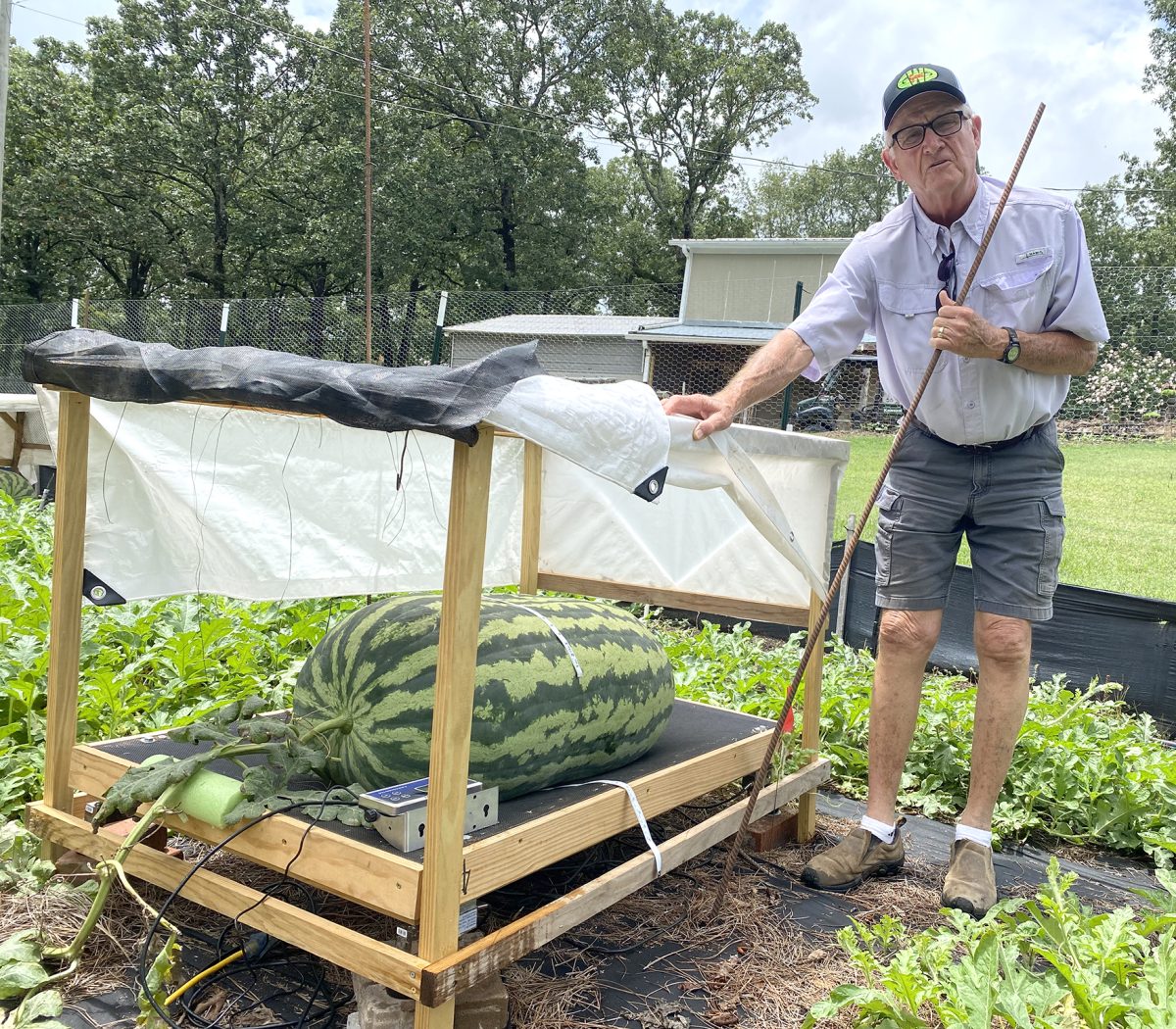
Alan Rogers checks the weight on his largest watermelon in his patch in the Sylva Rena community. He rigged the scale on the rack that holds the watermelon off the ground and is able to monitor daily growth. Rogers did not share the weight, but it was over 200 pounds last week and still growing fast. He plans to leave this one growing and pull a smaller melon for the carnival contest Saturday.
Spoiler alert: You will not see the biggest melons growing this season during the carnival contest Saturday, but you will likely see the biggest melons ever entered in this contest. This means the record for the biggest watermelon in the carnival’s Largest Melon Contest that has stood for 18 years could be in jeopardy. The number to beat is 210.2 pounds, a record set by Marty Bost during the carnival’s Largest Melon Contest in 2006.
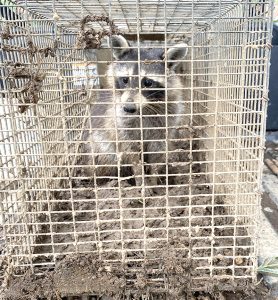
Hal Vaughn has several live traps around his melon patch. He catches coons and releases them several miles down the road to keep them away from his prized melons.
Hal Vaughn has five massive watermelons growing in his garden, and several were estimated to be over the 200-pound mark weeks before the carnival. Vaughn reported the melons were growing as much six pounds each day in mid July. Another local grower, Alan Rogers, also has several giant melons and his biggest was only 20 or 30 pounds behind Vaughn’s. While the weight for Vaughn’s melons are estimated by plugging multiple size measurements into a proven formula, Rogers has a scale under his big watermelon.
“Some days it gains six pounds, some days it may gain four,” Rogers said. “It grows more at night that it does in the daytime.”
Rogers also noted that as the melons get larger, they will not grow as fast.
Now for a quick disclaimer – Vaughn and other growers have produced numerous 200-pound melons in the last decade, but they were all pulled in September or October. The challenge is to have a 200-pounder for the carnival weigh-in and Vaughn has only crossed that threshold one time with a 202.1 pound melon that he grew in 2019. In fact, the 210.2 pound melon in 2006 and Vaughn’s melon in 2019 are the only times in carnival history a melon has tipped the scales over 200 pounds.
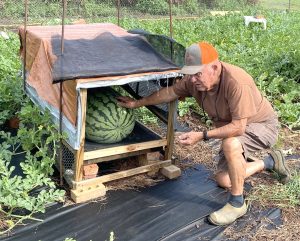
Hal Vaughn has five monster melons growing in raised boxes. He protects them from the sun to keep the skin on the melons from drying out, an important precaution as the skin must be able to stretch when they are putting on six pounds a day. The boxes also protect the watermelon from varmints.
Neither Vaughn nor Rogers are expected to pull their biggest melons for Saturday’s weigh-in during the carnival, but their “smaller” melons are contenders for a new carnival record. The melons they leave in the patch will continue to grow in August and September, well after the carnival.
Both Vaughn’s and Roger’s successes this year with these huge melons are a strong indicator that the state record set in 2013 is also in jeopardy. Water Valley grower Jerry Vaughn holds the record for the largest watermelon ever grown in Mississippi with a 239.5 pound melon that was pulled in October that year. Barring any unforeseen complications, Rogers believes that he and Vaughn could have melons over the 300-pound mark in September.
Growing monster melons is a labor of love for Vaughn, Rogers and other growers who enter the carnival contest each year, but few take it as serious as these two men. It even haunts their dreams.
“I had a dream the other night that this watermelon grew to be 400 pounds. Hal had the same dream,” Rogers said.
They invest countless hours year-round working on their garden spot where the melons are grown, hauling in concrete sand, gin trash from the cotton gin, horse manure and multiple fertilizers.
“Anything you plant, it is all in your dirt,” Vaughn explains. “These watermelons have everything they need.”
Vaughn also has his melon patch on a grade, where it will drain after a rain. Another trick most growers all use is pulling off the melons on each vine that continually pollinate, leaving only one watermelon on each vine so it does not have to compete for the nutrients. Vaughn has four vines growing, three of them each feed one big watermelon and the fourth has two big watermelons. He also trims the vines almost daily as they grow so fast they would cover the entire hillside.
“The seeds make a difference too,” Rogers explained.
Typically Rogers and Vaughn will plant seeds harvested from some of the biggest watermelons in the world as they tap into the tight-knit group of growers for support. Many of these famed growers do not mind sharing a few seeds from a monster melon grown the previous year.
While all of these variables have been fairly consistent in past years, there is a notable change this year. Rogers learned how to graft the watermelons, a tactic used by some of the top growers in the nation. He grafted 11 watermelon seedlings, attaching each one to a bushel gourd vine. The gourd vine gives each seedling a bigger root system to draw nutrients to feed the watermelon. Rogers started with six grafted watermelon seedlings and Vaughn started with five grafted seedlings. Rogers also has four non-grafted watermelon vines and reports there is no comparison as the melons on the grafted plants are growing much faster.
Another big boost this year that could also be a catalyst for a new carnival record is having watermelons on the vine early.
“I got them pollinated earlier than I ever have before, that is important,” Vaughn explained. “I tried myself,” Vaughn said about hand pollinating the blooms. “But I can’t tell you whether I did it or the bees did it.”
Hand pollination is a common technique used by some growers as they transfer pollen from the male flowers to the female flowers using a small brush or cotton. Vaughn often hand pollinates to try to get a melon growing on the vine early. This year his first watermelon was growing on the vine on May 27.
“One year it was almost the end of June before I had my first watermelon, a month later than this year,” Vaughn recalled.
That slow start was back in 2021, and there was just over four weeks growing time before the carnival when the melon was pollinated. It grew fast and still tipped the scales at just over 148 pounds. Vaughn’s late melon that year was four pounds lighter than the first place melon grown by Jerry Vaughn and he earned a second place finish that year, the only time he hasn’t won the Largest Melon Contest since the first year he entered it in 2018. Granted last year he shared the first place finish with Jerry Vaughn, as both competitor’s melons weighed 163.9 pounds.
Vaughn still remembers that some of the competitors were reluctant to share any tips or secrets about growing big watermelons when he first started.
“When I went to the competition last year in 2018, those guys didn’t tell me much.” Hal recalled. “In fact, they were asking me what I did.”
But Vaughn and Rogers enjoy sharing tips and helping each other. Last year Rogers made a trip to Kentucky to attend a fair that attracts some of the top watermelon growers in the world. He learned several growing tips that both men implemented with this year’s crop.
Vaughn and Rogers won’t be the only competitors with a big melon in the contest Saturday. Others trying to grow a respectable melon for the carnival include George Rounsaville, Lee McMinn and Kenny Harmon.
Another chapter in the contest history will be written at high noon at the gazebo in City Park Saturday. Another chapter in Water Valley’s watermelon history may also be written later this year when Rogers and Vaughn pull their big melons with hopes for setting a new state record in Mississippi.