Football, Drainage And A New Darter
PROTECTED CONTENT
If you’re a current subscriber, log in below. If you would like to subscribe, please click the subscribe tab above.
Username and Password Help
Please enter your email and we will send you a password reset link.
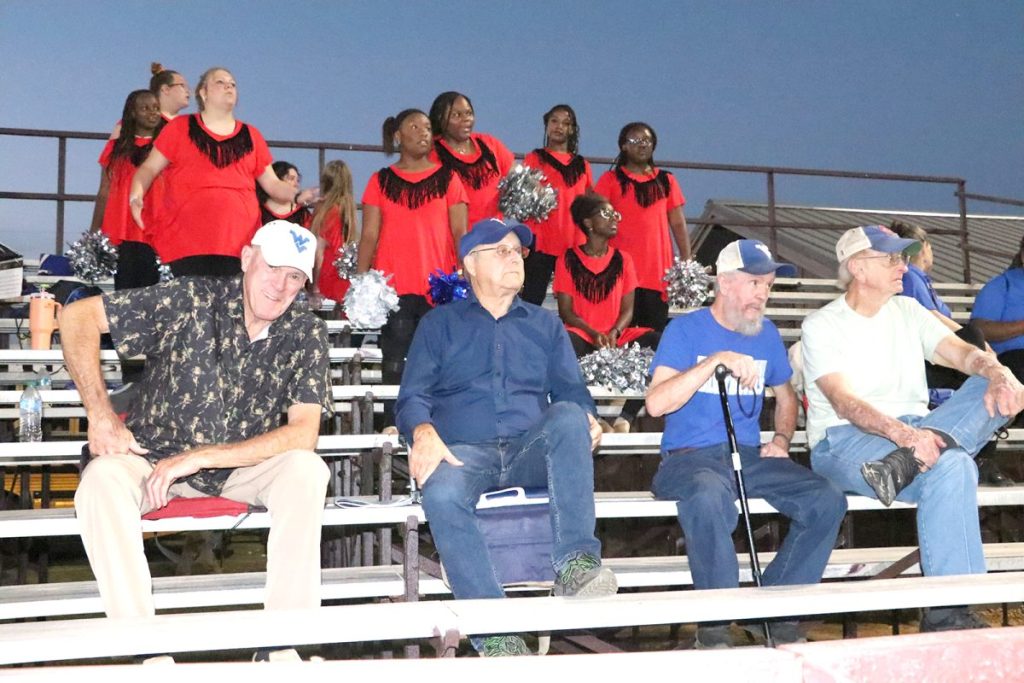
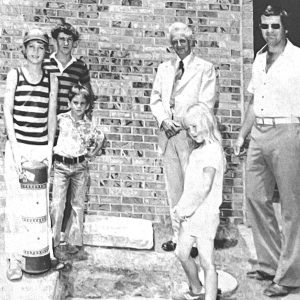
Jim Gholson, Billy Stark, Artie Stewart and Charles Health are faithful Blue Devil fans.

DAVE’S WORLD
By David Howell
There were a few fans who left Friday night’s game in Eupora at halftime. Down two touchdowns in the game and three games in the season, it didn’t look good for the Blue Devils.
Minutes before the half, the Blue Devils had a touchdown that was called back, giving the Eupora a final possession and an opportunity for another score that would have likely put the game out of reach.
The Eagles wasted no time flipping the field, but the Blue Devils flipped the switch. They stood strong in the red zone, headed out the field at the half, and the momentum for the remainder of the game was clearly in the visiting team’s favor.
It wasn’t immediately evident that the tide had changed. The first half was extremely physical, and the September night was as muggy as any game this season. The field house for the visiting team was hot, with no air-conditioning, and the players and coaches huddled behind the visitor’s side bleachers.
The rest is history as the Blue Devils would fall behind another touchdown before taking care of business. There ain’t nothing like Friday night football and I am looking forward to Friday night at J.Z. George!
Now switching gears, I learned something interesting Monday night. I attended a public hearing at City Hall regarding proposed drainage work to help alleviate flooding problems in the city. The Natural Resources Conservation Service (NRCS) is in charge of the project with assistance from Dungan Engineering and Allen Engineering and Science.
The project is currently in the planning phase that should be completed by the end of the year. The design phase will follow and is expected to take two years before construction actually starts. Preliminary engineering is underway and problematic areas cited in the meeting included portions of Martin Street, Main Street, Lee Street and other areas in the city.
The solution will be widening and reshaping drainage channels, desilting the channels and replacing culverts. A recurring problem cited in the meeting were numerous culverts that are too small and restrict water flow. Some of these are big box culverts under main city streets.
The project is one of three across the state that received funding from the Bi-partisan Infrastructure Law passed by Congress and there will be approximately $4.5 million in funding for the actual construction work. The report Monday night is it will take every bit of it this funding.
Obviously with any federal project, the potential environmental impact is part of the discussion and this is where it gets interesting. I learned that there is a species of fish, the Yoknapatawpha darter, that is only occurs in tributaries of Enid Lake including the Yocona River, Otouchalofa Creek and other creeks in Lafayette, Yalobusha, and Calhoun counties and possibly in creeks in southwestern Panola County.
This darter is listed as a species of concern, meaning the species needs proactive conservation efforts. Thankfully this concern will have very little impact to the proposed drainage work. The United States Fish and Wildlife Services (USFWS) recommended using bottomless culverts or span bridges when possible to make sure the darters can pass through culverts when the water is low.
And, from Monday’s meeting it looked like the darter’s range in the city that the USFWS is interested in is only the portion of Town Creek between the South Main Street bridge and Blackmur Drive box bridge. Most of the proposed drainage work is upstream from this area, so the darter should not be a concern.
I though it was pretty neat and did a little internet research to learn more. Prior to 2020, the darters found in tributaries feeding Enid Lake were thought to be the same darter found in the tributaries that feed Sardis Lake, a fish known as the Yazoo darter. Research revealed that this darter is different and this species was split from the Yazoo Darter.
According to the USFWS, Yoknapatawpha darters are one of few endemic species to Mississippi and take their scientific name, Etheostoma faulkneri, from “favorite son” and Nobel Laureate William C. Faulkner.
Yoknapatawpha was the original name of the Yocona River and the name Faulkner gave to his fictonal version of Lafayette county in his writtings.
The Yoknapatawpha darter is around two-and-a-half inches long and the males have brilliant colors of orange and blue during the mating season.
All of this was news to me and now I am curious if any readers have input on these “new” darters. Let me know if you know something.