The Big Melon Season Is Underway
PROTECTED CONTENT
If you’re a current subscriber, log in below. If you would like to subscribe, please click the subscribe tab above.
Username and Password Help
Please enter your email and we will send you a password reset link.

DAVE’S WORLD
By David Howell
This week’s topic should come as no surprise for my longtime Dave’s World readers, especially following my turkey hunting adventures in last week’s edition. Traditionally, watermelons follow turkey season as part of the natural progression of spring activities. I’m not talking about the everyday melons, although I know some seeds will be in the ground soon.
I’m thinking about the giant melons and the quest to create new carnival and state records that has already been underway for months.
Months?
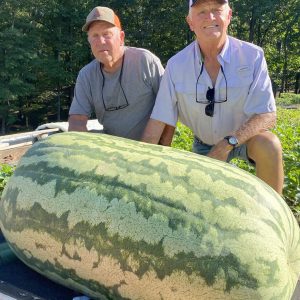
That is right, the big boy growers start early (or really never quit), as the site prep work is almost year-round, not to mention the actual growing season. For those who may not be up to speed on the topic, the competition melons are all Carolina Cross watermelons, a variety known for a lengthy growing season. The sure-enough big ones can grow until early fall — the ones that weigh well over 200 pounds.
The challenge is always the setbacks. Last year, it was an extremely wet spring and cool nights that delayed planting, stifled early growth and brought a fungus that took out some big melons midway through the season.
This year, that certainly won’t be the issue. Temperatures warmed up fast, and it is as dry an April as I can recall in a long time.
But don’t forget Winter Storm Fern. Back in January, Allen Rogers already had grafted seedlings — a Carolina Cross plant on a bushel gourd root system — in the early stages in his greenhouse when the electricity went out for an extended period. I am sure Allen figured out a workaround, and several other big-name growers in Water Valley also rely on those grafted plants.
And that is where things get interesting.
Grafting is one of the keys to growing these giants. Rogers takes a watermelon seedling, called the scion, and carefully joins it to a stronger gourd rootstock. A small clip holds the two together while they bond, and the plant is placed in a controlled environment with low light and high humidity until it heals.
It sounds simple, but it is anything but.
“This isn’t a shortcut,” Rogers said. “It’s something you learn.”
It made me think about the learning curve driven by the quest to grow the biggest melon for the Watermelon Carnival. The real quest started back in 1999 when Marty Bost had one of the first triple-digit melons at the carnival weigh-in, a 100-pounder. Each year since, the quest — and the learning curve — has been fun to watch.
Only two times in Carnival history has there been a 200-pounder at the weigh-in. In 2006, Marty Bost had a 210.2-pound melon. In 2024, Hal Vaughn had a 219.6-pound melon, the all-time carnival record. Sure, we have had local growers with bigger melons, but those are pulled weeks or even months after the August carnival.
Vaughn’s 219.6-pounder is a big number to beat, but you never know.
As for me, melons aren’t my expertise, but I usually grow a garden each summer. This year, I’ve been too busy, and aside from a few vegetables growing in tubs, I don’t have anything in the ground.
Maybe this weekend… if I can stay out of the woods. It’s hard to focus on chores when the turkeys are still gobbling. If you’ve got one talking, let me know.