Count The Hours, Cut The Cost
PROTECTED CONTENT
If you’re a current subscriber, log in below. If you would like to subscribe, please click the subscribe tab above.
Username and Password Help
Please enter your email and we will send you a password reset link.
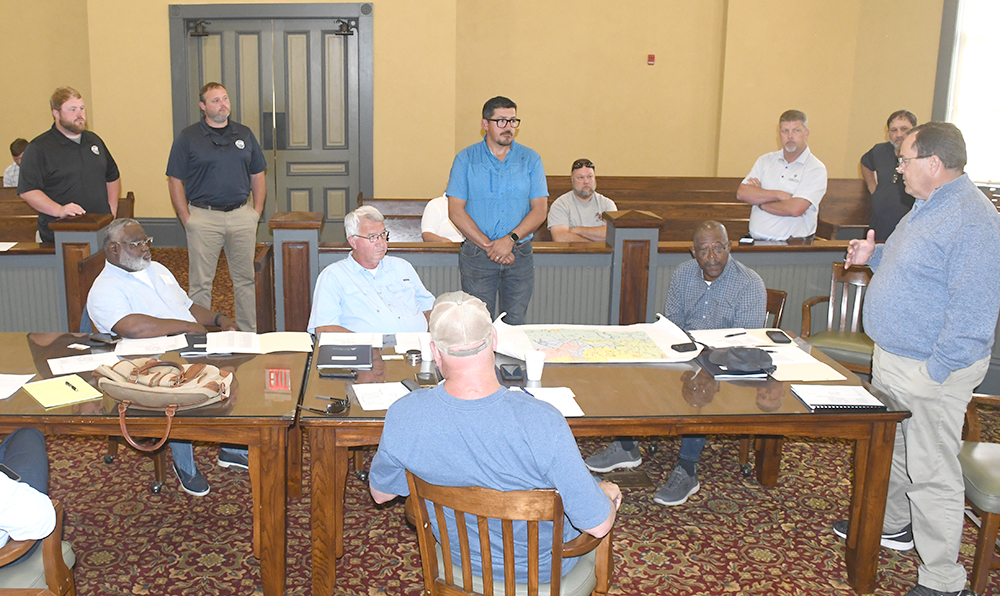
Mike Mejia (center), coordinator for TFR, the Texas company contracted for debris removal, and Brandon Sims, left, the new park manager at Cossar State Park, are pictured at Monday’s Yalobusha County Board of Supervisors meeting. During the meeting, supervisors discussed storm cleanup efforts, including maintaining the $7 million budget for TFR and executing a memorandum of understanding between the county and the state to allow TFR to remove debris from state property at the park.

DAVE’S WORLD
By David Howell
Count The Hours. Cut The Cost.
It’s a simple message, but one that reflects some practical thinking by county officials and could play an important role in the recovery effort following Winter Storm Fern.
In a county where neighbors still show up for one another, the idea is simple: turn the work already done by local residents into real dollars that can help offset cleanup costs. And there has been plenty of work. From the first days after the storm, residents across Yalobusha County were out with chainsaws, tractors and pickup trucks, cutting trees, dragging limbs and clearing roads and driveways. This early effort made roads passable, the dig-out that was essential for power restoration, emergency response and getting life somewhat back to normal.
In the weeks after the big storm, the county contracted with a debris removal company to get rid of this mess. Thousands of tons of debris have been hauled away, and many, many thousands of leaning trees and limbs have been cut along road rights-of-way from one end of the county to the other.
It has been, by any measure, a massive undertaking.
The total cost of cleanup in Yalobusha County is estimated at roughly $9 million. Under the current reimbursement structure, Federal Emergency Management Agency is expected to cover 75 percent of eligible costs, with the state covering another 12.5 percent. That leaves the county responsible for the remaining 12.5 percent — an estimated $1 million.
That’s where this campaign comes in.
FEMA allows documented volunteer labor to count as an in-kind contribution, meaning the time and effort already put in by residents can be applied toward reducing the county’s share of the cost.
In short, your time can save taxpayer dollars.
You may have helped a neighbor clear a driveway.
You may have cut a tree out of the road in front of your house.
You may have spent hours running a chainsaw or tractor, or hauling limbs to the right of way for pickup.
All of that work matters — but only if it’s documented.
County supervisors are now asking residents to take a few minutes to report that work if it has not already been recorded. Basic information is all that’s needed: your name, the type of work performed, any equipment used, the approximate location and date, and a phone number. The documentation is essential, and it’s a simple process, but one with real impact.
The county has already logged hundreds of thousands of dollars in in-kind contributions, possibly as much a half-million dollars, tracked by ER Assist, an outside company hired to help with the recovery. Those numbers continue to grow and every additional hour reported helps reduce the amount that must ultimately come out of local funds.
Without that offset, the remaining cost would likely be divided among the county’s five districts, pulling from road and bridge budgets that are already stretched thin.
That’s why supervisors are pushing the message: Count the hours. Cut the cost.
It only takes five minutes — and it matters.
Residents who contributed to cleanup efforts are encouraged to contact county employee John Ferrer at 662-607-6068 between 8 a.m. and 8 p.m., seven days a week, or email ycpo@yalobushacounty.net.
Remember, in a recovery effort defined by long hours and hard work, this may be one of the easiest ways to continue helping.
—————-
Last week, a longtime Water Valley resident stopped by the office to share a story.
She talked about dealing with mental health struggles, and how on some days she has needed help.
That’s where local police officer Trey Pullen came into the conversation.
What stood out wasn’t anything dramatic, just the way she described him.
“He doesn’t judge me,” she said.
In situations that could have escalated, she said he took the time to talk and help settle things down.
“I’m not scared when he comes,” she said.
That’s not something you hear every day. It’s also a reminder of how much the job has changed. Officers today are often called to handle situations that don’t come with easy answers.
She said she mainly wanted to say thank you.
“I just want people to know they don’t have to be scared to call,” she said.
We hear plenty about the challenges in a community. This is part of the story, too.