Landowners Question Rails To Trails Project
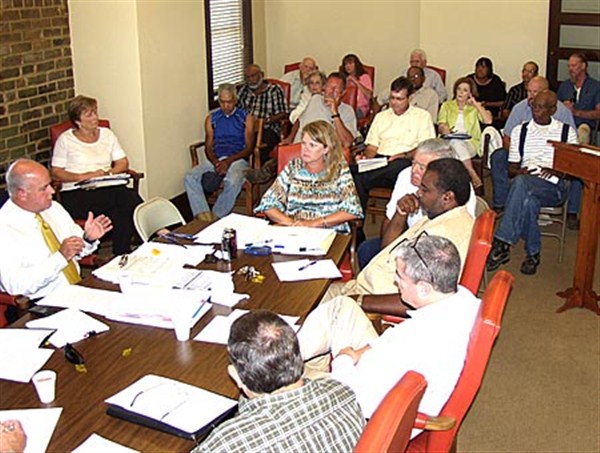
More than a dozen landowners attended last week’s supervisor meeting in Water Valley to voice concern about a Rail to Trails project. Board Attorney John Crow (left) explains the steps taken by the Board of Supervisors. – Photo by David Howell
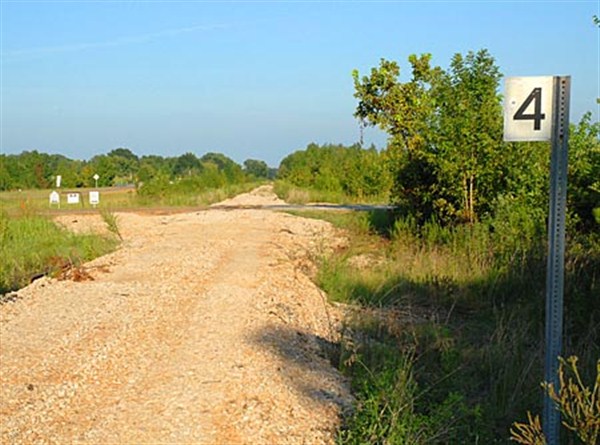
Looking east where the old Mississippi and Skuna Valley Railroad crossed County Road 221. The 100-foot wide right-of-way stretches 21 miles through Yalobusha and Calhoun Counties.
Editor
WATER VALLEY– Ownership of a 21-mile stretch of abandoned railroad that stretches from Coffeeville to Bruce has created controversy after landowners asked county officials both in Calhoun and Yalobusha Counties to honor their deeds.
At issue is the 100-feet wide right-of-way that the two counties took ownership of last year, following the donation from Patriot Rail for future use as a “Rails to Trails” project.
Patriot Rail acquired the Mississippi and Skuna Valley Railroad (MSV) in 2010 as part of the purchase of six railroads owned by Weyerhaeuser Company. The MSV had ceased operations two years earlier, in April 2008, because a bridge required substantial repairs.
Last November, the two counties accepted the right-of-way from Patriot Rail, a salvage company, who purchased the rail for scrap. In return, the salvage company obtained tax credit and has 18 months to strip the steel, cross ties and gravel on the rail.
Fielding questions from Skuna Valley Neighborhood Association spokesperson David Scobey, John Crow explained the project was spear-headed by the Mississippi Attorney General’s Office. Crow’s comments came during a recessed meeting last Tuesday, August 28 in Water Valley.
“They proposed to donate the land to the county and advised how to set up the Rails to Trails,” Crow explained. “Calhoun and Yalobusha was receptive to this because of the success of existing Rails to Trails districts in the state.”
The two counties next entered into an inter-local agreement establishing Skuna Valley Trails District, a local district which oversees the project, according to Crow. Each board appoints a representative to the district.
After Crow answered questions about the procedures undertaken on the project thus far, the topic turned to a reverter spelled out in a right-of-way easements from 1926.
The problem cited by landowners, stems from the removal of the steel which constitutes the abandonment of the railroad. Their comments came both during the August 28 meeting and a mid-August meeting in Calhoun County.
Landowner Nancy Clark read the wording on the portion of the deed.
“It is distinctly provided that an abandonment of a railroad herein provided for and the taking up of the steel of the same shall cause the property granted herein to revert at once to the grantor or grantors,” Clark read outloud at the recessed supervisor meeting.
Crow then explained the reverter had already been researched, and the Supreme Court had ruled on a similar case, Presault versus ICC in 1990.
“It did cause me great concern that these reverters were in there,” Crow said.
After researching the issue and conferring with the AG’s office, Crow explained the reverter issue was put to rest based on the Presault case.
Clark countered, explaining that the Supreme Court is not divine.
“It sanctioned slavery at one time. Things that are sanctioned by the Supreme Court can be overturned,” Clark said.
“It seems that this battle that we are in today is a matter of semantics,” Clark continued, explaining that the term “interim use” on the rail right-of-way had been substituted for abandonment to keep the reverters in the deeds from being honored.
Another landowner also addressed the board, Corinth-resident Glenn Parker, who explained the landowners were aware of the Presault case referenced in the meeting.
But Parker pointed to additional court cases that pointed to landowners winning similar cases when the deed had similar wording concerning abandonment of railroad right-of-way easement.
“The Presault case does not say that,” Crow explained.
“This is probably more recent than what you are quoting,” Parker said.
Crow countered, explaining that his research and input from the Attorney General’s office is accurate and up-to-date.
“The U.S. Supreme Court says it doesn’t revert. You know they are the last word They are the big daddies of the law. Despite what Congress says, either house or the President says, they have the last word on everything. Regardless of whether we like it or not, that’s it,” Crow explained.
“This is what the law is. It will be up to the board to make a decision as to the future use of this line,” Crow added.
More Comments
“I have heard you won’t get your land back. I want to know who took the land,” Parker said later in the meeting, adding he has a mile of land through which the railroad passes. A mile of 100 foot right-of-way through his property encompasses just under 13 acres, Parker added.
“We are not trying to hurt anybody, we are trying to help Yalobusha County. We felt like it would be an economic boost to our county like it has been to other counties,” Board President Tommy Vaughn said, referring to successful Rails to Trails projects across the state.
His comment brought a sharp response from Parker, “We have no interest in what Hattiesburg is doing. Or what is being done from Pontotoc down toward Houston. Or maybe something going on around Oakland somewhere. We are interested in ours and we will do our best to protect our interest.”
Also addressing the board was Clayton Horton, who questioned the cost to the county to maintain the right-of-way.
Vaughn said the county will only be required to spray the right-of-way annually to keep the weeds and grass in control.
“Are you going to pave that track?” Horton then asked.
“No sir, if that thing ever came to fruition where you actually had a Rails to Trails District, you would have to fix it where people would use it. And that would be done on grant money. Quite frankly, I don’t think it will happen anytime soon the way the economy is,” Vaughn continued.
Next Horton questioned the four-wheeler traffic on the right-of-way at night.
“They are already running up and down it,” Horton added.
To counter this issue, supervisors agreed to post no trespassing signs and requested Sheriff Lance Humphreys to step up enforcement to curb ATV traffic.
The final question voiced by Horton concerned liability on the 100-foot right-of-way.
This question brought the discussion back to the starting point, as any potential liability would follow the actual owner.
Crow explained later in the meeting that the Skuna Valley Trails District has accepted liability following the transfer of land last November. Crow also provided a quote to provide liability insurance coverage for district at a cost of around $2,000 between both counties.
Cost to County
The final issue surfacing in the meeting concerned the expense to the county for the district.
“It is my understanding that we have already had a vote without consulting the taxpayers to support the maintenance of these trails. Is that correct?” Scobey asked.
“No,” Vaughn answered.
Scobey then presented a signed agreement between the two counties last December that stated each county can levy up to a quarter-mill to fund the district.
Crow said that agreement doesn’t require the county to levy millage, but is only an option.
“I am not aware of anything in the budget for Rails to Trails for this coming budget year,” Crow continued.
Scobey then switched to anticipated expenses for the Rails to Trails district, citing information obtained from the National Rails to Trails website, which spells out stringent requirements for operation of the trail.
“You have to pick up garbage. The trails must be sealed every four or five years. We are talking astronomical expense. You are going to have to have access points to this trail, which means parking lots and restrooms. The sheriff is going to have to ask for more help in the way of the officers and patrol vehicles,” Scobey continued.
“My fear is that we the taxpayers are going to be stuck here paying for something that we don’t even want,” Scobey said.
“We are already a poor county. We have very little industry. We are sitting here paying $4 million dollars now for the renovation of two courthouses. We are going to be looking at $1,253,000 we got to pay for this gymnasium and administration building for the Coffeeville High School. And the sheriff has already asked for a new jail to be built.
Scobey added that all of this points to higher taxes when many Yalobushians already struggle to pay property taxes.
“We would like to ask as a group that you reconsider, and back out of that Rails to Trails agreements,” Scobey asked.
Following much of the public input, District 5 Supervisor Frank “Bubba” Tillman stressed that shutting down traffic on the right-of-way would alleviate much of the landowners’ concern.
“I don’t think this is nearly as bad as being portrayed. But everybody is entitled to their opinion and I appreciate it. I just disagree with it,” Vaughn added.
Vaughn also stressed if the project comes to fruition, the board will not vote to invest tax dollars if it is not justified.
After the room emptied, Crow explained that a St. Louis attorney had contacted landowners about a potential lawsuit pertaining to the right-of-ways.