Junky Yard Brings Discussion In County Meeting
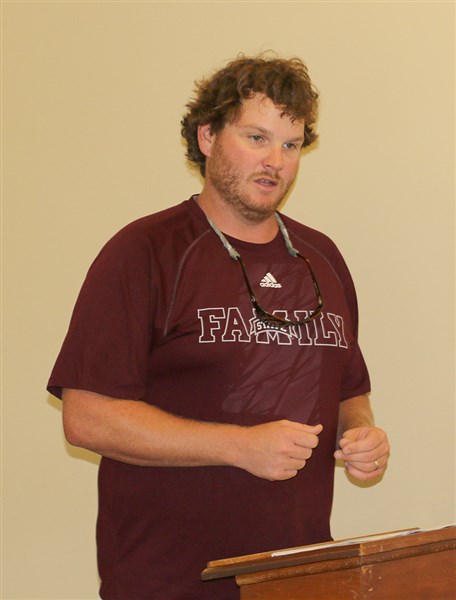
Steven Hill told county officials that a neighbor’s yard on County Road 224 was an eyesore for his neighborhood.
Junky Yard Brings Discussion In County Meeting
By David Howell
Editor
WATER VALLEY – A Yalobusha resident asked supervisors if legal steps could be taken to force his neighbor to clean up his property, prompting a 20-minute discussion about property rights and other eyesores in the county that potentially affect property values for adjacent landowners.
Appearing at a recessed meeting on June 27, Steven Hill explained that one property owner on County Road 224 has created an eyesore for the entire neighborhood. Hill described the scene that includes at least five junk cars, an abandoned mobile home adjacent to the house on the property, a camper that is occupied, and piles of garbage.
“Everybody out there has a nice place, they keep it nice, and he has a junkyard out there,” Hill explained.
Board President Cayce Washington was first to provide input on the situation, telling Hill when he campaigned last year a number of people listed economic growth as a top priority for the county and one aspect of potential growth in the county is new home construction.
“I share your concern, nobody wants to come in and spend $100,000 to $200,000 on a new home with a chance of a mobile home park or junkyard going up beside them,” Washington said. But he also expressed concern about enacting a county-wide ordinance or zoning, citing people who live in rural areas or farmers who store old equipment.
“If you go buy a piece of property and you want to do something that is perfectly legal and you pay your property taxes, you should have that right. So for one man to say what is ugly or clean to another, that is where it gets real gray,” Washington continued.
Next Board Attorney John Crow cited one relevant state statute, §19-5-105, which allows the county to clean up property if it is deemed a menace to the public health, safety and welfare of the community.
Under the statute, the attorney explained that cities and counties in Mississippi have the right on their own motion, or on the petition of the majority of the residents residing on the street within 750 feet of the location of the property, to request the owner to clean up the property or for the county to take steps to clean up the property and assess the cost to the property’s tax bill. Crow said the owner must be given due process, including a hearing.
“Typically what you see in municipalities is the grass needs to be cut or there are two or three junk cars in the yard. Or a run-down house that is a fire hazard. The city (Water Valley) has done it a number of times, I don’t recall Yalobusha County ever doing it,” Crow explained.
“You have to be careful, it has to be a menace to the public health,” the attorney cautioned.
Crow also cited another solution, enacting a county ordinance that could address specific issues including junk cars.
District 3 Supervisor Lee McMinn also provided input, explaining that he was very familiar with the area on County Road 224, and other areas in his district.
“Same thing with some areas around the Water Valley Boat Landing area. There are several properties out there that are beyond awful. It absolutely affects property values. Nobody would invest money in a property that is near these areas,” McMinn said. “There are tens of thousands of dollars in lost property values because people don’t care about what their place looks like.”
McMinn pointed to one specific property on County Road 53, at the main entrance to the Water Valley Boat Landing.
“There was a person who brought in an old, depilated, single-wide mobile home… where all of the tourists and campers come,” McMinn said. The supervisor said he approached the owner about removing the mobile home using the county’s environmental grant to fund the cleanup.
“We checked into it, and we felt like it was legal. So we approached the person about removing that mobile home, and honestly we were threatened. They said don’t touch it,” McMinn recalled. “It seemed like it would have been a favor… it will sit there from now on. Right there on the right-of-way of one of the main entrances into one of our resources that we have in our community where people come for fishing, camping and hunting.”
“Tourism is economic development. As a proactive group of county board members, this is something we probably need to look at,” Washington said about taking future action on the situation.
Final Comments
To Hill
“To answer your question this morning, it sounds like we need to look at our state statute and see if this meets the criteria,” Washington told Hill. “You have my word that I am going to make it something that we try to accomplish.”
Crow again pointed to criteria in the state statute.
“If the cars are unlocked, if there is a refrigerator out there that can be opened and a child can crawl into, if there is a dilapidated house that is not boarded up. It has got to be dangerous,” Crow explained.
“But if you are talking about the effect that a situation like this would have on adjoining properties, then you are talking about land values. That can be covered by ordinance,” the attorney added.
“There is no doubt the majority of people would be for something,” McMinn said about a potential ordinance. “But you are going to have that very vocal, upset minority of folks that are going to fill up the courthouse when you start trying to pass something like that. They don’t want to be told what they can and can’t do with their property in the county,” McMinn added.
“It’s basically a zoning law, and in rural counties they are not very popular,” Crow added.