Committee Recommends Changes To Ordinances

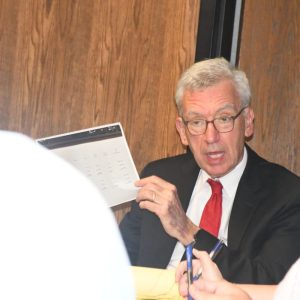
Eight committee members including Casey Clevenger and Vickie Persons led a discussion on the City of Water Valley’s sound and beer ordinances last Thursday. Input came from committee members as well as the public during the forum. – Photo by David Howell
By David Howell
Editor
WATER VALLEY – An eight-person committee appointed by the Water Valley Board of Aldermen will recommend two changes to the city’s beer ordinance and three changes to the sound ordinance following a public discussion last Thursday.
Among the changes recommended for the beer ordinance was to strike the sentence that requires a restaurant to only serve a beer to a customer in anticipation of a meal, a requirement that has generated the most controversy since the ordinance was revised in 2014.
The Oct. 26 public discussion meeting was prompted by Terry Warren, who explained to city officials at a city board meeting on October 3 that he needed clarification on the matter. Warren owns a pair of adjoining Main Street buildings that he is renovating with plans to open a restaurant and bar and a venue room for private-party rentals. Warren also requested changes to the sound ordinance, prompting a unanimous vote from aldermen to seek public input and appoint a committee to review the lengthy beer ordinance and sound ordinance before taking action.
Other changes that will be recommended includes striking another sentence in the beer ordinance that does not permit salads and sandwiches to meet menu requirements in order for a restaurant to serve beer.
The committee members – Daniel Martin, Raymond Hawkins, Vickie Persons, Barron Caulfield, Kathy Williams, Ethel Morgan, Casey Clevenger and John Beaty – will also recommend revisions to the city’s sound ordinance including setting a decibel level to gauge outside noise, establishing a permit system that would allow a variance in the sound ordinance for special events and extending the hours specified in the sound ordinance from 11 p.m. until midnight on Fridays and Saturdays.
Each of the recommendations followed a majority vote from the committee after members of the public also weighed in during the 90-minute meeting last Thursday. The committee’s input will be presented at the Nov. 7 city board meeting, but is non-binding and only a recommendation.
Beer Ordinance Discussion
Trusty Diner owner Lawton Gafford was the first person to comment on the beer ordinance requirement that requires a beer to be served in anticipation of a meal. He explained that the ordinance is confusing, both as a citizen and business owner. He also explained as a restaurant owner, he would not allow customers to drink multiple beers and get intoxicated.
Committee member Kathy Williams also expressed concern about the same sentence, explaining that she thought it was too vague.
“The other thing, there is really no need for it,” Williams explained, citing another requirement in the beer ordinance that requires food sales to be 50 percent of the revenue. The 50 percent rule in the ordinance keeps a restaurant from turning into a bar, as only half of the revenue can come from beer sales.
“We have been told it won’t be enforced, my question is why have that in there. My recommendation is that we delete that sentence,” Williams continued.
“That was going to be my motion,” committee member Barron Caulfield agreed before the committee voted to recommend removing the requirement.
Another Change
Committee member John Beaty questioned the requirement in the ordinance that states that restaurants serving sandwiches and salads are not considered a bonafide restaurant and do not meet the requirements to serve a beer.
“Are hamburgers considered sandwiches, are hamburgers and fries not a meal?” Beaty asked, before seeking input from the public on this portion of the beer ordinance.
Committee member Daniel Martin explained that the purpose of restricting salad and sandwiches was to limit cheap and inexpensive food to be served at a restaurant in order to serve beer. But Martin added that the 50 percent rule should be sufficient to ensure that only restaurants can serve beer under the city’s ordinance.
“Personally I am comfortable with the 50 percent mark too,” Martin explained, referring to Williams’ earlier input about the restriction that requires food sales to be 50 percent of the restaurant’s revenue.
Committee members and members of the public spent considerably more time on discussion to change the ordinance to allow the sale of cold beer at convenience stores. Currently the ordinance restricts convenience stores from refrigerating beer and the committee did recommend changes to this portion of the ordinance.
“I was asked by some of our local business owners to at least have this open for discussion – the sale of cold beer for off-premise consumption,” committee chairman Casey Clevenger told the group.
Input from the public included comments from Dr. Dominique Jegan, who told committee members that consumers are going to purchase beer whether it is hot or cold.
“If they are going to buy it, get them to buy it here,” she noted.
Terry Warren also said selling beer cold would increase revenue for Water Valley businesses.
“Buying it hot slows you down from drinking it now, if I have to go home and put it in my refrigerator, I’m at home drinking it,” committee member Raymond Hawkins said about the current restriction in the ordinance which may curtail drinking and driving.
“The revenue is important but are we after the dollar or we about making Water Valley a safe place that we can take our kids down the street without seeing the town drunk with a beer in his hand,” Hawkins added.
Ditto,” Martin agreed.
“I think the argument goes that most everybody else is doing it so why don’t we do it,” Caulfield added. “We might lose a dollar, here and there, somebody might go to Oxford. But I think there are some things more important than economic considerations,” Caulfield continued.
“It is illegal to drink in a car, whether it is cold or warm. It is a hat on a hat,” Beaty countered, pointing to other laws that already make drinking and driving illegal.
“But if you have those rules in place it is more likely to deter you from doing those things,” Hawkins noted.
“I would just rather not have to buy that bag of ice,” Clevenger said, adding that it is an unnecessary obstacle for law-abiding citizens.
“What you are doing is assuming that folks are going to start cracking beers as soon as they walk out of the gas station whereas I haven’t been offered any evidence that is the case. In fact, the evidence that I found, that is not the case,” Clevenger continued.
Martin then said the law is to protect reasonable-minded people from people who have lost their rationality and may open and drink a cold beer while driving.
“We have a law there to protect reasonably-minded people from the negligence actions of the few.” Martin said.
“I am more into saving lives than anything else… more than the economy, the economy is fine,” committee member Ethel Morgan added.
“If we offer cold beer, people will be drinking and driving more. We are trying to protect the innocent… My greatest fear on the highway is being hit by a drunk driver,” Morgan said.
A final question about the beer ordinance came from Cliff Lawson, who asked if the committee would consider recommending allowing Sunday beer sales. After a brief discussion committee members agreed that the sentiment of the public was not to change the ordinance to allow Sunday sales.
Sound Ordinance
The first question debated for the sound ordinance was if a decibel level to gauge outside noise should be added.
Caulfield was first to voice favor for a establishing a decibel level.
Committee members deferred recommending an actual decibel level reading to aldermen, instead agreeing that the committee should agree on the outline of the rules and allow city aldermen to consult with an expert, if needed, on determining a decibel reading.
Next the committee discussed changing the time set forth in the sound ordinance from 11 p.m. to midnight.
“The time is questionable to me because I live right behind Main Street,” Hawkins said.
Williams said she was in favor of allowing the city to issue permits to extend the sound ordinance until midnight for special events.
Members of the public then spoke on the issues, with Betsy Person recommending that noise inside a building should also be regulated to keep customers from experience hearing loss.
Clay Ashford expressed concern that if the city’s sound ordinance becomes more lenient than what is permitted in Oxford, it could generate negative spillover from the neighboring town.
Mickey Howley recommended consulting with an expert on both the decibel level and regulating the city’s business district different from other areas of town.
Herbert Rogers suggested that city official should research state standards including OSHA requirements to help identity appropriate steps for the ordinance.
Rex Howell requested committee members and members of the community to talk with Terry Warren and learn more about his business plan.
“He is not trying to run a honky tonk… he is trying to open a nice steakhouse where he can have music and private parties at times. He is willing to meet whatever standards that are implemented to have these special parties that run until midnight,” Howell noted. Howell also said the special parties would not be an every night occurrence.
Charlotte Lane noted that Warren’s description of his business plan at the October 3 city board meeting included a music venue and not just an eating establishment.
“I do think consideration of noise issues should be part and parcel of what the community establishes,” Lane said, noting the sound ordinance should not be limited to addressing a nice steakhouse.
“I’m not sure what church it is that plays hymns, but when I got out for a walk Sunday morning I can hear it all over town,” Lane said about other noises in town.
“My understanding is that we are not just here to talk about Terry Warren, we are here to set policy for our community…for the long term,” Williams said.
Martin said in follow-up, the purpose of the sound ordinance is regulate the noise level that can be heard outside the building and not regulating what is happening inside the business.
Martin then motioned that the committee recommend that the board of aldermen set a decibel reading to measure the outside noise.
“For any building, whether it is a wedding party in a back yard or business on Main Street,” Martin said about a blanket policy that does not delineate business districts.
His motion prompted further discussion, with Beaty recommending delineating areas in town such as a business district for different levels of noise allowed.
Following another comment from Ashford noting that the topography is different in Water Valley, with Main Street in a bowl-like area that could be different from other towns, committee members voted in favor of Martin’s motion.
Clevenger clarified that the committee’s recommendation include that city aldermen also consult with experts to help clarify how the decibel level will be measured.
Martin then motioned that the committee recommend to aldermen to allow special permits for exceptions to the sound ordinance for special events.
After committee members voted in favor of Martin’s recommendation, the topic then shifted to general noise in Water Valley during the daytime from 7 a.m. until 11 p.m. when sound isn’t regulated by the ordinance with no action taken.
Daytime Noise Conversation
“I don’t care if it is a night club going late in the morning or if it is church first thing at 8 o’clock in the morning. That is noise to me,” James Jegan noted as the topic strayed into a broader scope.
“The ordinance speaks to things that happen during the day,” Clevenger explained, citing noise that is permitting during waking hours and might include a jack hammer or construction or even street work.
“What about the weekend stuff?” Jegan asked, adding that he doesn’t have to wake up early.
“Most churches start at 8 a.m.,” Hawkins noted.
“I really shouldn’t be hearing any churches, not in my house with all the doors and windows closed,” Jegan explained.
“What are you hearing?” Cinnamon Foster asked.
“Music, it’s like an organ,” Jegan explained, adding that it goes on for an hour or more.
“Have you been able to pinpoint which church that is?” Foster asked.
“It’s definitely coming from behind me,” Jegan asked. “Every building should be held to an equal standard,” he added.
“It is my ethical duty now to advise that in my opinion we could be violating the open meetings act so we need to cancel this committee meeting, thank you Cinnamon,” Martin said. “Y’all can keep talking if you want but I am going home.”
“Because of an alderman?” Williams asked.
“Two or more aldermen can’t be in the same place and discuss public concerns without open meeting laws being followed. Which means having it set, and open and certain times,” Martin answered, referring to Foster’s comments while two other aldermen, Nicole Folson and Kagan Coughlin, were also in attendance. Martin later added that aldermen could attend the meeting for informational purposes but can not engaged in the discussion.
The meeting then resumed as Foster left and discussion shifted to the beer ordinance.