Taxes For Road Improvements, Where Does Your Money Go?
PROTECTED CONTENT
If you’re a current subscriber, log in below. If you would like to subscribe, please click the subscribe tab above.
Username and Password Help
Please enter your email and we will send you a password reset link.
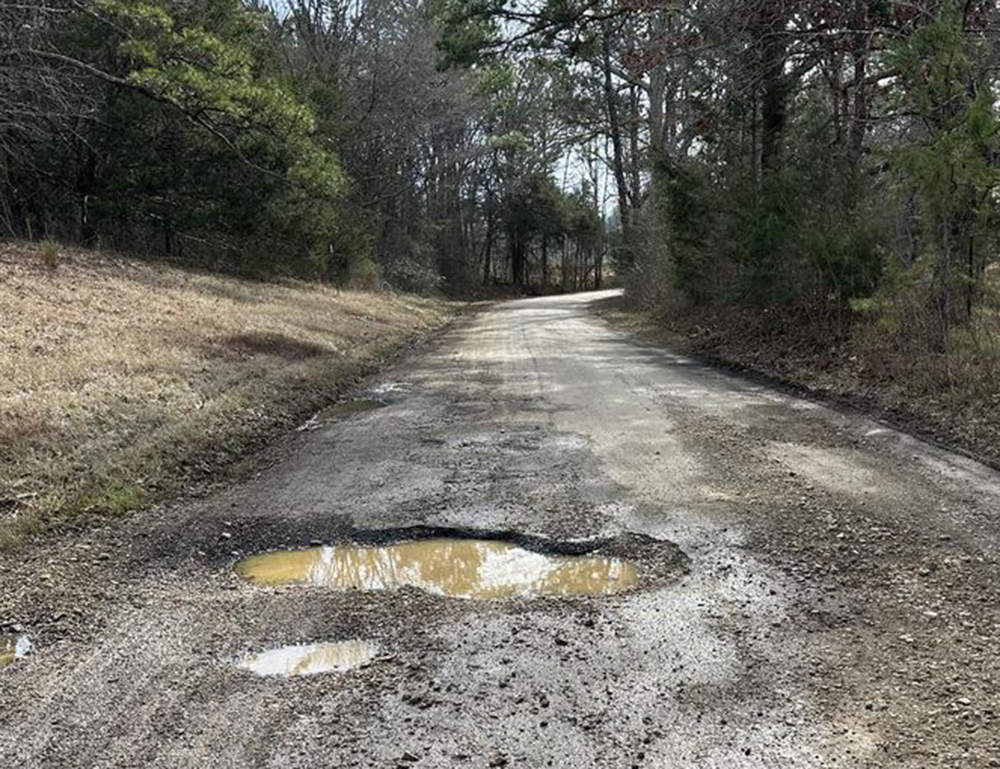
A pothole on County Road 112 outside of Water Valley attracted scrutiny on social media. District Three road workers filled the pothole.
WATER VALLEY – It’s wintertime in Mississippi, the toughest months for roads across the county as problems are exacerbated with freezing weather and frequent rainfall. One common statement is with the high cost of vehicle license tags in Yalobusha County, there should be plenty of tax money for supervisors to allocate for improvements on the county’s roads. But it is not that simple, revenue collected for ad valorem taxes, including vehicle tags, fund all county expenses and the schools and municipalities.
An example, let’s look at a vehicle valued at $25,000. The real value, $25,000 in this analysis, is established by the Mississippi Department of Revenue based on the manufacturer’s suggested retail price plus a certain percentage of depreciation over 10 years.
The assessed or taxable value of the $25,000 vehicle is 30 percent in Mississippi, or 7,500. Based on the county millage plus the school millage, minus the legislative tag credit, you would pay approximately $445 for the tag. Of that amount, $17.44 is allocated for road maintenance and construction in the county. In the 2022-2023 county budget that ended on Sept. 30, 2023, each supervisor’s district received $11,443.31 from motor vehicle licenses tags. (See chart on page 9 for other revenue sources for the District 3 Road Fund.)
Now back to the winter weather, District Three Supervisor Kenny Harmon explained that when the temperature dips below 32 degrees, water enters cracks in the roads, freezes and expands, creating cracks and potholes in the pavement. He cited a recent example, a deep pothole on County Road 112 that attracted scrutiny on social media.
On this road, the problem was compounded by recent logging as load after load of timber hauled from a nearby property tract also caused damage. Harmon also readily admitted that County Road 112 needs more attention than patching a pothole, just as many across the county need to be resealed.
The problem, as Harmon explained, is the all-too-familiar lean budget in the county. He spent almost $140,000 from the District Three road budget in the same vicinity last year, work on County Roads 25, 116 and 224 to reseal approximately seven miles on the three roads. Harmon reported the money spent for that work was just over a third or 38 percent of his $363,084.82 road budget. District Three has 80 miles of paved roads and 25 miles of gravel roads, which means Harmon spent 38 percent of his road budget on seven percent of the road miles in one resealing project in his district.
“It’s always an uphill battle,” Harmon explained.
He is two months into his second, four-year term and reported 43 culverts were replaced during his first term
“It doesn’t do any good to reseal over a bad culvert, you will have to dig up the whole road to replace it later,” Harmon added.
There is a silver lining, a new revenue source that was adopted by state lawmakers in 2019. Commonly called an online sales tax, the state’s Use Tax has brought hundreds of thousands of dollars to Yalobusha County that is earmarked to purchase materials for road and bridge work. This new revenue source was phased in starting in 2020, money that comes from the seven percent use tax from items ordered online in Mississippi.
The county received $167,184.52 in 2020, money that is split evenly between the five supervisor districts. In 2021, the county received $480,171.70. In 2022 the use tax increased to $848,863.09 and last year the allocation to the county jumped to $1,175,139.16. In 2024 the county received $599,857.19 in January and a second payment will follow in July.
But catching up is slow, and Harmon said it will take years in his district, also called a beat, as he battles battered roads. He estimates almost half of the roads in his district need extensive work beyond resealing, work that will come at a much higher cost than resealing.
“I don’t how Baily (Walker), Butch (Surrette) and Lee (McMinn) did it without the use tax money,” Harmon said about his predecessors in District Three.
“This will help all of us supervisors across the county. If we can reseal more roads each year, that means they will last longer.
“But is definitely an uphill battle,” Harmon reiterated.
Tax money collected from a vehicle valued at $25,000
based on County Ad Valorem Tax Levy for 2022-2023
• $391.35 for general county operations (sheriff’s department, jail, courthouses, EMA and countless other operations);
• $7.50 for reappraisal
• $20.70 for reappraisal maintenance
• $8.18 for general support and maintenance for Northwest Mississippi Community College
• $7.50 for Northwest Mississippi Community College capital improvements
• $69.00 for maintenance and construction of bridges in the county
• $34.88 for road construction and maintenance in the county
• $23.03 for county rural fire protection
• $16.05 to retire general obligation bond for the Yalobusha County Jail
Total County Taxes $578.19
(Minus Legislative Tag Credit that is typically around half of the tag amount)
Water Valley School District Tax Levy
• $333.60 for Water Valley School Maintenance
• $19.58 for Water Valley School Transportation Bond and Interest
• $66.23 for Water Valley General Obligation Bond and Interest ($6.5 million borrowed for school improvement in 2019)
Total Taxes If you live in the Water Valley School District – $997.60
(Minus Legislative Tag Credit that is typically around half of the tag amount)
Coffeeville School District Tax Levy
• $294.15 for Coffeeville School Maintenance
• $13.73 for Coffeeville School Repair Bond and Interest
Total Coffeeville School Taxes – $307.88
Total Taxes if you live in Coffeeville School District – $886.07
(Minus Legislative Tag Credit that is typically around half of the tag amount)
Note: This does not include the municipal tax levy. If you live in Water Valley, Coffeeville or Oakland you will also pay city taxes.
District 3 Road Budget Revenue Sources for
fiscal year that ended Sept. 30, 2023
• $44,030.21 – Realty, personal taxes
• $11,443.31 – Motor vehicle tags
• $1,470.83 – Mobile home taxes
• $5,000 – Weight limit bond
• $655.72 – Harvest money
• $32,871.88 – Road and Bridge Privilege
• $92,262.93 – Gasoline Money
• $567.21 – Truck and bus privilege
• $11,075.48 – Forest Direct (state)
• $115,516.29 – Federal P.I.L.T. payment
• 10,851.03 – Flood control
• $877.80 – Overweight fine money
• 28,264.36 – Interest earned
• $8,197.77 – Sales income
Total Revenue – District 3 Road Fund – $363,084.82
Glossary For Story
• Ad valorem tax – A tax based on the assessed value of an item, such as real estate or personal property. All ad valorem taxes are based on the assessed value of the item being taxed.
• Legislative Tag Credit – The Mississippi Legislature applies a financial credit to license plates/tags on any vehicle that is 10 years old or less, in order to keep the cost of vehicle tags lower. This credit is known as “legislative credit.” The percentage of the credit varies slightly depending on the vehicle, but typically accounts for approximately 50 percent of the actual price of the tag. Therefore, without the credit, tags fees would be nearly double what they currently cost. The county receives the full amount with half of the taxes coming from the taxpayer who purchases the tag and other half from the state coffers.
• Mill – A mill is one-thousandth of one dollar, or $ .001. For example, 54.5 mills is $.0545. Millage rates change annually. Local taxing authorities must adjust millage rates to support the operations of government, which is done with the tax levy. In Yalobusha County, the millage rate for road construction and maintenance is 4.65 mills. To calculate the tax levy for a vehicle valued at $25,000, you first determine the assessed value which is 30 percent of the actual value, or 7,500. The 4.65 millage rate for road millage is multiplied by the assessed value, or .00465 times 7,500 = $34.88 for road construction and maintenance.
• Resealing – A process to preserve a road that starts with replacing any bad culverts. Next any uneven spots should be fixed in a process called leveling. Once that is done, the shoulders are cut down so the water will drain off the road. Next county workers apply a thin coat tar to the road, followed by spreading rocks on top of the tar to seal the road. This will keep the water out of the pavement. In Yalobusha County, workers from each of the five supervisory districts work together during paving season to reseal roads across the county. It typically takes 12 to 15 road workers operating together.
• Tax levy – At the local level, taxes are levied each year by county supervisors, school district trustees and city alderpersons. The ad valorem tax levy is expressed in mills and applied to the dollar value of the assessed valuation on the assessment rolls of the respective taxing district.