A Few Lessons From Grandmother’s Pistol
PROTECTED CONTENT
If you’re a current subscriber, log in below. If you would like to subscribe, please click the subscribe tab above.
Username and Password Help
Please enter your email and we will send you a password reset link.

John Nelson graduated from the U.S. Merchant Marine Academy at Kings Point, New York in 1965 and enjoyed a long career at sea on commercial and military support ships. After retiring from his seagoing career, he continued working in various capacities in the maritime industry until a final retirement in 2012. Since then he has been active in researching local history and restoring and operating steam engines and antique mills.
He lives in neighboring Panola County and is a long-time member of the Yalobusha Historical Society. He is also the uncle of Herald editor David Howell.
I was about ten when I first saw a nickel-plated pistol in a bureau drawer in my grandparents’ home. As I later learned, it was a Smith & Wesson revolver with a patent date of July 7, 1903, and something of a milestone in that company’s development of its modern revolver.
Today, the significance of the pistol is not so much its place in handgun history but rather how it fits into America’s changing notions about firearms and the particular debate over whether teachers should be armed to protect themselves and their students.
The serial number indicates that it was manufactured around 1904 when my grandmother, Annie Neilson Little, was finishing her studies at Mississippi’s Industrial Institute and College.
That school with the confusing name had taken root in 1885 on the grounds of the old Columbus Female Academy. The name came from its dual role of providing liberal arts courses to young women while also offering job skill training.
It had opened to some acclaim as the country’s first public college for women, and by the time Grandmother attended, it had evolved into a model institution for training teachers for Mississippi schools. The name was changed to Mississippi State College for Women in 1920, and to Mississippi University for Women in 1974.
My talks with Grandmother about her pistol, coupled with some recent research, have taught me something about the life of a teacher in her day. By the turn of the 20th Century, about 90 percent of teachers were female, but women had much less representation in school administration. It was primarily men who decided that these young female teachers should not be married.
It was common then for a teacher to board with a family in the neighborhood and either walk or ride horseback to the school where she would not only teach but also be directly involved with the maintenance of the facility. In the many rural schools of the day, that sometimes included such things as going out in winter months with older students to cut firewood for the heater.
She told me that she had carried the pistol to not only for personal protection while riding alone on county roads but also to protect her school. A possible threat that she mentioned was that a small school with just a young woman and a few students inside could be a target for harassment.
A photo from around 1907 shows grandmother standing outside the Tillatoba High School in Yalobusha County. Tillatoba was a small town in those days, and the photo shows a substantial building with Grandmother and another female teacher on either side of a male who was likely Thomas A. Early, the principal at the time, In a fairly large school with several teachers, a young female would have felt more secure.
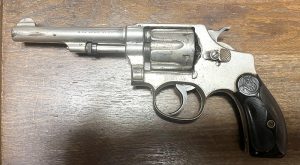
School teacher Annie Neilson Little carried this Smith & Wesson pistol for personal protection and to protect the school.
Her last assignment to the small, one-room school in the Chapletown community in Panola County would have been more typical of the day. There she boarded with the Murphree family and rode horseback to the school which was next to the Wesley Chapel church. It was there during the 1911-12 school term that she met my grandfather. They were married in 1913, and that ended her teaching career.
There are now many questions that I wish I had asked. Had there been talk at II & C about the dangers faced by young female teachers in rural schools; were other teachers armed, and were there discussions at the time about whether they should be?
I haven’t done exhaustive research, but I have spent some time looking for answers to these questions with little success.
It’s likely that in those days when Mississippi, as well as much of the nation, was still largely a rural society in which most people grew up around firearms, armed teachers would not have stirred a lot of discussion.
I did learn from my internet research that there were examples of gun violence in schools in Grandmother’s time. These incidents could be classified as “shooting at schools” since they were acts of passion, jealously, or revenge that happened to occur in schools or on school grounds.
There were few, if and, examples of what we now call “school shootings.” These incidents of extreme violence can originate from the human failings already mentioned, but describe a crime in which a person, or persons, enters a school with the intent of shooting as many people as possible.
Today, the majority of teachers, as well as the general population, oppose arming teachers. The primary reasons given are the training required and the mishaps that could occur.
It seems that most favor turning school defense over to professional law enforcement officers, but that approach also has problems. The response time of those coming in from outside can be a factor, and even having armed guards inside is not without drawbacks. Perpetrators often know who they are, or can identify them from their actions and eliminate them at the beginning of their rampage.
Beginning back in the 1990’s, Gun-Free School Acts were initiated, and some schools now display signs declaring the school to be a gun-free zone, But would anyone so depraved as to enter a school determined to shoot teachers and students be concerned about breaking a gun law?
Other schools have recognized the need to arm some of their teachers and administrators. A sign outside a Texas school warns that “staff is armed and may use whatever force necessary to protect our students.
There seems to be no perfect solution to the school shooting malaise, but if Grandmother could tuck a pistol under her blouse and teach a class while watching the door, there are teachers today who can do the same.
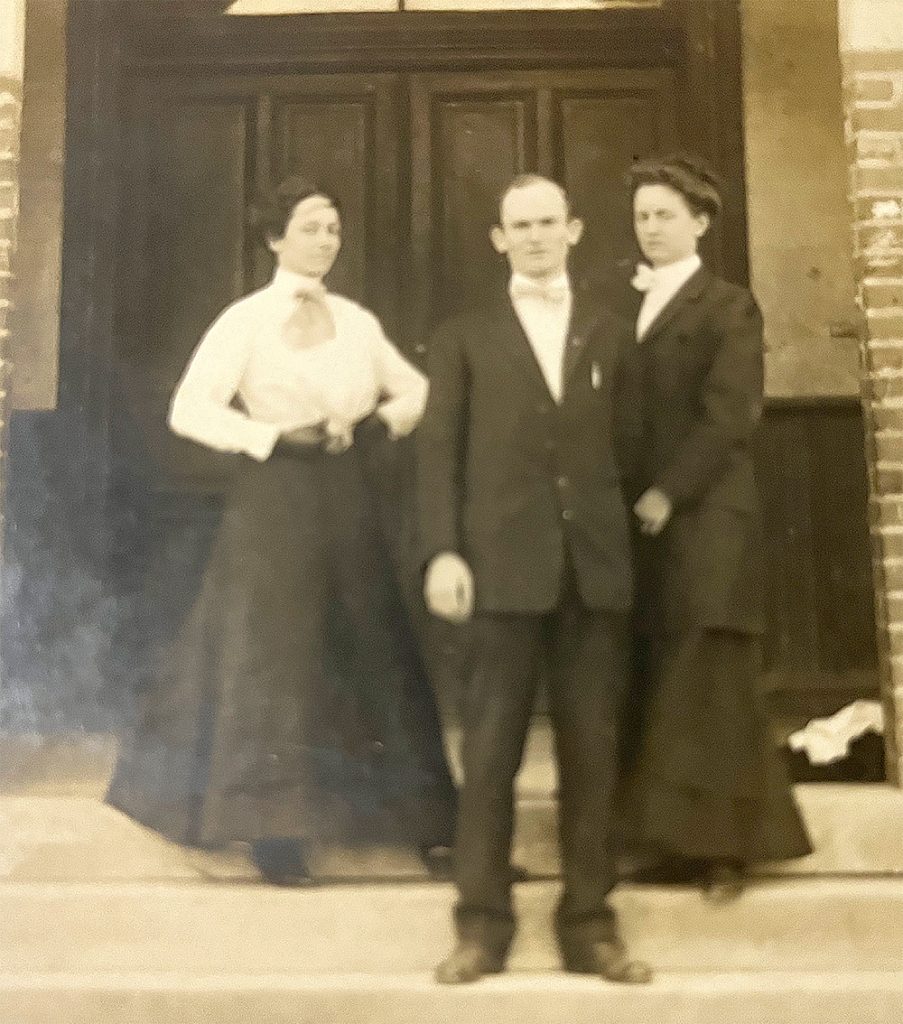
A photo from around 1907 shows John Nelson’s grandmother (right) standing outside the Tillatoba High School. Tillatoba was a small town in those days, and the photo shows a substantial building with grandmother and another female teacher with a male who was likely Thomas A. Early, the principal at the time.