Courthouse Maintenance Costs Big Bucks
PROTECTED CONTENT
If you’re a current subscriber, log in below. If you would like to subscribe, please click the subscribe tab above.
Username and Password Help
Please enter your email and we will send you a password reset link.

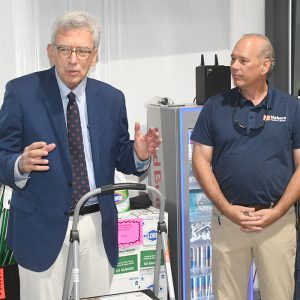
Yalobusha County Board of Supervisors President Cayce Washington reported the county has spent over a half million dollars during the last five years for repairs to HVAC systems at the courthouses in Water Valley and Coffeeville.
WATER VALLEY – Water is continuing to leak from pipes under the Water Valley courthouse, hundreds of thousands of gallons each month, and figures shared during Monday’s supervisor meeting showed that hundreds of thousands of dollars have been spent in the last five years for repairs on the HVAC systems that heat and cool the county courthouses in Water Valley and Coffeeville.
The issues, as identified during a pair of county meetings in February, are the 21 year-old geothermal heating and cooling systems utilized at both courthouses that are past their life expectancy. The most pressing problem, also a topic in the Feb. 5 and Feb. 26 board meetings, is an estimated 10,000 of gallons leaking daily from the underground pipes. The pipes connect to the heating and cooling system at the Water Valley courthouse and water is pumped through the closed-loop water system for cooling and circulated through the heat pumps.
The leak in the system was discovered in early February, and Board President Cayce Washington reported in Monday’s meeting that the water usage for December was 274,900 gallons, triggering a bill from the City of Water Valley for $814 for water and $629 for corresponding sewer usage. Washington also said the county hasn’t received the bill for January, but the water usage is 392,000 gallons. He noted that the city could waive the sewer portion of the bill if the water is not entering the city’s sewage system.
“The question is, how are we going to fix this problem? We still haven’t found any water seepage anywhere. We suspect (the leak) is down about 150 feet deep and the water is entering a sand aquifer and flowing out somewhere, but we don’t know that,” Washington added.
Citing input from employees at Upchurch Services, LLC, the company that installed the geothermal system in 2003 when the courthouses were renovated, Washington said the only way to find the leak is to start digging, an expensive operation that could cost hundreds of thousands of dollars before the leak is discovered.
“But the challenge is if we do find the leak, it is a 21-year old system and we may have another problem pop up,” Washington explained, again citing input from Upchurch Services, LLC.
The strongest option discussed Monday is the installation of a cooling tower at a cost of several hundred thousand dollars. The cooling tower would be located above-ground between the courthouse and the addition that houses the chancery clerk’s office, and would eliminate the use of the underground water line system as water used to cool the heat pumps would instead circulate through the tower.
Washington said estimates from Upchurch Services, LLC, indicated it would take a minimum of 12 weeks before a cooling tower could be operational.
“We have to do something, my question is how are we going to stop the bleeding on the water right now?” District Five Supervisor Gaylon Gray asked.
Washington said one option is to turn off the heating and cooling units at the Water Valley courthouse, stopping the water leak that will cost an estimated $1,000 per month.
“Mr. Upchurch shared that we could turn off the units given the weather is at a moderate temperature right now. We could use plug-in heaters in some of the offices,” Washington added. “We have new windows, we may go old-school and raise the windows.”
Washington next asked board members if they had any idea how much money was spent on maintenance and repairs the HVAC systems during the last five years.
“Three hundred thousand dollars,” District Four Supervisor Eddie Harris guessed as the meeting shifted to a brief episode of The Price Is Right.
“He is close, I am going to say $420,000,” Gray guessed during his turn.
“We got $420,000, anybody else? The Price is Right,” Washington continued.
“Three hundred and fifty thousand,” District Two Supervisor Ken Rogers guessed.
“These are real numbers, $501,388. Half a million dollars in five years,” Washington said. “I am floored that we spent that much money. I knew we replaced a lot of units. That is maintenance cost with one company just on air conditioners.”
A Possible Solution
Although much of the discussion in Monday’s meeting centered on the immediate problems, county officials also learned details about a program that could help fund long-term upgrades to lower utility and maintenance costs for county-owned buildings and possibly fund the water cooling tower at the Water Valley courthouse. Upchurch Services, LLC, Business Development Manager Earl Byrd provided details about the funding source, a program called Infrastructure Financial Solutions.
Byrd explained savings are generated by LED lighting upgrades, HVAC upgrades, water conservation and making buildings more air-tight and easier to heat and cool will substantially lower utility and maintenance costs. He said that funding for the upgrades would then be paid by utilizing the savings from the upgrades that would repay a low-interest, long-term loan. He added that preliminary research indicates the county is spending $200,000 annually for electricity, gas, water and sewer, as well as propane that is used in some county buildings. The county’s building inventory includes the courthouses, sheriff’s department, jail, 11 fire departments, five county barns (shops used in each supervisory district) and other buildings.
Byrd said preliminary figures indicate annual savings in utility and maintenance costs would be $58,600, creating enough funding to pay an estimated $900,000 to $1.2 million in efficiency upgrades to the buildings that would be repaid over a 15 to 20 year period.
“The savings pay for the work, creating a budget-neutral project with no up-front costs,” Byrd added. “There are companies that love to finance this type of work because it is low risk for them. The only way you could get a better (interest) rate for these type projects would be a bond issue.”
Byrd also told supervisors that Mississippi Development Authority’s Energy Division oversees the process. He explained the first step to start the process is advertise for proposals, allowing companies including Upchurch Services, LLC to submit proposals to perform the work. After a company is selected, a master development agreement will be executed that includes an investment grade audit.
“At the end of that we come out with costs for each energy conservation measure and the savings that will be generated by that. Then will develop a menu of items, and supervisors will select each menu item they want,” Byrd said.
Supervisors voted unanimously to advertise for proposals, a non-binding preliminary step to move forward with the program.