Commissioners Approve Work For Bank, City Hall
PROTECTED CONTENT
If you’re a current subscriber, log in below. If you would like to subscribe, please click the subscribe tab above.
Username and Password Help
Please enter your email and we will send you a password reset link.
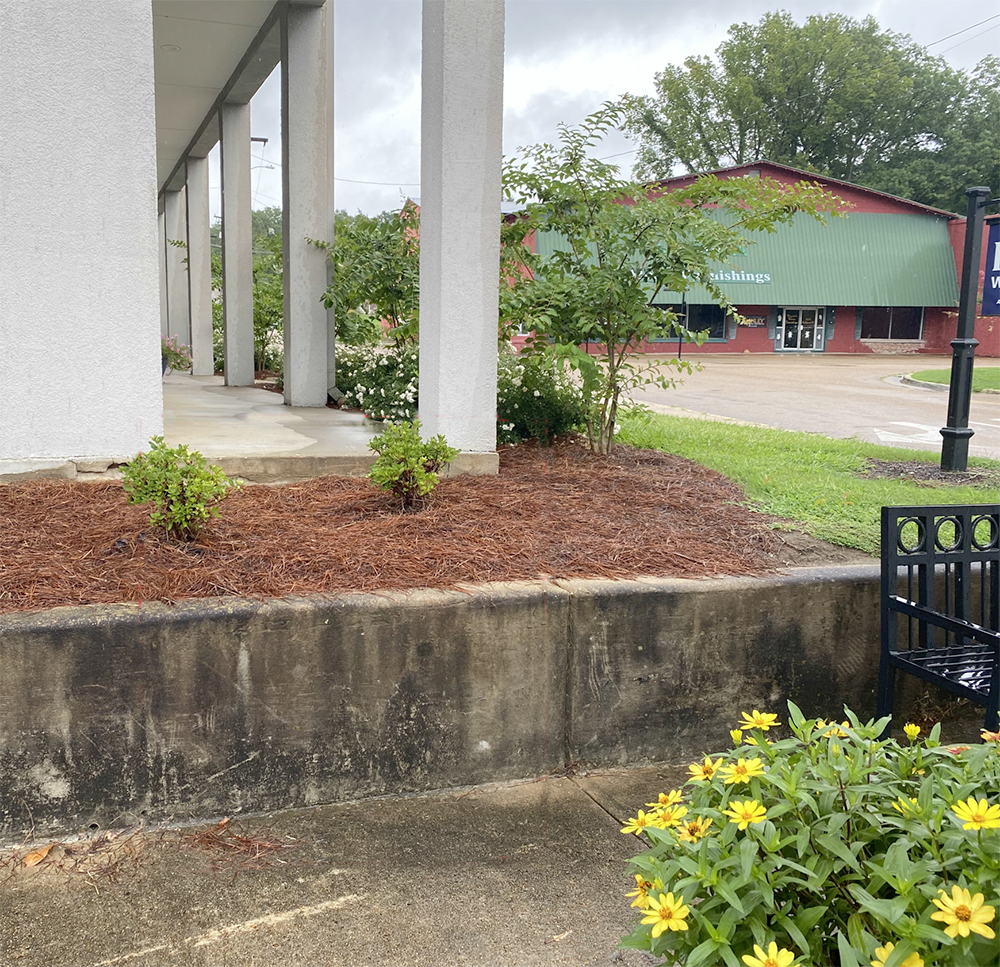
Plans at the FNB Water Valley bank include cutting a short staircase on the west side of the front patio to connect to the Main Street sidewalk.
WATER VALLEY – The Water Valley Historic Preservation Commission approved certificates of appropriateness for proposed exterior changes to two Main Street buildings and requested additional information on a third application during a Zoom meeting Monday night.
FNB Oxford Bank representative John Supple received approval for work at the FNB Water Valley branch at 400 North Main Street. Supple told commissioners the proposed work includes replacing the second-floor balcony rails, painting the roof and exterior stairway and touching-up other areas of the building.
“We bought the building a few months ago and did a lot of repair on the inside but the outside is needing some repair too,” Supple said. “We are working with Marchbanks Speciality to rehab the roof and give it a good paint job. Right now it is a severe two-tone,” he added about the fading paint on the roof.
The request also included adding a short staircase on the west side of the front patio that connects to the Main Street sidewalk.
Supple explained the staircase would allow customers who park behind the bank to access the front entrance from Main Street instead of walking around to the front of the building. He said some customers already use the shortcut, hopping down from the front patio and crossing the flower bed to get to the Main Street sidewalk.
“It is quite a ways around to the front to get to the entrance,” Supple added. “The staircase will be cut into the flower bed.”
The second application was submitted by Liz Reynolds for work at City Hall. Reynolds provided a brief overview of a proposal to put a lime slurry on the exterior bricks, an exterior glaze that will improve the aesthetics of the building while not compromising the breathability of the bricks. Reynolds also told commissioners the Board of Aldermen approved the exterior work during their July 2 meeting.
“The building was constructed in the early 1960s to serve as a small fire station. They had dispatch there and it has morphed into City Hall. Now it needs a facelift,” Reynolds said. “The best idea we could come up with to improve the looks of the building is to brighten it up with lime wash.”
Reynolds also said the work will be funded by donations and is the next step in a list of planned improvements to the building. She said other ideas include painting a mural on the west wall of the building that faces Railroad Street and updated signage.
“This is all being done with donated money, we are taking it one step at a time,” Reynolds added.
Commissioners voted unanimously to grant the request with Leigh Ann Black abstaining. Black, a local architect, has assisted Reynolds with the city hall project.
A second request by Reynolds for proposed work on the former Varner Printing building at 417 North Main Street was deferred to a later meeting to allow more information to be presented. Reynolds and her husband, Mayor Tommy Reynolds, own the building. She explained their plan is to put an office downstairs and two apartments upstairs.
“We feel like we need to a balcony on the front so they can go out and enjoy Main Street… since we are putting the apartments upstairs,” Reynolds said.
She said the balcony would be similar to the ones added at 16 South Main Street (TIN building) and 20 South Main Street.
Commissioner Mickey Howley noted that the addition of a balcony can present a problem, particularly if applying for historic tax credits to help offset the cost of the renovation, as a second-floor door must also be added. Howley explained that adding a door changes the exterior facade of a building. Citing an example, he explained that the second floor balcony on the BluBuck buildings on North Main across from the post office is only accessible by a window.
“The reason for that is (owner) Kagan (Coughlin) wasn’t allowed to modify the building because he received historic tax credits. The state didn’t allow him to modify that facade,” Howley said.
After additional discussion, commissioners requested that Reynolds provide a rendering of the proposed balcony and the request will be addressed during a special meeting that will be scheduled in the coming weeks.
“Liz, thank you so much. Thank you for the improvements that you are making to our inner city,” Commission Chairman Robbie Fisher added. “As soon as you are ready, we will reconvene and move on the 417 North Main project.”
Commissioners are Fisher, who serves as chair; Black, who serves as vice-chair; Howley, who serves as secretary; and Emily Fransee and Nicolas Trepanier.
The Historic Preservation Commission was established in 2019 to preserve, promote and develop historical resources of the city. Five commissioners were appointed by the Board of Aldermen and their first order of business was to designate boundaries of the historic district.
The boundaries of the city’s new historic district were approved by the Board of Aldermen in early 2020. The district includes approximately 106 properties in the commercial core of Water Valley on Main Street, extending from the North Main Street boundary by Everest (formerly Big Yank) and over to Market Street. The south end extends to where South Main Street crosses Town Creek. The district also extends west of Main Street and encompasses portions of Martin Street, Wood Street, Calhoun Street and Blackmur Drive.
Much of the district includes commercial buildings, but other properties include the Yalobusha County Courthouse and old county jails on Blackmur and Calhoun Street, several churches, the U.S. Post Office and a few residences.
The city-regulated historic district lines are identical to the Water Valley Main Street Historic District that was added to the National Register of Historic Places in 2012. Unlike the listing on the National Register of Historic Places, the city’s historic preservation district includes local regulatory authority within the district.
The commission is charged with reviewing applications, or a Certificate of Appropriateness, for proposed construction, alteration, demolition or relocation of any structure within the district. The commission’s authority does not extend to interior work in a building, nor exterior paint color.