City’s Historic Commissioners Review Permits
PROTECTED CONTENT
If you’re a current subscriber, log in below. If you would like to subscribe, please click the subscribe tab above.
Username and Password Help
Please enter your email and we will send you a password reset link.
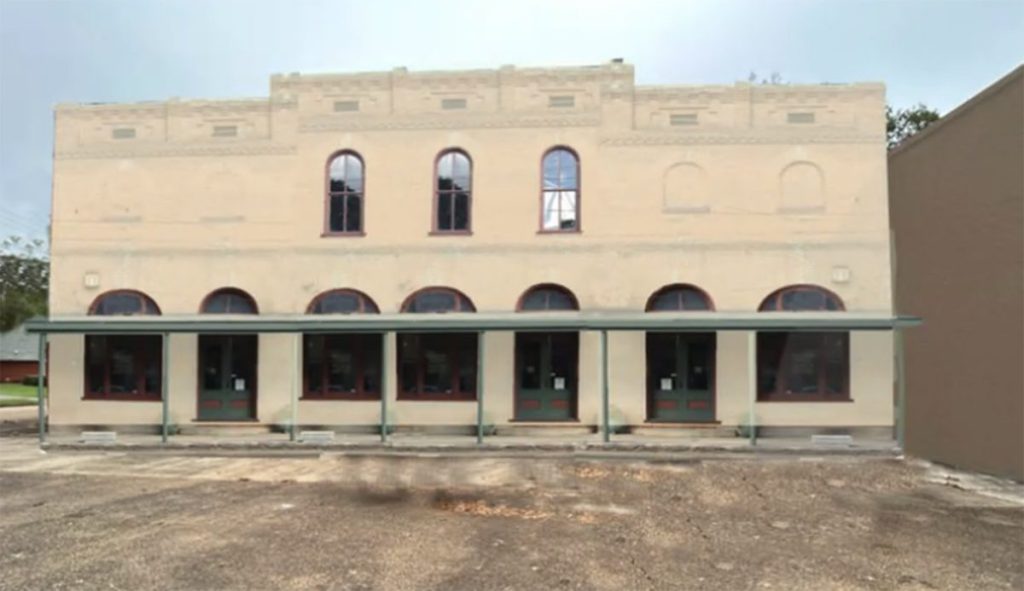
A rough Photoshop sketch of the proposed facade of the Railroad Avenue building that formerly housed Magnolia Furniture was reviewed during the Water Valley Historic Preservation Commission meeting on Jan. 27. Meagan Backes told commissioners that the rough sketch was a starting point to generate input from them before moving forward with a full design generated by an architect.
WATER VALLEY – The Water Valley Historic Preservation Commission (HPC) approved one permit and tabled requests for three permits during a quarterly meeting on January 27 via zoom. The permits, formally called a Certificate of Appropriateness (COA), were discussed in a lengthy two-and-a-half hour meeting via Zoom with commissioners Robbie Fisher, Emily Fransee, Mickey Howley and Nicolas Trepanier.
Meagan Backes and MaryLu Vaughn filed a COA for proposed renovations for the former Magnolia Furniture building located at 310 Railroad Avenue. Backes presented a rough Photoshop sketch of the building facade for the 9,000 square-foot building, explaining her intent was the get feedback from commissioners before moving forward with an architect hired to assist with the project.
“Any feedback now would be more helpful than after there are hours of design work in this project,” Backes explained.
Backes also shared pictures of the building that showed it had a full second story and wrap-around balcony. Commissioner Howley noted that the building has been modified numerous times since it was constructed. The changes make a restoration to make the building look like the original design infeasible.
Backes also said the building would be divided to into multiple smaller spaces for downstairs rental space and upstairs short-term Airbnb space. Commissioners tabled the COA following the review of Backes’ initial plans.
Other activity during the meeting included:
• Commissioners unanimously approved a COA from Charlie Dyer to install a new sign at 306 Railroad Street that formerly housed Black and Associates. Dyer reported the sign will be located in the same place on the building where a previous sign was located.
“We are wanting to put a sign on it for CWD Enterprises, LLC. It is a holding company and my corporate office,” Dyers said. “We are looking at possibly painting the building at some point,” he added.
Commissioner Fisher reminded Dyer that he does not have to file a COA to paint the building.
“Unless it is painting of bricks,” Fisher said.
“Or the stones,” Howley added.
“We might end up having to take the stones down on the left side, because they might fall down. That would be preventive maintenance,” Dyer said.
• Commissioners tabled a COA filed by Becca Finley for the addition of a mural on the front of the TIN building located at 16 South Main Street. Finley said the mural will depict the 15-year history of TIN, a non-profit organization also known as This Is Noteworthy. Finley also said local artist Bill Warren will paint the mural.
“People are always asking what we do. This visually shows what we do,” Finley explained.
Commissioner Howley noted that Design Guidelines – adopted by the City of Water Valley in July, 2022, to provide detailed guidance for proposed changes to buildings for property owners inside the historic district – recommend not placing a mural on the front of the building.
“The murals that we have already in town have been on the sides,” Howley said. “We really don’t have anything like this on the front of the building. Is there any other place you can put this?” he asked.
“There is not, we need something that shows what we do on the front on the building. We have a lot of space, and we need to occupy it,” Findley answered.
“This seems pretty clearcut in the guidelines,” Commissioner Trepanier added.
“We are trying to keep the look of the building, as if faces the street, to keep it relatively historically accurate,” Howley noted.
Following additional discussion, commissioners acknowledged that previous modifications to the building have already compromised the historical accuracy of the facade, and the request was tabled to allow additional research.
“Becca, you brought us a real dilemma. We like what you are doing, we like murals, we aren’t just crazy about the location. So how do we handle that?” Howley said.
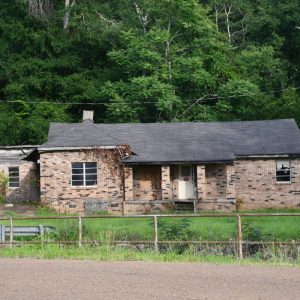
• Commissioners tabled a COA filed by Brett Crawford for the potential partial or full demolition of a residential structure located at 709 North Main Street. Crawford said his initial plan was to demolish the entire structure, but acknowledged a sentimental attachment to the property that prompted him to look at other options.
“My parents owned this house for 45 years at least,” Crawford said.
Crawford requested permission to demolish additions that were added on the rear of the house. He said once work starts, he will be able to determine if the remainder of the house is salvageable. If the house is too far gone, Crawford said he would like to take it down.
“Then I would want to go ahead and demo the whole house and clean the lot up,” Crawford explained.
Citing the Design Guidelines, Commissioner Fisher noted that commissioners can grant a request for demolition if proof is provided that all potential adaptive use options have been exhausted.
“I wanted the commission to have a reminder of what our local Design Guidelines say about proposed demolitions,” Fisher explained.
“The bigger issue is it is part of the neighborhood and we would almost have to advertise that and let all of the adjoining property owners know what is going on and give them space to comment,” Howley said about a demolition.
Crawford explained that if the house is salvageable, he plans to renovate it.
“I don’t want to tear it down unless I have to… I am trying to give it one more chance. I do this kind of work for a living,” he added. “But it is an old house and I don’t know what is underneath it as far as rot and things like that.”
Following discussion, Crawford agreed to start interior demolition to be able to better access evaluate the structural integrity of the residence and present the findings at a future HPC meeting.
The house is among a handful of residential structures that falls under the jurisdiction of the HPC as it is located in the city’s Main Street Historic District. In February, 2019, the Board of Aldermen enacted two ordinances – one created the Water Valley Main Street Historic District and the second created the Historic Preservation Commission charged with regulating properties within the district.
The Historic District’s boundaries adopted by the city use the same boundaries as the Water Valley National Register of Historic Places District, which was designated in 2012. The districts encompass 106 properties in an area that starts on the North side at the Everest building on Central Street and at Market Street on North Main and extends south to where Town Creek crosses Main Street (next to the Crawdad Hole). The historic district includes property that borders Main Street in that area as well as portions of Railroad Avenue, the courthouse area and parts of Martin Street.
The Historic Preservation Commission’s regulatory authority includes oversight for alterations and projects in the district including any modifications to the exterior of buildings, sidewalks, landscaping, or proposed demolitions.