Kit Jail Shipped To Town On A Train
PROTECTED CONTENT
If you’re a current subscriber, log in below. If you would like to subscribe, please click the subscribe tab above.
Username and Password Help
Please enter your email and we will send you a password reset link.
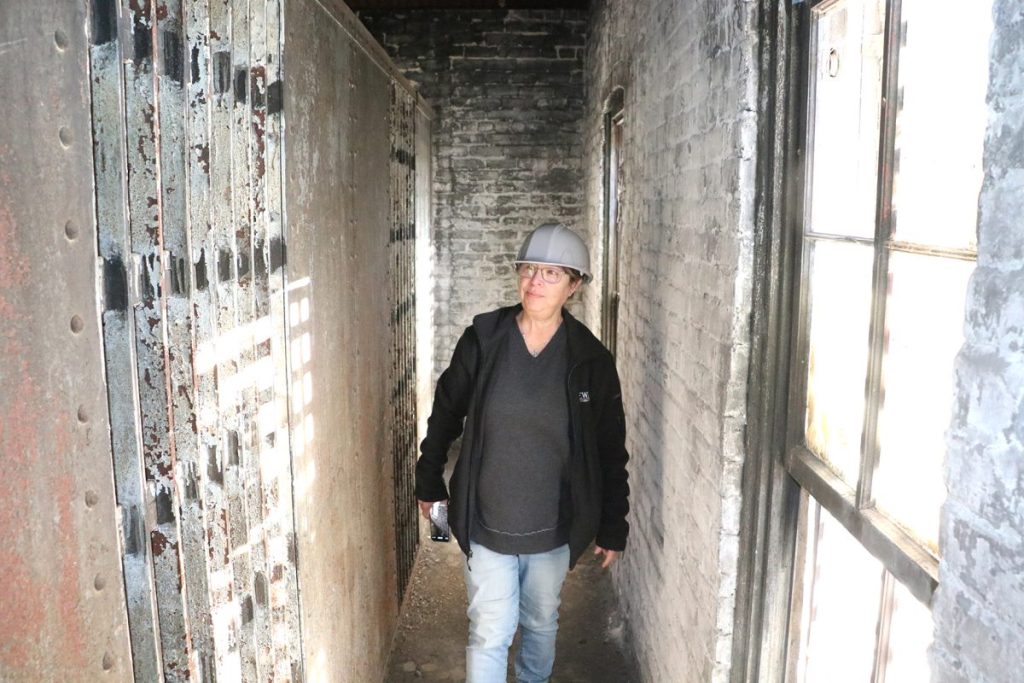
Water Valley Historic Preservation Commissioner Robbie Fisher inspects the metal box that contained multiple jail cells on the second floor of the old county jail on Blackmur Drive. Two of these metal boxes, known as a kit jail, were shipped to Water Valley on a railroad car in 1904. The metal boxes were hoisted up to the second floor, one on each side, before the construction on the walls and roof was completed. There are few kit jails from this era remaining in the country.

DAVE’S WORLD
By David Howell
After using the term in multiple stories during the last two years, I finally learned what it means when the county’s old jail is referred to as a “kit jail.” My education came during a tour of the building on Blackmur Drive, a building I refer to as the county’s old, old jail. The old jail is located on Calhoun Street was utilized from 1966 to 2015, and the old, old jail was constructed around 1905 and remained in service until 1966.
The two story building housed the sheriff’s department on the ground floor and the upstairs has two sides, each with separate metal enclosures that resemble large cages with six or so cells. Each side was a jail kit, shipped in on the railroad. The two metal structures were hoisted on the second floor, bolted down and the building construction was completed around them.
The cages were built by the Pauly Family, who were steamboat blacksmiths on the Mississippi River near St. Louis, and shipped to Water Valley by train. The Pauly Jail Building Company set the industry standard for jail cell construction at the time and remains a prominent manufacturer today.
The cells are riveted metal boxes, including the floor and the ceiling, with a cage door and a meal pass through that is about 3” x 8”. There is also a trapdoor utilized for hangings and a small dumbwaiter that was used to hoist food up from the first floor.
The footprint for the metal kit on each side of the second floor is a little smaller than the building, leaving room for a jailer to walk all the way around the cells. Apparently there are very few of these old kit jails remaining in the country and this one is a time capsule – nothing has been modified upstairs since it was constructed 120 years ago.
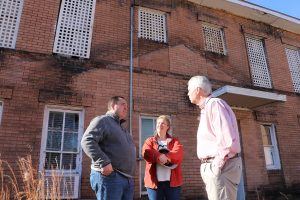
Cayce Washington, Cinnamon Foster and Brandon Presley discuss the history of the old county jail located on Blackmur Drive.
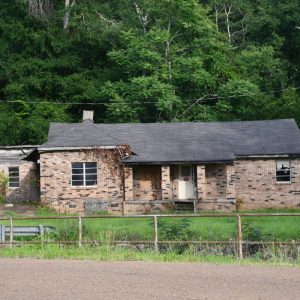
The downstairs, once used as the sheriff’s department and the sheriff’s quarters, has long been converted to office space and bears little resemblance of its origin. When you glance over at the building while driving up Blackmur, there is little indication of anything historical significant. Instead it looks like an old brick building that is slowly crumbling. And that is the problem, a structural report for the building cited corrosion and deterioration of the of the original brick anchor ties as the main reasons the bricks are separating from the building. The steel lintels over the windows are also corroded and a roof replacement will be needed in the near future
The building is designated as a Mississippi Landmark, the highest form of recognition bestowed on properties by the State of Mississippi. The designation protects the building from changes that may alter the property’s historic character.
Landmark or not, there are many needs more pressing and spending county tax dollars is not an option to save this building. Maintaining the county’s two courthouses, also designated as Mississippi Landmarks, is taxing enough for the county’s budget.
This means it will take some creativity to figure out what to do with the building and how to come up with several hundred thousand dollars to save it. The idea of touring the building came during discussion in a Water Valley Historic Preservation Commission meeting that included state officials from the Mississippi Department of Archives and History. Brandon Presley, Cinnamon Foster, Robbie Fisher, Cayce Washington, Kagan Coughlin and Mike Mitchell.
Robbie serves as the chairperson of the preservation commission, and will share details about the building with other commissioners.
Coughlin, although joking, may have had the best idea for a quick infusion of cash for the building. He suggested taking a cutting torch and removing a section of a metal that contains “art” scratched in the wall by a prisoner a century ago. There is no telling what this risqué piece would fetch in a New York art gallery!