Beer Law Is Back On Agenda

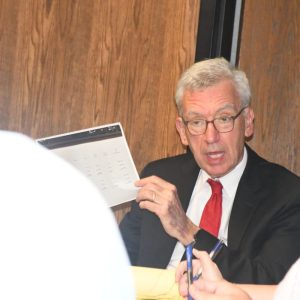
Kevin Morris (standing, center) shares details of the restaurant under construction on Main Street as owner Terry Warren (standing, left) asked for the beer and noise ordinances to be tweaked. His request will be revisited next month after a committee reviews the ordinances.
By David Howell
Editor
WATER VALLEY – Aldermen voted to appoint an 11-person committee to generate feedback from the public on the city’s beer and noise ordinances following a request from Terry Warren to change portions of the ordinances. The committee members are expected to report their findings during the November board meeting before aldermen act on Warren’s requests.
Warren is currently renovating a pair of adjoining Main Street buildings and outlined plans during the Oct. 3 city board meeting for the 10,000 square feet project that includes a restaurant on the bottom floor of one building, a specialty store in the bottom floor of his second building, a large commercial kitchen on the back side of both bottom floors, an upstairs bar that also serves food and an upstairs venue room.
“Our first one is the beer law, where it talks about anticipation,” Warren said “We need a clarification on what that means,” Warren told aldermen as Brad Walsh, his attorney, and Kevin Morris, his executive chef hired to run the operation, accompanied him at the meeting.
The portion of the ordinance Warren was referring to, Section 7 as amended in the 2014 ordinance, states, “No person of licensee under this Ordinance shall sell, give, or dispense or permit to be sold, given or dispensed beer or light wine to a patron without serving to such patron a meal therewith or anticipation thereof.”
“I talked to the mayor and he basically said if someone comes in and orders a beer, then I can just assume that that person is gonna eat. He doesn’t have to order. Well I can tell you right now, I am going to assume that everybody that walks in there, I am going to assume they are going to eat,” Warren explained.
He also cited an example, asking about consequences if his friend, Archie Manning, comes by every Thursday and drinks three beers and leaves without eating.
“What is my liability here?” Warren then asked.
“None,” answered Alderman-at-Large Donald Gray, who presided over the meeting in the absence of Mayor Larry Hart.
“You are not going to enforce that?” Warren asked.
“When we passed it, because I was on the board at that time, our legal counsel told us we would make that assumption,” Gray continued about the changes the previous board made with 2014 ordinance that included the stipulation that requires beer to be served in anticipation of a meal.
“We are not going to be out bird dogging you or anyone else. We are going to let you have a restaurant… That was the assumption at the time… It may need further clarification,” Gray continued.
“That clarifies it for me, but if you are not going to enforce the law, then why have it?” Warren asked. “My request to the board is just to do away with the law. What we are scared of is if you decide to enforce it. I have spent several hundred thousand dollars,” Warren continued as he noted that his business will be a restaurant that serves alcohol.
“We are spending a lot of money here. We want Water Valley to be proud of this. You can see what we have done to the outside and we are doing the same thing to the inside. And we can’t go forward any longer, on my attorney’s advice, until we get that cleared up,” Warren explained.
Next the city’s noise ordinance was also questioned by Warren.
“We would like to extend that from 11 p.m. to 12,” Warren also said about the current noise ordinance. Other questions included how the noise level would be measured, as Warren’s attorney, Walsh, suggested that the ordinance needs to state a decibel reading for clarification.
Warren explained that the music will be an important part of the attraction at the restaurant, adding that weekend music has been part of the success for the brewery on Main Street. He also said his business plan includes busing in fraternity and sorority students from Ole Miss for special events.
“We are at a point, we either have to get in or get out… We have another location in Oxford that I own. If we can’t get this worked out, we will have to go up there and do it. We will finish the building and put bathrooms and electricity in and simply rent it out,” Warren added.
City Input
“Any ordinance, any law, any policy should apply equally to everyone,” Ward One Alderman Kagan Coughlin said after Warren’s presentation. “If there are places in our ordinances that allow this board to treat people differently based on anything other than the letter of the law, I would like to correct that… the term anticipation seems like a space where we could do better,” Coughlin said.
“Anticipation, I googled that phrase and it is not anywhere else. It is only in our document. I compared it to the Mississippi state law. There is nothing like that in there,” Ward Three Alderman Cinnamon Foster noted.
“Where did that originate from, Donald?” Foster then asked.
“Our attorney at that time… they studied ordinances from several different cities,” Gray answered. He also noted that the original beer ordinance was adopted after the 2007 beer election in the county when David Burns was city attorney and Bill Norris was mayor.
“Effectively it sounds like we are doing our best to keep any business that would serve beer exclusively out of town. Does that sound like a fair assessment?” Coughlin asked.
“No,” Board Attorney Daniel Martin answered. “The intent behind it is to keep an establishment from being opened such as in an empty, abandoned warehouse and somebody putting up a plywood and being able to serve the cheap beer they have trucked in and throwing whatever temporary parties and creating a hazard or danger to the surrounding community, to the city at-large due to crime and the proliferation thereof. That is why there are different elements in there about the restaurant. There are different elements about the cleanliness and the number of restrooms. There are different facets of the ordinance which were introduced, the intent was to provide a safe and hospitable place for someone to enjoy a beverage while at the same time maintaining the integrity of the surrounding community,” Martin explained.
“Which seems reasonable. Under this ordinance would an upper class bar be able to exist in Water Valley?” Coughlin asked.
“Yes,” Martin answered.
“You can have a bar now. Like Terry stated, the State of Mississippi regulates alcohol. This deals with beer,” Gray also added, referring to the city’s local regulation that only pertains to beer and light wine, which is different from liquor is regulated under state law and not subject to local control.
“Again, I know it is vague, but the intent was not to stop someone from going in and having a beer prior to having a meal. And if they ordered the beer and decided they were not going to eat, that is not Terry or any other restaurant owner’s fault. They served the beer in good faith, so to speak,” Gray answered.
“Daniel, what if that line was stricken,” Foster then asked about the anticipation part of the ordinance. “What change would be made on a threat to our community?”
“I don’t know off the top of my head, I would have to ponder it,” Martin added.
Coughlin then pointed to the noise ordinance question, adding that he would be in favor of a decimal specification to gauge the level of noise.
“That sounded like a good idea,” Martin said as other board members agreed.
“But what I would like to not have is a knee jerk reaction to one business owner’s needs. I don’t want to revisit this. This seems to be a super contentious thing in Water Valley, now and since 2007. I have been approached with discussion about cold beer sales. I would like to hear input, or to get some sort of committee of business owners and people that are impacted by this, to give some input on anything that might need to change in this. I would like to review it with input from the community, business owners and everyone who lives here, and how they feel about it. And have a process around that, and then we could revisit it,” Coughlin said, adding that the intention would be to put the issue to rest with the majority of the town feeling like they were represented.
Committee Options
“Can we set up a committee of some sort?” Coughlin asked.
“You can set up a subcommittee that can report back to the Board of Aldermen,” Martin answered.
“I will tell you what the input of the community is that I have talked to for the last decade,” Foster said. “This is a culmination of what a general complaint is for this one little sentence,” Foster said about the sticky use of the word anticipation in the ordinance.
“It means nothing to me, whether it is in or out. If it is out, what is the consequence?” Foster asked about eliminating this part of the ordinance.
“The consequence there is the intent to have a cheap, ramshackle establishment which would be enabled by the fact that they do not have to serve a meal with,” Martin answered.
“That is not true, the State of Mississippi says you can’t serve alcohol without having 25 percent of food,” Foster countered, referring to state law that requires 25 percent food sales in order to serve alcohol.
“I am talking about this ordinance,” Martin answered.
“But we still have 50 percent food,” Coughlin said about the city ordinance which has a higher threshold than state law with a 50 percent food sale requirement for businesses that serve beer.
“Nobody can throw up a bar without selling food and getting an alcohol license,” Foster reiterated.
“I am really asking a serious question because I hear the same complaint all the time. It is the first and last thing that I would hear if I went and polled everyone that knows anything about this beer ordinance. I still can’t see where somebody can throw up a bar without serving food and this particular piece is going to stop that because everybody has to serve food who is serving alcohol because that is ABC (Mississippi Department of Revenue Alcoholic Beverage Control) law,” Foster noted.
Martin then used an analogy of a fully-loaded pickup compared to an antiquated Model T to respond to Foster’s question.
“The idea is you have a brand new Ford F150 and it has all the bells and whistles… A Model T will cruise down the highway, but if you have all these other things built into this machine, it will run better smoother and run better and do what you want to do. That is the same principle behind that little sentence. It is like another little facet of the big, overarching idea,” Martin answered.
“On the beer thing, you are going to have people right down the middle. Everyone that knows me knows that I don’t consume any alcohol. But I don’t care if you do, that is your business. It is split down the middle, I hear from both sides. I also am in favor of businesses growing in Water Valley, so I am conflicted. I am,” Gray said.
“We plan to hire about 40 to 50 people,” Warren added.
“So do you do something that stops businesses?” Gray asked.
“I think there are enough provisions in here to stop a warehouse with sawhorses and a piece of plywood and a keg, without this sentence,” Coughlin said. He also reminded aldermen that additional questions about the city’s beer ordinance may surface, especially after county supervisors changed the county’s beer ordinance to allow the sale of refrigerated beer at convenience stores while stores inside the city are required to sell beer hot.
“Rather than piece-mealing tweaks, I would rather take 30 days… I think one of the biggest criticisms that was valid about the last process about the beer ordinance, is that there was no process for the community to give input.” Coughlin continued.
“That is true,” Foster agreed.
Coughlin also noted that property taxes contribute 19 percent to the city’s budget while sales tax contributes 18 percent to the city budget.
“So our retailers and our businesses put as much in as we all do with our property taxes. So they have a voice and I would like to know what they think. I would like to do it right, do it once,” Coughlin said about changing the beer ordinance.
Coughlin then motioned to establish a committee of 11 people, with Martin included as a member.
After additional discussion, Martin recommended that each aldermen appoint two committee members, who then would report to him to ensure the process would be timely and a report available for aldermen for the next meeting.
“We would appoint one person out of that 11 to present the whole idea back to the board of aldermen,” Martin added.
“What is the tool for asking these questions?” Foster asked. “What questions are we going to ask?”
Martin said the committee would discuss the ordinance and potential issues and bring recommendations back to the board.
“What are criteria of the appointees? Do they have to be a citizen of Water Valley?” Foster also asked. “If you are going to get people from the county it is just going to be a big overlap. It is going to be a weird thing,” Foster continued.
“I would like it to be from the electorate,” Coughlin said. Later in the discussion he amended his motion to include business owners who do not live inside the city limits.
“I am not grasping this whole concept. The way you want us to play it out, I don’t really get,” Foster said.
Do you have another process for having the community discuss this and give us our feedback?” Coughlin asked.
“It was a vote in 2007,” Foster answered, referring to the election where a majority of the voters favored legalizing beer.
“To legalize beer, countywide,” Coughlin noted.
“How are two more people that we appoint to be on a committee going to be the voice of our electorate? How is that representative of a community voice?” Foster questioned.
“Would you rather that we make a decision right now?” Coughlin asked.
“My decision to appoint two more people, how is that an overall voice of the city?” Foster reiterated. “How is that the voice of the people, with five aldermen picking two more people to be on a committee that still is of our choice? And say that is the voice of the people,” Foster continued.
“I think we can benefit from using committees for a lot of larger topics, like our departments,” Coughlin countered.
“Is this under a state statute?” Foster asked.
“This is a process that many boards adopt when they are trying to address many different things. Essentially you need to identify subcommittees who can take and chew at length on a particular problem. We don’t have time, the five of us, because we have to discuss everything and have an audience and be here,” Coughlin said about conducting business during the monthly meetings.
Foster reiterated her earlier position that using a committee doesn’t mean that aldermen will get a balanced perspective on the ordinance. She also noted that one option is to revert back to state law, pointing to the 14-page ordinance adopted in 2014 and two subsequent revisions as well as two earlier ordinances.
“I am no lawyer, but I spent eight hours combing through this to try to figure out what all this means so I could address Terry Warren in an educated fashion. I don’t understand where and why all of these things come from when we have a state law that covers every bit of this,” Foster continued.
Gray then noted that the earlier ordinances were replaced by the current 2014 ordinance.
Foster countered, explaining that the current ordinance still has amendments stapled to it.
Following additional discussion, aldermen voted 4-0 to appoint a committee and move forward with Coughlin’s idea.
“I am so curious to see how this is going to turn out that I am going to vote for it,” Foster added.
Ward Two Alderman Fred White had exited the meeting just prior to the vote, leaving the meeting early.