Walking Tour Brings Historic Downtown Into Focus
PROTECTED CONTENT
If you’re a current subscriber, log in below. If you would like to subscribe, please click the subscribe tab above.
Username and Password Help
Please enter your email and we will send you a password reset link.
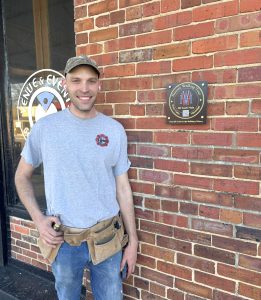
Grant Thompson used years of research and digitized newspaper archives to create a new historic walking tour of downtown Water Valley.
WATER VALLEY — A new historic walking tour is now in place in Water Valley’s historic business district, offering a self-guided look at the buildings and businesses that shaped the community.
The project grew out of a newspaper digitization effort launched nearly four years ago by Grant Thompson, the city’s historian and Ward 3 alderman. That work created a searchable database of historic editions of the North Mississippi Herald.
That database allowed Thompson to track the history of buildings and businesses across decades — following where they were located, when they moved and how downtown evolved over time.
“The biggest thing was gathering the information,” Thompson said. “There’s been a gap from about 1930 to present day where it’s hard to find what business was where. Once the newspapers were digitized and searchable, that changed everything.”
Instead of relying on scattered records, Thompson used archived newspapers along with phone books dating from 1954 to 2007 to confirm locations and timelines.
“That at least gave me an address,” he said. “I knew this business was at this location during this time.”
That research now takes shape through the Historic Downtown Walking Tour, which includes more than 20 stops. Each location is marked with a sign featuring a QR code that can be scanned with a smartphone, linking visitors to a detailed history of that specific building.
For those unfamiliar with QR codes, the process is simple. Using a smartphone camera, visitors point the camera at the square code on the sign. A link will appear on the screen, and tapping it opens a webpage with the full history of that location. No special app is required.
“It’s a 24/7 tour,” Thompson said. “You can start anywhere, go at your own pace and learn the history of each place as you walk.”
The information is also available through the City of Water Valley’s website, where users can browse each stop from a computer or device at home.
The tour stretches from Railroad Park through South Main and North Main streets, highlighting buildings that date back to the railroad era and the early growth of Water Valley following the arrival of the Illinois Central Railroad in 1857.
The project has also helped separate fact from folklore when it comes to downtown buildings.
“There’s always been a lot of talk about what buildings used to be,” Thompson said. “Now we can actually prove it.”
At 500 North Main Street, the former Herald building now owned by Eddie Foster and home to The Blue Melon Rendezvous gallery, Thompson found records confirming the building once housed a bottling plant. Earlier records show the same structure had previously been used as a livery stable.
“The history shows it changed over time,” Thompson said.
Every entry included in the tour is backed by documentation, primarily from newspaper archives.
“There’s no speculation,” he said. “If it’s there, it’s because there’s something to support it.”
While the walking tour offers a new way to explore downtown, Thompson said another long-term value is preservation.
The digitization project ensures decades of local history are protected, while the walking tour brings that history back into public view.
The current tour represents the first phase of the effort, with additional expansion already being considered. Future plans include extending the tour into residential areas and restoring historic painted advertisements that can still be faintly seen on some downtown buildings.
“I’d like to bring some of that back,” Thompson said. “There’s a lot more history out there.”
The walking tour is accessible both in person and online through the City of Water Valley’s website, allowing users to explore each location digitally or follow along while walking downtown.
“It’s designed to get people out and walking,” Thompson said. “Learning something and supporting local businesses at the same time.”