County’s Costliest Project In History Continues To Grow
PROTECTED CONTENT
If you’re a current subscriber, log in below. If you would like to subscribe, please click the subscribe tab above.
Username and Password Help
Please enter your email and we will send you a password reset link.
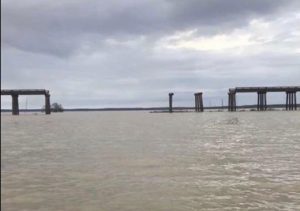
The spans of the bridge that splashed into the lake are covered in 27 feet of silt.
GUMS CROSSING – The price tag for the most expensive project ever awarded by the Board of Supervisors in Yalobusha County got a little more pricey this week. In February supervisors awarded a $16.24 million bid to replace the Gums Crossing Bridge on County Road 221. On Monday supervisors approved the extra work that could add up to $2 million more for the project.
The increased cost stems from four concrete slabs from the old bridge that splashed down into the lake. The massive concrete spans that were once the roadway on the bridge are now covered in 28 feet of silt. Making matters worse, two of the concrete slabs are located directly where the concrete pilings for the new bridge will be placed.
County Engineer Karl Grubb shared the dismal news during Monday’s recessed meeting at the Water Valley courthouse.
“Roughly $2 million dollars,” Grubb told county officials. “It is four slabs under the water, two of them are in conflict with the piers.”
Grubb said that his recommendation is to remove the two slabs that are in conflict and driving permanent pilings to stabilize the other two to keep them from shifting and damaging the new bridge.
“But this two million is for all four of them,” Grubb explained about the estimate which could be considerably less if all four slabs do not have to be removed. The engineer explained that the costly work will include dredging the area to remove the silt before the concrete slabs can be removed.
At just over a half-mile long, the bridge spans the backwaters of Grenada Lake including Skuna River and is the longest in the county. The bridge was closed in February, 2019, after historic flooding caused structural damage. Almost 200 feet splashed down into the river a year after it closed.
Work started on the demolition of the remnants of the existing bridge in April, and the entire project is expected to take well over a year, depending on the fluctuation of the water level at Grenada Lake.
The U.S. Department of Transportation is funding 80 percent of the total cost of the project, which leaves an estimated $4 million that will be funded from other sources. Of that amount, a million dollars will come from state bond money appropriated during the 2020 legislative session, leaving an estimated $3 million needed from the county’s coffers.
Discussion about the county’s portion of funding also resurfaced in Monday’s meeting as supervisors have identified different sources after opting not levy a county-wide bond to finance the project. Instead the funding sources include a $680,000 loan, the maximum the county can borrow without a issuing bonds. It also includes utilizing some portion state aid money that flows to the county from the Mississippi Department of Transportation and is allocated for roads and bridges in the county. The county will receive $1.7 million during the current four year term (2020 – 2023).
District 5 Supervisor Gaylon Gray also kicked in $200,000 from his bridge fund.
Another potential source is utilizing a portion of the proceeds from a settlement from an environmental lawsuit received by the county and hospital in late 2019, which was briefly discussed Monday.
“This thing is a monster,” Gray noted about the bridge during Monday’s discussion. The bridge is located in his district, and he is among hundreds of residents who are forced to detour 30 miles or more, one way, to get to Coffeeville or other areas of Yalobusha County. The closure also effects school bus routes and postal service delivery, as well as response for medical, fire and law enforcement calls.