Solar Farm Will Generate Tax Revenue
PROTECTED CONTENT
If you’re a current subscriber, log in below. If you would like to subscribe, please click the subscribe tab above.
Username and Password Help
Please enter your email and we will send you a password reset link.
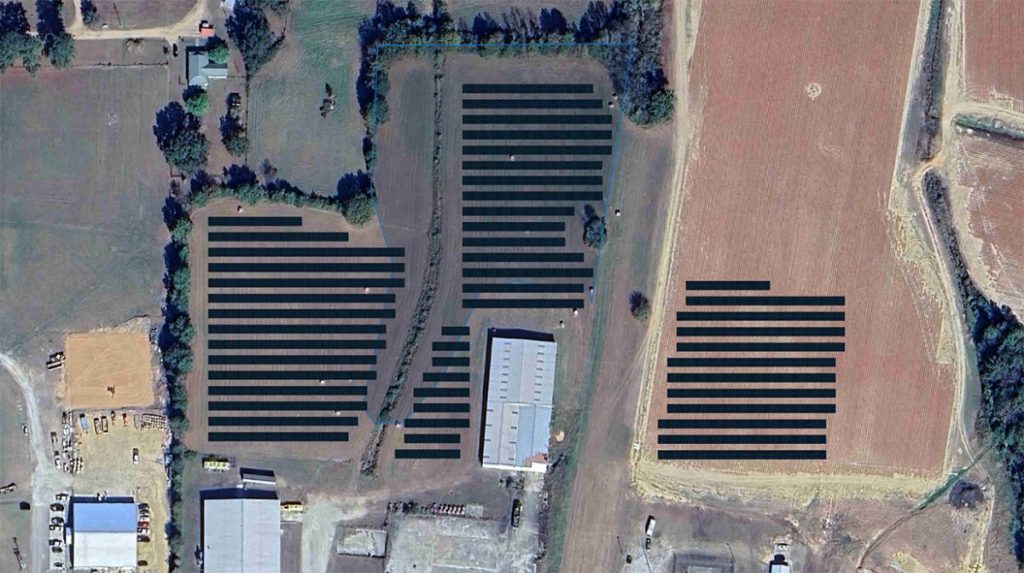
The 12-acre site for the proposed micro solar farm in Water Valley is located on Hwy. 32 across from Solero Technologies.
WATER VALLEY – The Yalobusha County Board of Supervisors are expected to approve the tax rate for a proposed micro solar farm in Water Valley that will generate $34,000 annually in taxes.
Yalobusha County Economic Development District Executive Director Kagan Coughlin brought a proposal that includes $5,000 annually for taxes paid to Yalobusha County, $3,000 for the City of Water Valley and $26,000 for the Water Valley School District.
Speaking at the Feb. 4 Board of Supervisor meeting, Coughlin explained that Renewvia, the company the City of Water Valley has executed an agreement with for the micro solar farm, will spend an estimated $3 million to erect solar panels on 12 acres owned by the city. Renewvia will lease the acreage from the City of Water Valley for 25 years, and solar panels located on the property will be taxed.
Coughlin explained that the city and county taxes could be fully exempt, similar to the industrial tax exemption granted to industries in the county, meaning Renewvia would only pay school taxes.
“But we have been working with the company to see how much we can tax them without killing the entire project. We can tax them at a 15 percent rate, which will bring in $5,000 annually for the county and $3,000 to the city,” Coughlin said. He also noted that Renewvia will pay $26,000 in taxes to the Water Valley School District, and school taxes cannot be exempt.
“This will be almost $34,000 of new tax revenue,” Coughlin added.
The tax proposal was tabled and is expected to be approved at a later meeting.
Coughlin also listed additional economic benefits the solar farm will bring to the county including:
• Renewvia will spend $178,000 for interconnection costs and systems upgrades for the Water Valley Electric Department to allow the power from the solar farm to flow through the city.
• Renewvia will contribute $150,000 that will be matched by $150,000 from Tennessee Valley Authority to weatherize low income houses in Water Valley to reduce the electric bill.
• The City of Water Valley will save $100,000-plus annually on the purchase of electricity. The Water Valley Electric Department will purchase an estimated five percent of the electricity used in the city from the solar farm at a cheaper rate that what is paid for energy purchased from Tennessee Valley Authority.
Coughlin also circulated the 2024 annual review for the Yalobusha County Economic Development District. The list of ongoing projects in the county include:
• A project for a large solar farm south of Oakland continues to inch forward. The Coffeeville School District has optioned 400 acres for the project to lease for the solar farm, 16th Section Land that is owned by the school district. Neighboring land owners have also signed up to participate with large sections of land with an ultimate goal of a 1,500 acre site that would produce strong tax revenue for the county, and lease revenue for the Coffeeville School District.
• A road safety plan was funded through the Department of Transportation’s Safe Streets for All program. Yalobusha County received $120,000 to complete this study that will provide access to other funding for projects identified as high-need in the county. Coughlin has repeatedly stressed that four-laning Hwy. 7 in Yalobusha County is one of the high need projects.
Neel-Schaffer, an engineering, planning and construction management firm, was selected as the engineering firm to complete this study. During the latter part of 2024, the company collected information on problem areas across the county. The first draft of this study was presented to the Yalobusha County Board of Supervisors on Feb. 4.
• A fast charging station for electric vehicle was installed on Main Street in Water Valley in front of the Pocket Park. The charging station was completed in December, 2024, and was funded with Tennessee Valley Authority grant funds and a partnership with SkyView. All revenue for the first five years for charging fees (electricity) will go to the City of Water Valley for investment in the city’s electric grid. Coughlin reported the charging station earned about $25 per day during the first few weeks.
In year six, revenue will come from normal electricity sales for electricity used at the charging station and leases on three parking spaces.
• The Yalobusha County Economic Development District has been working with neighboring counties to strengthen a regional brand, following in the footsteps of highly effective organizations like the Golden Triangle. Coughlin reported that state leadership is very supportive of these efforts and efforts are underway for state legislation that would empower the county leaders to form a regional partnership.
• The initiative to convert the decommissioned railbed throughout the county to a community asset for walking and biking has attracted a capable group of citizens who are working diligently towards this goal. The group, Yalobusha Greenways Alliance, has raised funds to hire Neel-Schaffer, an engineering, planning and construction management firm, and submitted a Department of Transportation RAISE grant application.
Plans changed from pursuing funding to build the first 3.4 miles of trail inside the city limits of Water Valley, and are now targeting full design and engineering of a trail network from Coffeeville to the north end of Yalobusha County. Construction funds will be pursued next.
• A group of citizens, local businesses raised $49,000 to purchase an empty lot known as the Pocket Park in Water Valley. The Water Valley Area Chamber of Commerce contributed the remaining $11,000 in January to finalize the purchase. A grant to fund landscaping from the Small Town Center was received in 2024, and will be utilized as soon as the purchase is complete.
• Funding Delta Regional Authority (DRA) was received to establish two backup transfers that could power the entire city of Water Valley with electricity flowing from Tallahatchie Valley Electric Power Association’s substation. Mayor Tommy Reynold noted the $200,000-plus thousand from DRA arrived in the city’s bank account earlier this month for the project. One transformer will be located at Yalobusha General Hospital, and the second site will be at Solero Technologies. The two generators will provide back-up power for the city if these is a power failure at the city’s substation or transmission line feeding the city.
• The W.C. Gardiner Industrial Park development continued as Tennessee Valley Authority awarded an additional $700,000 in 2024, and Mississippi Development Authority awarded an additional $250,000. The 2024 allocations bring the total funding to $1.8 million for work that will include a new access road into the park from Hwy. 7, and a newly leveled building bad on the south end of the park that will support a new facility up to 300,000 square feet. Barring any complications from federal funding partners due to recent Presidential actions, dirt work should start this spring.
• The application to list the Walker High School in Oakland on the National Register of Historic Places was approved by the Mississippi Department of Archives and History in December. The application is now pending approval at the U.S. Department of Interior. The approval is part of a long-term project to gain access to Historic Tax Credits as a catalyst for developing the property. The Board of Supervisors has set initial sale terms, and the site is now a highly attractive opportunity for redevelopment.
• The 6.5 acre former site of the old Water Valley High School on North Main Street was returned to local control and ownership. The land was previously held by the Mississippi Department of Health, and local officials successful petitioned to have the land deeded to the City of Water Valley. The City of Water Valley is working to leverage this land for new residential homes.
• An application submitted for the second round of funding from the American Rescue Plan Act (ARPA) to support rural water associations was funded, allocating $2 million to Billy’s Creek Rural Water Association. The money is earmarked for system maintenance, adding a new well and extended water service to areas of the county that have never had access to a public water system.