Electric Commission Holds First Meeting, Confronts Financial Warning Signs
PROTECTED CONTENT
If you’re a current subscriber, log in below. If you would like to subscribe, please click the subscribe tab above.
Username and Password Help
Please enter your email and we will send you a password reset link.

Water Valley Electric Commissioners (from left) Dr. Vickie Person, Brandon Presley, Terry Allen Jr., and Dr. Barry Weeks participate in the commission’s first official meeting Monday night at City Hall.
WATER VALLEY – The newly formed Water Valley Electric Commission held its first official meeting Monday night at City Hall, a two-hour session that outlined early priorities for the city-owned electric department while also addressing ongoing financial challenges.
One of the more serious discussions during the meeting came when Chairman Brandon Presley explained that on August 1, the electric department’s general operating fund was short of the money needed to cover its $476,000 wholesale power bill to the Tennessee Valley Authority, a bill that was due.
Electric Department Manager Crystal Floyd said she was prepared to transfer funds from a separate account designated for substation repairs to ensure the bill was paid on time. Although the city’s largest customer made a payment that ultimately covered the shortfall, Presley said the situation underscores a deeper issue with the department’s financial position.
“That is an awful way for anybody to have to run a utility,” Presley said. “Anybody who believes there are not financial issues with the electric department—this should be a wake-up call.”
Presley said the department avoided dipping into its substation fund only because the city’s largest customer paid their electric bill in time. Otherwise, Floyd was prepared to transfer money from a substation repair account to cover the shortfall, something she had previously done earlier this year.
“It is a very scary feeling,” Floyd said about the situation.
“It’s unsustainable,” Presley said. “When you have to rob Peter to pay Paul, at some point you run out of disciples—and we are running out of disciples. As we go through the next several months working with the city on budgeting and other issues, we need to be completely honest, without any gray areas, where the finances stand.”
In other business, the commission adopted a three-page bylaws document. The bylaws define the five-member structure, lay out duties of officers, require at least one meeting per month, and include a process for future amendments. Presley noted the document is just a starting point and will likely evolve. Officers were also elected by nomination from Barry Weeks. Presley will serve as chairman, Allen was named vice-chairman and Person was named secretary. Commissioner Ray Hawkins was ill and unable to attend the meeting.
Manager Crystal Floyd provided several updates to the commission, starting with a welding trailer hookup project for Water Valley High School. She also reported that she is working on the annual compliance report to TVA, which is due August 15 and includes detailed information about the city’s electric operations.
Floyd said the city is continuing work to install two backup transformers, one at Yalobusha General Hospital and another at Solero-owned property. These transformers are designed to provide emergency power in the event of a system-wide outage and will connect to the Tallahatchie Valley Electric Power Association grid. However, Floyd said the agreement with TVEPA has not been signed, and attorneys for the city and TVEPA are still reviewing the documents.
“So if we get everything done and that is not signed, we are still dead in the water,” Commissioner Terry Allen Jr. noted about the project.
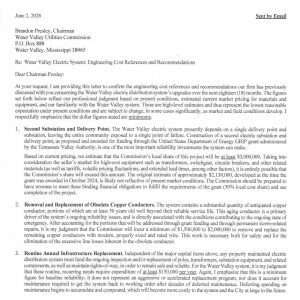
Allen’s comments come as the city is facing an October 31 deadline to install the transformers, a deadline from Delta Regional Authority (DRA) as the organization provided $387,000 in grant funding for the transformer project. Presley emphasized that the project, which started almost three years ago, must be completed before the city can credibly request further DRA funding, including a new $2 million grant the commission discussed later in the meeting.
Other business in the meeting:
• Commissioners voted to issue three separate requests for proposals during the meeting—one for legal representation, another for contract auditing services, and a third for property tagging and inventory identification, including documenting all assets.
Presley said that although the city currently contracts with ATA of Jackson, Tenn., for its audits, the firm failed to flag the lack of a fixed asset inventory system and equipment tagging, which are required by the state auditor’s office. He also noted that other firms have quoted lower fees for the same auditing services, with potential savings estimated for the department around $5,000 a year.
Presley explained that the auditing services and inventory must be handled by separate firms. He also stressed the urgency of completing both the audit and the inventory system by mid-September, noting that elected officials in the city must answer the annual audit compliance questionnaire required by the state. If the inventory and tagging work is not finished by then, officials would be forced to provide negative responses on the record, indicating noncompliance.
• Commissioners approved a new logo or seal for the Water Valley Electric Commission. The new logo will be placed on all department vehicles, four of which currently lack proper identification, according to Presley. That includes two bucket trucks that are unmarked, which is out of compliance with state law, he added.
Presley said branding the vehicles is part of the transition to commission governance and ensures consistency across the department. Officials are also gathering estimates to purchase uniforms for department employees.
• The commission authorized Atwell and Gent Electrical and Consulting Engineers to draft specifications and initiate the bidding process for a three-phase project to address deteriorating utility poles on the city’s electric grid. The work will include pole inspection, followed by either treatment or replacement based on condition.
The city originally received $750,000 from the state legislature in 2023 specifically for pole replacement in connection with fiber deployment. With accrued interest, the total available for the project has grown to $813,000. Presley said engineers estimate that approximately 10 percent of the city’s 1,800 poles are in poor condition and in need of attention.
• Commissioners also agreed to review ongoing work by Tallahatchie Valley Electric Power Association (TVEPA), which is replacing poles as part of TVIfiber’s broadband expansion. Commissioner Terry Allen raised concerns after hearing reports from residents that fiber lines were being attached to poles in visibly poor condition.
“This is a one-time shot for us to get our poles replaced,” Allen said. “We really need to hold their feet to the fire and make sure the work they’re being paid for is being done properly.”
•Floyd noted that TVEPA has already completed a pole study that could assist the commission.
• Commissioners discussed submitting a new application to the Delta Regional Authority (DRA) for up to $2 million in grant funding to begin converting a portions of the city’s outdated 4kV electric system to a modern standard. The 4kV infrastructure still serves key areas, including the west side of Main Street and areas westward including the Water Valley High School and across the bypass. If awarded, the grant would also help fund upgrades to install reclosure devices that allow outages to be isolated rather than affecting large portions of the system.
Presley said he spoke directly with DRA national director Corey Wiggins about the condition of Water Valley’s electric grid, and Wiggins indicated the project would be a strong candidate for critical infrastructure grant funding. Presley also noted that completing the $387,000 DRA-funded backup transformer project—currently delayed pending a tie-in agreement with TVEPA—is essential before the city can credibly seek additional federal assistance.
Presley reminded the commission that grant funds, along with the $1.5 million appropriated by state legislators in 2024 for grid improvements and the $750,000 for pole replacements, are restricted for capital improvements and cannot be used to cover general operating expenses including the monthly TVA bill.
• Floyd also addressed progress on the advanced metering infrastructure system, or smart meters, a project first launched in 2022.
She said about 300 of the city’s 2,082 electric meters still need to be upgraded to smart meters, which allow remote data collection for billing purposes.
Presley noted that it has been more than three years since the program began, and the city still hasn’t completed the changeover.
He also pointed to the six percent line loss on the city’s grid—well above the industry average of four percent—and said outdated and inaccurate meters are a contributing factor. Floyd said the department can install about eight to ten smart meters per month, and a full plan is being developed to finish the work. She also explained that entering data from the remaining analog meters takes her about half a day each month.
• In other actions, commissioners voted to stagger employee lunch breaks to ensure the electric department office remains open during the noon hour. They also paid monthly claims after a line-by-line review, including a discussion about overtime and shared costs with other city departments.
Shared costs include a $142 monthly rent fee paid to the city for electric department office space and a $1,795 monthly dispatching fee. That dispatching cost is part of a larger $70,000 annual bill the city pays to Yalobusha County for dispatching services across fire, police and electric departments. The electric department currently covers almost 30 percent of that cost.
Presley also asked about Floyd’s time entering information for water billing.
“It takes a whole a day,” Floyd said.
“So you spend more time on water meters than electric meters,” Commission Allen added.
Presley added that the city could invest in handheld meter readers for the water department, which would reduce that process from hours to minutes.
“But this is not in our jurisdiction,” he added.
Presley also said a new joint cost study to update how departments share costs, noting that the current study is nearly 12 years old.
The commission will continue to meet monthly or more frequently as needed. All meetings are open to the public.