Mapping the Future: City’s Road Plan Offers A Lesson For The County
PROTECTED CONTENT
If you’re a current subscriber, log in below. If you would like to subscribe, please click the subscribe tab above.
Username and Password Help
Please enter your email and we will send you a password reset link.

DAVE’S WORLD
By David Howell
Just when I thought it was time to tone down the discussion about a unit versus beat system of government in the county, along come more ideas — and this time from inside the city limits.
Take what Mayor Tommy Reynolds and the Water Valley Board of Aldermen are doing with their new street-mapping project. The city spent about eight thousand dollars — which doesn’t go very far when you’re talking about asphalt — but it might be one of the smartest investments the city has made in years.
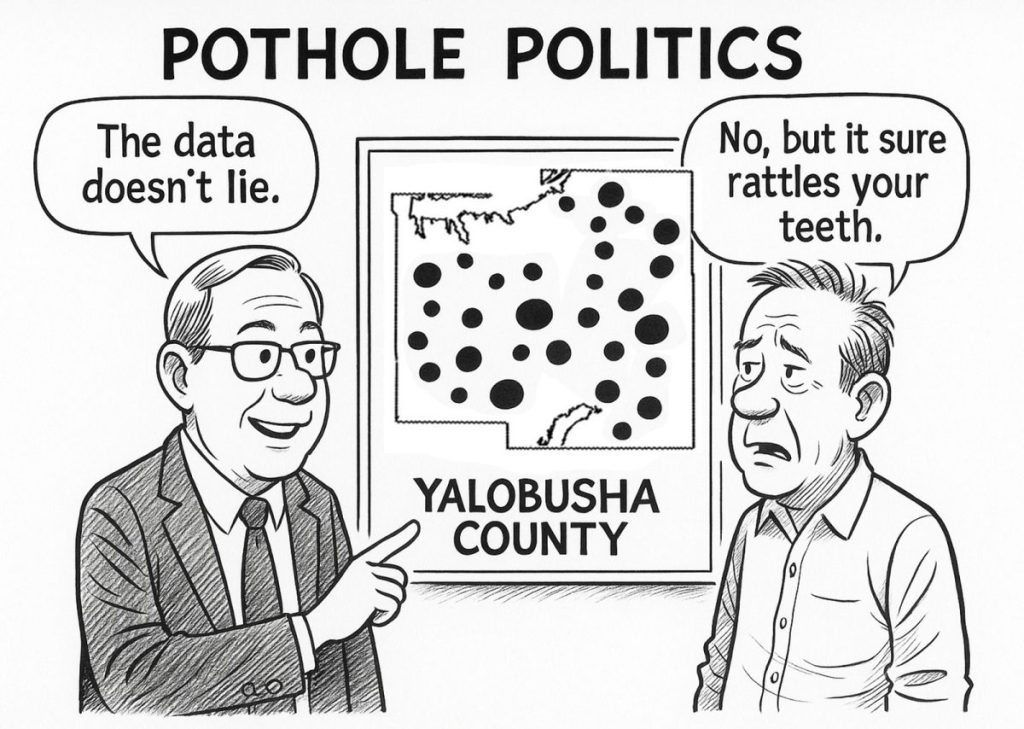
They hired the Golden Triangle Planning and Development District to drive every street in town using LiDAR technology. The system scanned, filmed, and graded every road surface down to the centimeter. When they were finished, the city had a complete digital map showing every crack, rut, and pothole. Instead of guessing which streets need paving first, they now have data that lays it out in black and white.
The plan is to use that information to develop what the mayor calls a “transformative paving program” — a $1.1 million project paid for through the city’s use-tax revenue, better known as the internet sales tax. It’s a scientific roadmap for paving streets based on need, not politics. Technology is amazing — good job harnessing it, Mayor Reynolds!
And this idea got me thinking about the county again.
What Tommy has done is essentially to write the first chapter of what a county road plan could also look like. There’s no reason the same planning district couldn’t do the same thing for Yalobusha County. Imagine a countywide report that grades every county road and ranks them from best to worst. The data could show which roads need work in 2026, which ones in 2027, and which ones can wait until 2028. You could publish it, let the public see it, and take the guesswork out of the process.
How could you go wrong with a road plan based on science, data, and transparency?
If you think about it, that’s really what the whole conversation about the beat system versus the unit system has been about all along — whether there’s a better way to manage our resources and get the most out of taxpayer dollars. The beat system has worked for a long time in this county, but it’s no secret that it also breeds duplication.
Every supervisor has their own crew, barn, and equipment. It’s costly, and it’s political by nature.
But again, imagine if decisions were guided by a public road plan built on traffic counts and pavement data — a plan that everyone could see. You’d know where your money’s going. You could see that your tax dollars were fixing the worst roads first with usage also calculated.
Like somebody told me the other day — sometimes the facts don’t fit the politics, but that’s okay. The important thing is being honest about what the roads really need.
The city’s plan shows what can be done with a small investment. The county has a lot more money to work with — over a million dollars a year in use-tax revenue — and the same technology, paired with traffic counts, could help make sure those funds are spent where they’re needed most.
Common sense says if you’re going to spend millions of dollars, you ought to spend them wisely. And common sense, as we’ve learned, isn’t all that common anymore.
Maybe the next step is to map it, measure it, and publish it. Let the numbers speak for themselves — and find out if there’s equality in the quality of roads from beat to beat. The results may be surprising.
Now, I should add a disclaimer: any system of government is only as good as the officials who are elected. And I can report that the Yalobusha County Board of Supervisors run a tight ship. There’s little waste, and fiscal management is a clear priority.
That’s not only my opinion — just ask Kelly Magee. She’s been doing some contract work for the Water Valley Electric Commission and stopped by the office earlier this month. Magee is an expert in local government. Her résumé includes decades with the state auditor’s office, serving as deputy comptroller and inventory control clerk in Lafayette County, and later as county administrator in Panola County for eight years.
During retirement, Kelly has remained busy with stints that included working with the North Central Planning and Development District helping counties including Yalobusha prepare annual budgets, and now doing a little contract work for the city’s electric commission.
Magee is very complimentary of our supervisors and their fiscal management. And for the record, she thinks the beat system serves this county better than moving to the unit system.
One argument against the unit system is that a county road manager would answer to three supervisors — a simple majority — and could focus on certain areas while neglecting others.
I can think of no better rebuttal than the Gums Crossing bridge project — the $20-plus-million job that required the full board’s support. When it looked like there might be a major funding gap, all five supervisors agreed they would borrow money, even issue general obligation bonds, if needed to see the project through. That’s strong unity, and we’re fortunate to have it in this county.