Storm Cleanup Cost Projected At $7 Million
PROTECTED CONTENT
If you’re a current subscriber, log in below. If you would like to subscribe, please click the subscribe tab above.
Username and Password Help
Please enter your email and we will send you a password reset link.
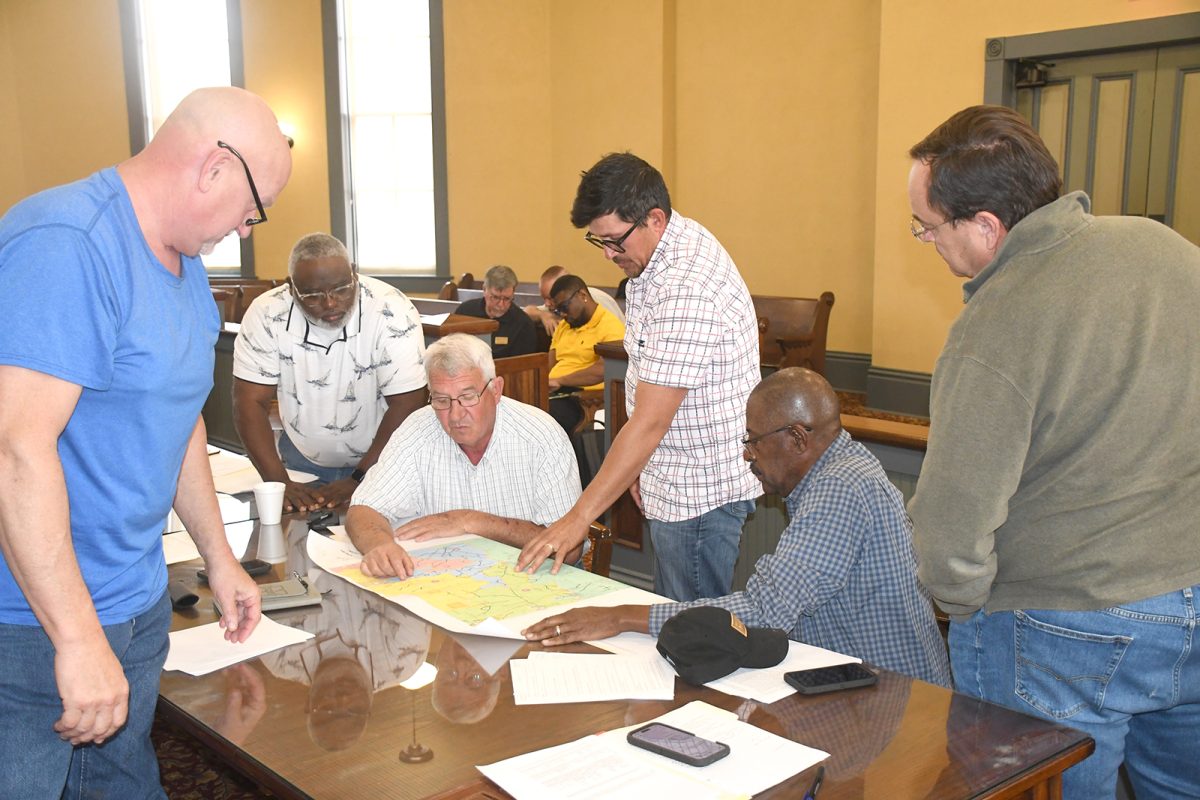
From left, Supervisors Gaylon Gray, Ken Rogers, Kenny Harmon, TFR coordinator Mike Mejia, Eddie Harris and Board President Cayce Washington study a county map Monday as they evaluated cleanup progress and financial implications of the ice storm recovery effort.
COFFEEVILLE — Yalobusha County’s ice storm cleanup is on pace to become one of the most expensive recovery efforts in county history, with total costs projected seven million dollars. While federal and state agencies are expected to reimburse 87.5 percent of eligible expenses, supervisors took steps Monday to prepare for a reimbursement timeline that could stretch eight to 12 months — or longer — including exploring options to borrow millions of dollars to carry the upfront cost.
Under FEMA guidelines, the county is responsible for 12.5 percent of eligible expenses. However, officials noted that portion will not necessarily have to be paid entirely in cash. Volunteer labor, donated meals, county equipment use and employee time can be counted as in-kind contributions to offset much of that local share. If total costs reach seven million dollars, the county’s 12.5 percent share would total approximately $875,000, though officials believe aggressive documentation of in-kind work could substantially reduce the amount of local cash required.
As of Monday’s meeting, approximately $2.137 million in tree cutting and debris hauling work had been completed, just 20 days into what was originally projected as a 45-day recovery effort. The total includes $1,733,000 for cutting and $403,973 for hauling debris from roadsides. It does not include nearly another $500,000 billed by Debris Tech, the monitoring firm required to document the work for FEMA reimbursement. The scale of the cost reflects the widespread nature of the damage, with bucket trucks, cutting crews and haul trucks deployed countywide, along with
FEMA-required monitoring at debris sites to ensure reimbursement compliance.
Supervisors have authorized TFR, the primary debris contractor, to spend up to $6 million and Debris Tech up to $1 million.
District 4 Supervisor Cayce Washington said the pace of spending forced him to scale back operations late last month.
“So late last Monday (Feb. 23), we were running up a pretty healthy bill,” Washington said. “They were doing exactly what we asked them to do. But we’ve run up a pretty healthy cut bill to date.”
Washington said he became concerned the county could reach $6 million or $7 million before even completing half the work.
“My concern with guys, more than anything, was I was seeing we were burning through a lot of cash,” Washington said. “And I was concerned we were going to get 30, 40 percent complete, and we were going to have expended six or seven million dollars and still had a portion of the county that we hadn’t even touched.”
On Feb. 23, Washington said he contacted TFR and Debris Tech and directed them to reduce bucket trucks from roughly 25 countywide to two per supervisor district (10 trucks) and to focus only on trees and limbs that pose a direct roadway hazard.
“We put two bucket trucks per district,” Washington said. “Right now they’re basically cutting those things up high that pose a risk to the roadway, not so much the right-of-way.”
Under the revised approach, hangers and leaners that will not fall into the roadway are generally being left in place as a cost-saving measure. Work on roads within the national forest where there are few homes has been minimized, and hangers and leaners along state highways are not being cut except in limited circumstances. One exception cited was Highway 7 south of Coffeeville, where trees are hanging over the highway.
TFR representative Mike Mejia estimated that about 40 percent of leaning and hanging trees along county rights-of-way have been cut as of Monday’s meeting. He also said that after one week of hauling debris from roadsides to debris management sites for burning and chipping, approximately 10 percent of the debris pickup has been completed.
Supervisors emphasized that roadway safety remains the priority.
“We’ve sort of laid the groundwork,” Washington said. “We still want him to focus on anything that would affect the roads. Is that the consensus of the board? … And if it’s in a gray area that may affect the road, we want to cut it.”
The remaining supervisors signaled agreement with the scaled-back cutting approach.
Supervisors also cited a tentative April 1 deadline to have debris removed from public rights-of-way under current FEMA guidelines — effectively giving residents less than a month to move storm debris from private yards to the roadside if they want it included in the county’s pickup effort. Supervisors stressed that debris must be at the roadside before that cutoff in order to be eligible under the current FEMA collection plan.
Cash Flow Options
Because the county must front the money and wait for reimbursement — 75 percent from FEMA and 12.5 percent from MEMA — Board Attorney Shannon Crow outlined possible financing options.
Crow said officials with BankFirst have indicated they would consider emergency financing, potentially structured as a revolving line of credit that could be paid down as reimbursement funds arrive. He said FNB of Water Valley may also be willing to entertain a similar arrangement.
“It could potentially be done as a line of credit,” Crow said. “As the reimbursement comes, we’ll pay it down, and it’s just added back on.”
However, Crow cautioned that a state statute governing emergency borrowing requires the loan to mature in a year.
“The loan has to mature March the 15th of 2027,” Crow said about borrowing the money. “What happens when you get in a situation where you’ve got a matured loan and we haven’t gotten the bulk of this reimbursement?”
Crow said issuing a traditional bond may be the safer option, and supervisors instructed the board attorney to prepare financing options to have options in place should action become necessary.
Meanwhile, ER Assist representative Joe LoBianco reminded supervisors that the county remains responsible for the 12.5 percent local share. If overall costs reach $7 million, that portion would total roughly $875,000. He urged the board to document volunteer labor, donated meals, county equipment use and other in-kind contributions, which can be credited toward that obligation.
Supervisors are scheduled to meet again at 8 a.m. Friday at the Water Valley courthouse with LoBianco to begin formally tallying volunteer and in-kind contributions tied to the storm response.