Water: The Battle Few People Saw After Ice Storm Fern
PROTECTED CONTENT
If you’re a current subscriber, log in below. If you would like to subscribe, please click the subscribe tab above.
Username and Password Help
Please enter your email and we will send you a password reset link.

DAVE’S WORLD
By David Howell
When Winter Storm Fern roared through Yalobusha County in late January, most of the public attention focused on restoring electricity. Crews worked around the clock clearing trees and rebuilding power lines, and understandably that’s what people were watching.
But another battle was happening at the same time, mostly out of sight.
The fight to keep the water running.
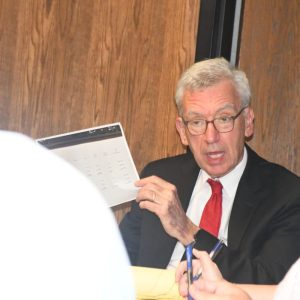
Monday I sat down with Tri-Lakes Water Association operator Donnie Morris, who stopped by the office wanting to make sure people understood just how much help came from Yalobusha County Emergency Management Director Stewart Spence and the U.S. Army Corps of Engineers during the storm. Morris was quick to give credit where it was due.
I figured sharing a few more details about the struggles Morris and other water operators were facing across the county wouldn’t hurt.
“It was a battle,” Morris said. “Everything was freezing up.”
Tri-Lakes serves about 660 meters spread across roughly 80 miles of pipeline and is one of about a dozen systems that serve residents in the county, counting the municipal systems in Water Valley, Coffeeville and Oakland. Tri-Lakes also happened to be Mrs. Betty Shearer’s favorite water association. She always bragged on longtime operator Bo White, who ran the system for many years before Morris took over. From everything I’ve seen, Donnie does just as good a job as Bo did.
After the storm, Morris estimated that nearly 300 customers were without water at one point as wells and equipment struggled through the extreme cold that followed the ice.
Generators were running nonstop. Regulators were freezing. Even the propane systems used to power backup generators were icing over.
At Tri-Lakes, Morris explained that at one point a single generator was trying to keep two wells going. When that generator failed, both systems went down.
“That meant two systems without water,” he said.
The cold created problems beyond electricity. Morris said ice built up on propane tanks and regulators, forcing crews to improvise just to keep generators operating.
“We had ice on that propane tank an inch and a half thick,” he said.
Not surprisingly, just reaching the well sites the morning of the storm was another challenge. Downed trees blocked roads across the county. Morris took a backhoe to clear roads just to reach the wells and get generators running. It took nearly three hours to reach the well in the Camp Ground community.
Coordinating assistance from MEMA and FEMA during and after the storm was Yalobusha County Emergency Management Director Stewart Spence. I have already reported that he was able to secure fuel that was trucked in by the Mississippi National Guard, and some of that fuel ultimately flowed to generators at numerous water associations.
Spence also reached out to MEMA requesting generators for water associations, a call that was ultimately answered by the U.S. Army Corps of Engineers. Spence said the Corps had staged equipment at Camp McCain outside Grenada and was able to respond quickly.
“The Army Corps of Engineers pulled up at the well site and asked, ‘What do y’all need?’” Morris explained.
The answer was simple.
“We told them we needed generators.”
By that afternoon, two generators were delivered by the U.S. Army Corps of Engineers. Crews installed them, monitored them and returned daily to refuel them.
“They didn’t fool around,” Morris said.
The system was soon pushing water again while crews worked through leaks and broken pipes caused by the freeze.
Similar struggles were happening across the county.
Jeff Davis Water Association was fighting frozen valves as operators tried to thaw them with heaters. Billy’s Creek Water Association relied on diesel generators. At Yalobusha Water and Sewer District, a single generator had to be moved from well to well to keep tanks from running dry.
Across the county, operators were dealing with the same problems — frozen equipment, broken pipes and the struggle to keep generators working.
The freeze also caused major water losses from busted pipes. Morris said some customers unknowingly ran tens of thousands of gallons before leaks were discovered.
“Sixty thousand gallons at one place, thirty thousand at another,” he said.
Those losses made it even harder to keep pressure in the system while wells were struggling to stay online.
It was a difficult few days for the people responsible for keeping water flowing across rural Yalobusha County.
“But you’ve got to have water,” Morris said. “That’s more fundamental than electricity.”