The Island That Couldn’t Stay Isolated
PROTECTED CONTENT
If you’re a current subscriber, log in below. If you would like to subscribe, please click the subscribe tab above.
Username and Password Help
Please enter your email and we will send you a password reset link.

John Nelson graduated from the U.S. Merchant Marine Academy at Kings Point, New York in 1965 and enjoyed a long career at sea on commercial and military support ships. After retiring from his seagoing career, he continued working in various capacities in the maritime industry until a final retirement in 2012. Since then he has been active in researching local history and restoring and operating steam engines and antique mills.
He lives in neighboring Panola County and is a long-time member of the Yalobusha Historical Society. He writes about his experiences in the Panolian, Oxford Eagle and Herald. He is also the uncle of Herald publisher David Howell.
Since I have spent more time on Diego Garcia than any other place other than home, it was a little upsetting to me when Iran fired a couple of intermediate-range ballistic missiles at this beautiful little atoll in the middle of the Indian Ocean.
To understand how an isolated, little-known island has become a player on the world stage, one must take a look at its history over the past 300 years.
In the early 1700s, the island came under French control and was administered as a dependency of the Isle de France, now called Mauritius, 1200 miles to the southwest. Since the island was best suited to growing coconuts, it settled into a quiet plantation culture, and its remoteness and relative unimportance kept it isolated from the world.
When Great Britain emerged victorious from the global conflict with France known as the Napoleonic Wars, the island, along with Mauritius, came under British control. But it seemed to matter little to the inhabitants what flag flew over them. They continued in their French Creole culture and focused on growing coconuts.
During World War II, the islanders showed their indifference to the outside world in an incident involving the German light cruiser Emden. The ship had been preying on British shipping in the Indian Ocean, when a safe anchorage was required to make some repairs. There were no German bases in the area, so the captain chose Diego Garcia since he didn’t think the island had a military detachment or a wireless station.
The Emden entered the lagoon cautiously with deck guns at the ready, but they were welcomed. Over the next few days, the islanders assisted the Germans and provided them with fresh pork, fish and fruit. The Germans reciprocated with wine, spirits and cigars and even repaired the plantation manager’s motor launch.
When later challenged by British naval authorities for aiding the enemy, the islanders claimed to have no knowledge of the war, and it’s never been established whether they really didn’t know, or knew but really didn’t care.
German raiders again preyed on allied merchant shipping in the Indian Ocean during World War II, but a greater threat to the area came after Singapore, Malaya, and the Dutch East Indies fell to the Japanese. With the Indian Ocean open to Japanese naval forces, the British hurriedly established a chain of bases and refueling stations stretching from Ceylon to the coast of Africa.
Diego Garcia’s lagoon offered a safe anchorage for ships, and the island became part of the defense chain. Troops were permanently stationed there for the first time, and the island also hosted a detachment of Royal Air Force Catalina flying boats to patrol the surrounding ocean.
WWII gave the island its first taste of a military presence, but it was the global struggle between the United States and its allies and the old Soviet Union that changed Diego Garcia into a military base.
It began in the 1960s as Russian ships began probes into the Indian Ocean with the apparent purpose of filling the vacuum left by the British pullout from the area. The Brits planned to grant independence to Mauritius and that would include Diego Garcia as part of the Chagos Archipelago.
Great Britain did grant independence to Mauritius, but at the urging of the United States, it held on to the Chagos islands and established the British Indian Ocean Territories (BIOT). Diego Garcia remained a British island and in an agreement with U.S., it was to be made available to meet the defense needs of both governments for an “indefinitely long period.”
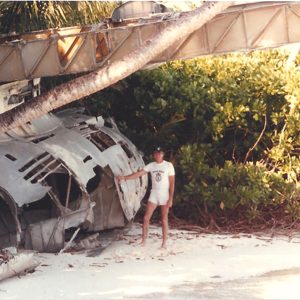
John Nelson stands beside the remains of a Royal Air Force Catalina flying boat on Diego Garcia in 1986. According to Nelson, the aircraft was blown onto the beach during a storm in 1944 and remained partially intact for decades due to its aluminum construction.
The agreement granted the U.S. the right to eventually construct a naval base on the island, but there was a problem since about 1500 Chagossians were still producing copra and coconut oil on the Diego Garcia plantation and plantations on two other islands of the group. It was decided that in order to maintain security, the inhabitants would have to be resettled. Most were relocated to Mauritius while a few were sent to the Seychelles.
It was the mid 1980s when I first arrived on the island on a ship that was part of a five-ship squadron loaded with all the supplies necessary to support a marine expeditionary force for 30 days. For the first five of the 10 years that I was assigned to that squadron, the island remained relatively unknown.
That began to change in 1990 when Saddam Hussein sent Iraqi forces into Kuwait. To counter this threat, our squadron steamed up to Jubail, Saudi Arabia, where our war-fighting cargo equipped the 7th Marine Expeditionary Brigade and made that unit the first armored ground force opposing further penetration by Iraqi forces.
After performing our primary mission, the ships of the squadron began shuttling additional military hardware to Saudi Arabia until the US-led coalition was sufficiently equipped to initiate what is called the First Gulf War to drive Iraqi troops out of Kuwait.
It was during our more than a year’s absence from the island that the B-52’s arrived. When the big planes – more noisy and more newsy than a squadron of ships- began bombing missions against Iraqi targets, people began to hear about Diego Garcia.
Since the US is currently engaged in a military action against Iran, it’s not surprising that the US Air Force sent some of its new B-2 stealth bombers to Diego Garcia, and also not surprising that Iran considered the island a target worthy of a couple of missiles.
To make things more interesting, those natives forcibly resettled decades ago, have been petitioning the courts for the right to return to their home islands. In 2019, the International Court of Justice, an agency of the United Nations, decided in their favor by basically ruling that BIOT had been established contrary to international law and that the Chagos Archipelago “forms an integral part of the territory of Mauritius.”
Negotiations between the UK and Mauritius are ongoing, and the US will have a say in the future of the islands. Diego Garcia is almost certain to remain a military base for the foreseeable future, but whatever happens, it will never again be the isolated, unknown island it once was.