
Local Growers Keep Tradition Alive
PROTECTED CONTENT
If you’re a current subscriber, log in below. If you would like to subscribe, please click the subscribe tab above.
Username and Password Help
Please enter your email and we will send you a password reset link.
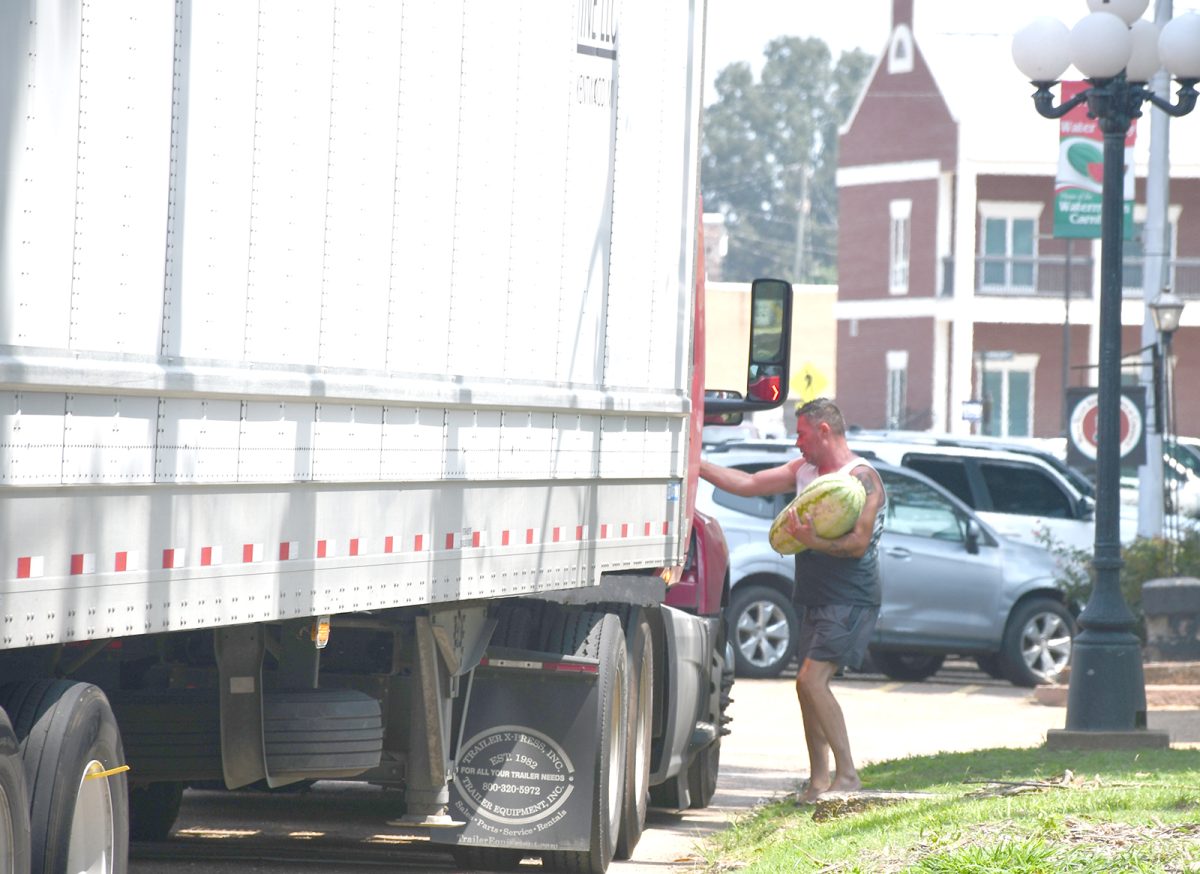
It wasn’t a full truckload, but it may have been the sweetest freight hauled out of Water Valley all weekend. An over-the-road truck driver spotted the Pullens’ watermelon stand on Main Street, pulled over and left with a Jubilee riding shotgun.

DAVE’S WORLD
By David Howell
There was a time when the supply of locally grown watermelons in the county almost dried up. Joe Pullen doesn’t remember exactly when it was, maybe 10 or 15 years ago.
“Nobody had any local melons for that carnival,” Pullen told me.
“I went and bought a load and I said, ‘Ain’t no sense in this.’”
He decided then and there if Water Valley was going to celebrate watermelons, there needed to be Water Valley watermelons available.
This year, Joe Pullen, his brother Willie Pullen and Dalton Rogers did more than their part.
They harvested nearly 600 watermelons in time for the 56th annual Watermelon Carnival, filling two trailers and a pickup before setting up Friday morning beneath the magnolia tree on the south side of Railroad Park. And by late Saturday afternoon, only a handful of melons remained.
And they weren’t the only ones. Ross Burney grew enough melons to supply a carnival himself, and Ross Ingram also had a crop this year. I didn’t get a chance to catch up with Ingram during the carnival, but I hope to tell his story next year.
I enjoyed my visit with Joe Pullen, reminiscing about the days gone by. That was before noon Friday, and sales were already brisk. We watched as an 18-wheeler found enough room by the Chamber office to pull over. The driver picked out a big Jubilee and loaded it into the cab.
“We sold more Friday than we usually do,” Pullen said. “Usually Saturday’s the big day.”
The crop included Crimson Sweet, Jubilee and yellow-meated varieties, with prices ranging from $5 for smaller melons to $15 for some of the largest Jubilees.
This year’s harvest was one of the best the family has raised in years.
The difference, Pullen believes, started with where they planted.
“We planted them on new ground,” he said. “The rain came just right, and we didn’t have any trouble with grass.”
The field had not been farmed in roughly a decade.
“If you plant behind row crops, the weeds will take it over,” he said. “New ground makes a big difference.”
The yellow-meated varieties mature in about 80 days, while the red varieties require closer to 90 days. Timing the planting to match the Watermelon Carnival is part experience and part guesswork.
“You don’t want to plant too early,” Pullen said. “The weather has to work with you.”
Wildlife caused few problems this season.
A live trap caught one raccoon, while an electric fence kept deer away from the patch.
Harvest began Wednesday, just in time for the carnival.
Joe and Willie Pullen still do all of the pulling themselves, handling every melon by hand before it is loaded onto the trailer. The loading is done with the help of children, grandchildren and friends.
“We figured out where we could drive down beside the patch so they don’t have to carry them so far,” Pullen said.
Even so, the work remains demanding.
“I can’t take the heat like I used to,” he admitted.
Dalton Rogers has worked alongside the Pullens for almost a decade. Before that, he grew watermelons with his father-in-law, Bailey Walker.
For Joe and Willie, the tradition stretches back to childhood.
Some of their earliest memories are working alongside longtime grower Peck Vaughn, who picked them up before daylight to peddle watermelons around Grenada.
“He’d pick us up about five o’clock in the morning,” Joe Pullen recalled.
The brothers also remember picking cotton for Peck after school for two cents a pound, earning what seemed like good money at the time.
Today, many of the old railroad workers and truck-patch farmers they grew up around are gone.
“I miss Baxter Jones, David Green and Paul Lindsey McCullar,” Pullen said. “They’re all gone.”
Pullen is optimistic another generation will continue growing melons for future carnivals.
“But it’s a lot of time involved,” he admitted.
By the end of the carnival Saturday, only a few melons remained on their trailers. But Pullen estimated another 600 melons were still waiting in the field for a second harvest. If you see them for sale in the coming days, stop and buy one. You won’t just be getting a delicious watermelon — you’ll be taking home a slice of Water Valley tradition.


