Getting (G)older, Giving Back
PROTECTED CONTENT
If you’re a current subscriber, log in below. If you would like to subscribe, please click the subscribe tab above.
Username and Password Help
Please enter your email and we will send you a password reset link.
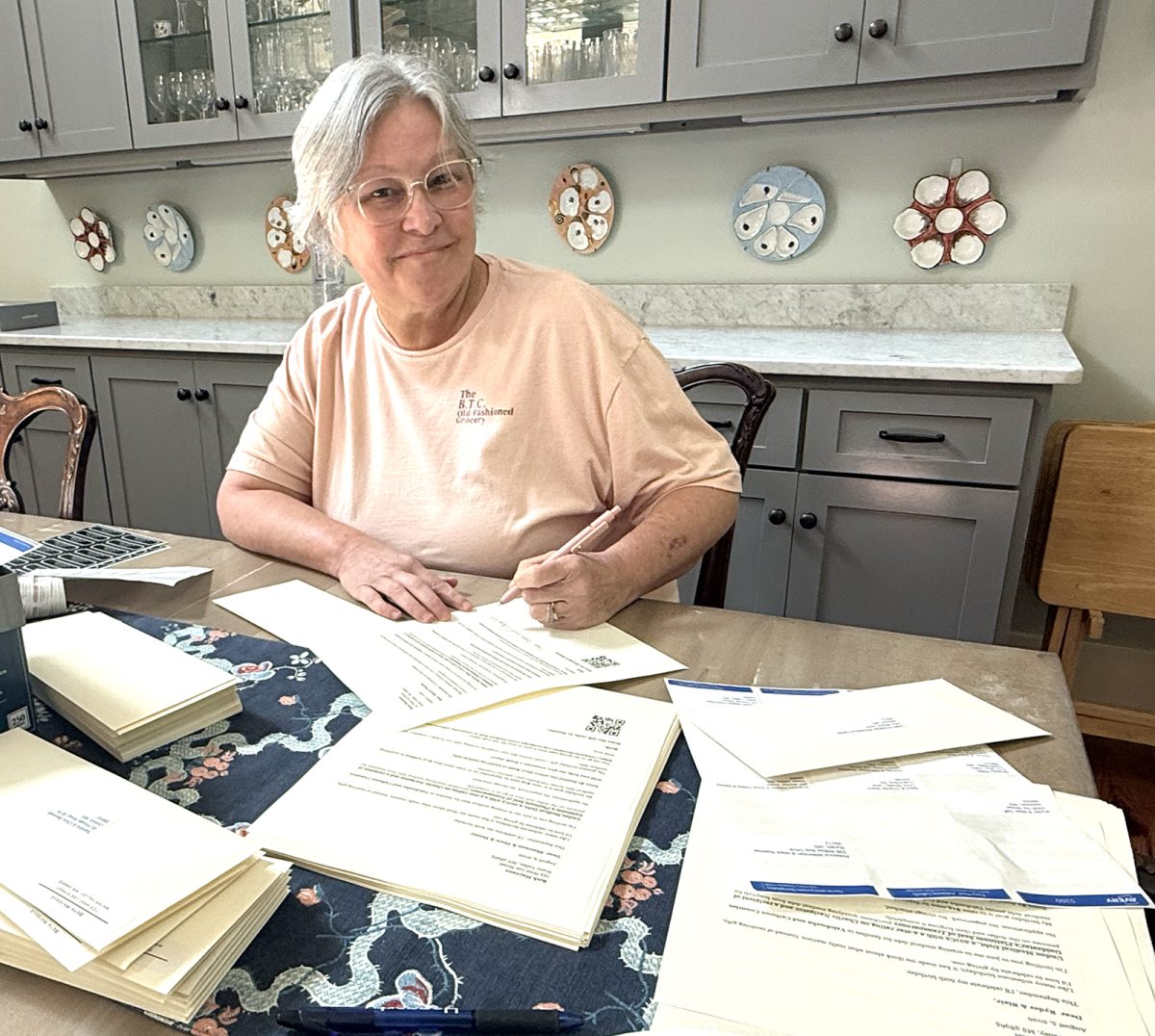
Beth Mayeaux addresses personal letters asking friends and community members to support her “Getting (G)older Giving Back” campaign.
WATER VALLEY — Most people celebrate a milestone birthday by receiving gifts.
Beth Mayeaux hopes her 60th birthday will become a gift for more than 900 people she may never meet.
Instead of presents, the Water Valley resident is asking family, friends and the community to help raise $15,000 to erase approximately $1.4 million in qualifying medical debt for residents of Yalobusha and Calhoun counties.
The campaign, called “Getting (G)older Giving Back,” partners with Undue Medical Debt, a national nonprofit that purchases qualifying medical debt for pennies on the dollar and then abolishes it.
“Turning 60 has made me think about what really matters,” Mayeaux said. “The greatest birthday gift I could receive is knowing that together we have helped relieve an enormous burden for families in our own communities.”
If Mayeaux’s campaign reaches its goal, more than 900 people in Yalobusha and Calhoun counties are expected to have medical debt abolished, according to Marisa Clemente, vice president of philanthropy for Undue Medical Debt.
The $1.4 million represents a snapshot of qualifying medical debt identified in the two counties when the campaign was established. It does not represent every unpaid medical bill in Yalobusha and Calhoun counties, and that amount changes as new debt accumulates.
Mayeaux’s goal is to raise enough money to wipe out all of the debt identified in that snapshot.
The idea grew in part from her own experience.
As a young woman working as a waitress, Mayeaux struggled to pay a medical bill following an emergency room visit. She remembers dealing with a collection agency and the anxiety that came with owing a bill she couldn’t afford.
How It Works
Undue uses donated money to purchase large portfolios of unpaid medical debt from hospitals, physician practices and debt collectors. The nonprofit says every dollar donated abolishes an average of about $100 in medical debt.
“We use fundraised dollars to buy unpaid medical bills in bulk — for often a penny or less on the dollar — for those least able to pay,” Clemente said.
Instead of trying to collect the debt it purchases, Undue eliminates it.
Communities can direct campaigns toward specific geographic areas, which allowed Mayeaux to target Yalobusha and Calhoun counties. She initially planned to focus on Yalobusha County before expanding the campaign to include Calhoun.
People receiving the relief don’t have to apply and may not know their debt has been purchased until a letter arrives in the mail.
“Once Undue acquires the debt, it’s simply erased — no application, no red tape, no strings attached,” Clemente said.
By the time that letter arrives, the debt is already gone.
“Relief is already final by the time the letter arrives,” Clemente said.
Recipients don’t have to respond or take any additional steps. Clemente said any negative credit mark associated with the debt is also removed, and recipients face no tax consequences from the relief.
Not everyone with unpaid medical bills qualifies. Undue generally identifies people whose household income is less than four times the federal poverty level or whose medical debt equals five percent or more of their annual income.
Donors also cannot choose whose bills are eliminated, and Mayeaux won’t know the identities of the people who benefit.
For her, knowing who receives the relief isn’t the point.
“If I had gotten that letter when I was 20, it would have been a game changer,” she said.
Mayeaux’s campaign began Aug. 1 with a goal of raising $15,000 by Sept. 30, around the time of her 60th birthday.
Small donations can have an outsized impact. Based on Undue’s national average, $10 can abolish approximately $1,000 in medical debt, while $100 can potentially eliminate about $10,000.
If the campaign exceeds its $15,000 goal, Mayeaux hopes additional money can be directed toward qualifying medical debt in other Mississippi counties.
“I just hope that six months or a year down the road, someone is opening up a letter,” she said.