Comments Flow In Beat Versus Unit Meeting
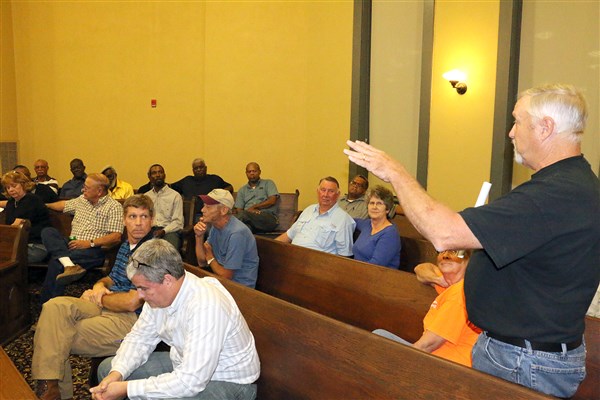
T.G. Baker spoke in favor of switching to the unit system at the Oct. 6 meeting in the Coffeeville courthouse.
Almost 60 people attended the meeting, an audience that included former supervisors, current supervisors, incoming supervisors and others in a largely pro beat system government audience.
Mississippi State Univer-sity Extension Service Govern-mental Training Specialist Sumner Davis moderated the meeting that included comments from T.G. Baker and Frank B. Brooks in support of the unit system and input from Tommy Vaughn and M.H. “Butch” Surrette as the primary speakers in favor of the beat system.
Baker was first to speak following Davis’ opening comments and brief description of the two systems of government.
“Our supervisors have done a tremendous job, this is nothing against them. And the supervisors we have elected, there is no doubt in my mind they are going to do a good job, as administrators operating the business of the county,” Baker said.
Baker first focused on the conditions of the roads in the county, noting roads in the county that have been turned back into gravel. He also said there were bridges in his district that have been condemned.
“It’s not because the supervisors did a poor job, it’s because we don’t have the money,” he added.
“We’ve got things that would make people want to move to this county. But do they want to build a $200,000 house on a gravel road,” Baker added.
Baker also said there is a duplication of equipment, providing what he described as a rough estimate that included five tractor-trailer dump trucks, eight backhoes 20 single-axle dump trucks, 13 farm tractors, five tractors with boom mowers, six motor graders and other equipment, some of which he said was aging.
Baker also pointed out that the road manager works directly for the supervisors, and will be held accountable for tasks performed in the county. Another point by Baker included an increase of efficiency for operating one road district versus five road districts.
“I am not going to tell you your taxes are going to go down. But with the same taxes we got, we could get a better road system,” Baker noted later in the meeting. “Centralized, we could all do a better job with the same money,” he added.
Board of Supervisors President Tommy Vaughn followed Baker to explain the advantages of the beat system.
“I am really proud of the turnout we have tonight, people trying to make this county a better place to live,” Vaughn said in his opening statement.
“You can’t do any better job with bridges, we are spending the money we have now, no matter who is running the show,” Vaughn first said about the condition of the county’s bridges. Later in the meeting five to six bridges in the county were identified as problematic.
Vaughn also responded to Baker’s equipment assessment.
“When you say you can have one road grader that will take care of the county, that is not even close; or one side-cutter. It sounds good, but it just won’t work.”
Vaughn added that his insight come from experience.
Vaughn said he wasn’t totally against the unit system. “I think if we had a larger county, a higher assessed value… it might be exactly what we need,” Vaughn said.
“But we got 12,800 people. A $59 million assessed value,” Vaughn said.
The board president also explained the county is running a modified beat system.
“It is not a unit system,” Vaughn explained, pointing to a centralized purchasing department and checks and balances in every county department.
Vaughn also explained the county’s beats work together sealing roads and clipping the grass on county property at Windsor Foods. He also pointed to strong cooperation between the supervisors on distributing state aid money that flows to the county each term.
As for paying a county administrator and road manager, a figure that was estimated as $100,000 several times during the meeting, Vaughn also responded.
“We keep going back to where is that money coming from. Absolutely where is it coming from?” Vaughn continued.
“We got five supervisors. Y’all elect them. You elect these five supervisors to govern the entire county. You expect them to turn around and appoint two people to do it for them. That’s crazy,” he said.
Vaughn also noted that his support as well as the support from other existing supervisors in favor of the beat system comes as they prepare to step down and no longer have a “horse in the race.” But he said their support comes as they know the beat system is the right thing for the people in the county. He also said at least three guys preparing to take supervisor positions also support the beat system.
Vaughn also noted the description of the incoming supervisors as “businessmen” and explained the tough times the current board faced.
“Do you know what five old, dumb country boys did for this county for the last 12 to 15 years. We carried you through the worst economic downturn the United States of America has had since the Great Depression. Without raising your taxes,” Vaughn said.
Surrette followed Vaughn at the podium, explaining that he had served for 20 years, and pointed to several former supervisors he served with attending the meeting.
“In all my years serving, I never saw a group of men that were more concerned about the well-being of this county,” Surrette said, pointing to the budget as one example. Among former supervisors attending the meeting were Henry Dean Gray, Danny Barton and Freddie Winters.
Vaughn also said a county administrator hired to work in Yalobusha would not have the dedication of elected supervisors.
“Working on this budget every year was a gruesome task. But there is one thing I can tell you for sure. They don’t have worry about half-a-million dollars because it is already going to be spent when we hire a county administrator and road manager in one term,” Surrette added.
Input From McMinn
Multiple participants in the meeting then asked questions on varying issues.
Baker questioned District 3 Supervisor Lee McMinn if the District 3 motor grader is working and sufficiently maintaining gravel roads in his district.
McMinn replied that every road in his district had been graded before addressing the crowd.
“Tommy (Vaughn) alluded to the fact that one or two beats in our county didn’t have the resources that the others might have and that’s true. I’m one of the two that struggle all of the time with the need for money,” McMinn said. McMinn said his resources limited his road maintenance.
“I am operating on a bare budget I have cut back everything I know to cut back. I didn’t take a county truck. I don’t take reimbursements for my travel,” he told the group.
McMinn also acknowledged he operated old equipment, both trucks and a 1962-model road grader.
“I don’t know what the answer is. If the unit system were the cure for what ails me, which is lack of money, then I probably would have been one of the first ones to speak for it,” McMinn added. He also said he has visited other counties to see how the unit system worked.
Another question from the audience brought up the disparity of the funds each road beat has in reserve.
“I can answer that question. All supervisors get the same amount of money,” Vaughn answered, adding that McMinn inherited a district from his predecessor that was flat broke.
“Some people have been a little better stewards of the money. There are a couple of beats that needs some money. And that’s the only thing we need in this county, for the two beats to get their money back,” Vaughn said, referring to District 3 and 4.
“We have $2.171 still owed on the courthouse debt, we have $1.9 million on the hospital debt. We have $3.1 million on the jail debt,” Brooks noted.
“Tommy has gone on record several times to say that will not increase our taxes at all… there is never going to be a tax increase because of the jail,” Brooks said.
Vaughn replied, first noting that a headline in the Herald back in March reported taxes were going to go up because of the jail.
“Anybody with any sense knows it is going to take more money to run a jail,” Vaughn said, adding that people didn’t know that a hospital debt paid by the county would be shifted to the jail debt, plus money utilized from the 911 fund to pay dispatchers that was previously paid to the City of Water Valley would be shifted to the jail budget for dispatching.
“There was no increase,” Vaughn added, referring to the tax rate for Fiscal Year 2016.
“Now,” Brooks answered, referring to the future jail expense.
Brooks then noted the cost to fund the two new jobs would be around $100,000, explaining that many counties utilize the Chancery Clerk as county administrator for additional pay equivalent to the salary of a supervisor.
Brooks also noted there are more checks and balances outlined for the unit system, but Davis explained the beat system can also implement similar checks and balances. Davis also said both systems use a centralized purchasing office.
But Brooks said he was questioning the documentation of the use of materials received after they had been purchased, including fuel consumption at county barns.
“This is a business,” Brooks added.
Brooks also questioned the cash on hand at the start of the fiscal year on October 1, a number he referenced at $2.7 million, according to a published report in the North Mississippi Herald.
Vaughn said the number was under $2 million in reserve balance, but the reserve was used for county operations from the start of the county’s fiscal year in October to January, which is when the tax money starts to flow in at beginning of the year.
“Thirteen years ago the county had to borrow money to close out the year,” Vaughn added.
“I only brought this up to say there are adequate finances available,” Brooks said. “Let’s don’t worry about where the funds are going to come from. We already have them. It is how they are utilized,” Brooks explained, pointing to the county’s aging equipment.
“Are they safe?” Brooks said, referencing 20 year-old gravel trucks in use that were purchased used with over a million miles on the odometer. “The county is not going out of business. Why are we not planning for the future? Why are we not buying or leasing equipment occasionally? What you are paying your men is below the poverty level. It is time to start thinking about the future… I would be ashamed if I could not pay my people where they could afford to live,” Brooks continued. “It’s time to start thinking broadly. Yalobusha County. Not Coffeeville. Not Water Valley. Not Beat 5 versus Beat 2… It’s time that we start unifying the county rather than dividing it.”
New School(s) On The Horizon?
“We have spent 12 years planning for the future,” Vaughn countered, explaining that supervisors have kept the debt to a minimum. Vaughn said the intent has been to keep the county’s bonded indebtedness down with plans to build a high school in the next 10 years.
“You can bet it is coming,” Vaughn said about a new school.
“Or we going to build two high schools. You said a high school. What are we going to do, Tommy? That is my point. We are divided. We reworked two courthouses, we are still paying for them,” Brooks countered.
“Anybody that thinks we didn’t need to do something with these two courthouses, tear them down, burn them down, fix them – is crazy,” Vaughn said, referring to the condition of the courthouses before the renovations.
“I would agree. But do we need two courthouses in a county with 12,000 people,” Brooks asked.
District 1 Supervisor candidate Cayce Washington then spoke, first acknowledging that he had to win the November election before taking office.
Washington said he had traveled to Montgomery County with McMinn to see how that county operates under the unit system. He said the road manager’s position had been contentious in that county, explaining he is pulled from multiple directions from different supervisors. He also said the equipment in Montgomery County wasn’t much better than Yalobusha’s equipment.
“On the cover it sounds really good,” Washington said about the unit system.
“But at the end of the day, we have the same amount of roads. We have five supervisors. If you don’t like the job that man is doing, you have the opportunity to vote that man out,” he added.
Another topic surfaced was the purchase of county trucks for supervisors, as several in the audience pointed out the cost of the new trucks.
“Any supervisor that doesn’t purchase a new truck should be fired,” Vaughn answered as the meeting turned contentious for several minutes. Vaughn said the trucks are used by the supervisor, then passed down to the road workers and are in use for several hundred thousand miles.
Other topics discussed included the amount of time a supervisor spends on the job and other specific duties outlined in each form of government before the meeting came to a close.