Meek Replays ‘Battle Of Ole Miss’ At YHS Meeting
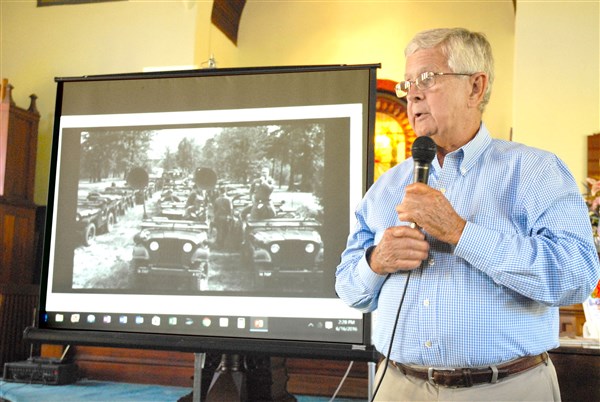
Ed Meek, retired assistant vice chancellor for public relations and marketing and associate professor of journalism at the University of Mississippi, spoke to the Yalobusha Historical Society in Coffeeville during their June meeting. His topic was the 1962 riot, which he illustrated with photographs he took as a young staff writer for the school. – Photo by Jack Gurner
Meek Replays ‘Battle Of Ole Miss’ At YHS Meeting
By Jack Gurner
Herald Contributor
COFFEEVILLE – A firsthand account of what is known as the “Battle of Ole Miss” was the topic of the June meeting of the Yalobusha Historical Society (YHS).
Ed Meek, retired assistant vice chancellor for public relations and marketing and associate professor of journalism at the University of Mississippi, had just become a staff writer for the school in 1962. In October, just a short time after Meek’s hiring, James Meredith came to the university to enroll as a student.
Meek, who was introduced by YHS Program Chairman Mike Worsham, told the YHS members and guests about the events surrounding the enrollment and presented photographs from his book, Riot: Witness To Anger And Change.
Worsham described Meek as a native of Charleston who attended school in Oakland. “The Ole Miss School of Journalism has his name on it,” said Worsham, describing the Meek School of Journalism and New Media. The school’s journalism department became the Meek School in 2009 after a $5.3 million gift from Meek and his wife, Becky.
Meek described his early years in Oakland and said he remembered when Hwy. 32 was gravel. “I feel very privileged to have grown up in Oakland and then Charleston,” he said. “Small towns are just special places.”
The former vice-chancellor, who eventually earned his doctorate in communications, said that he hadn’t even considered college during his high school years. But, at the end of his senior year he wrote a term paper that was the best in the class, according to the teacher who urged him to go to college.
To Meek and others in his class, college meant Mississippi State College in Starkville. But, his family didn’t have the money. So, the summer after graduating from high school, he and six other boys worked as fire fighters for the Forest Service in Montana.
Although he only earned $1.25 an hour, that was still “a lot of money in 1958,” Meek said. But, because of overtime and working over 12 hours in a day, he ended up with $7200 at the end of the summer.
So, that fall he was off to Mississippi State. He tells of arriving on campus and being asked what he was doing there. “I’m going to major in journalism,” he said.
“We ain’t got none of that,” Meek quoted the person who asked. “You need to be at Ole Miss.”
While earning his degree at the University of Mississippi, Meek worked with “best buddy” Larry Speakes, who became White House Press Secretary under President Ronald Reagan. As the events of October 1962 began to unfold, Meek and Speakes were covering the story before other news services became aware that the enrollment was about to take place.
Meek said that he, Speakes and the students who had assembled in front of the Lyceum had no idea of the seriousness of the situation. “It was a pep rally. It was the best time. We were hotty-toddyian and carrying on,” he noted. “It was all students and we were having a blast.”
As dark approached, Meek said that he heard a noise.
“Woomp…woomp…woomp…woomp. Someone threw a bottle and hit a marshall upside the head and knocked him down.”
Meek said that when he turned around and looked at the crowd, what had been a gathering of students had turned into a “group of people from everywhere.”
What had happened, according to Meek, is Jackson television WLBT had called for Mississippians to go to Oxford and save Ole Miss. “In effect to do battle with the federal government. And, a lot of people did. A lot of people showed up.”
Within minutes things exploded, Meek added. Snipers were on top of buildings and bullets were flying everywhere, he said. There was so much teargas that the federal marshals ran out of the grenade-style canisters and started firing larger canisters from shoulder weapons.
“There were three people killed that night,” he said. Meek believes that Kennedy’s deployment of 100,000 troops of the 101st Airborne probably saved the day, although at the time he thought it was a crazy move. “They took over the campus and the town.”
“All the good-ol’ boys who had come to save the city were arrested -they were ultimately all let go. But, they were incarcerated briefly, as was I. They rounded me up,” said Meek.
“I am convinced if Kennedy had not sent in the 101st Airborne there would have been a real tragedy,” he continued. “Everyone came with weapons.”
Meek also showed photos of Meredith sitting in a classroom, images that he had kept hidden for 40 years. “(President) Kennedy had made a big deal of not allowing anyone to interrupt or photograph the academic process,” he said, adding that he had to get pictures of Meredith in the classroom because of the importance of the event.
Some 360 reporters, photographers and TV people were registered by the University staff to cover the Meredith story, Meek said.
In the end, on October 1, Meredith became the first African-American student to be enrolled at the University of Mississippi. Meredith graduated with a degree in political science in August of 1963. At that time he was still being guarded.
Visitors and YHS members attending the meeting included: Debby Hughes, Sonny Stewart, Dave Hovey, Pat Brooks, Mike Worsham, Jack Gurner, Betty Stewart, Sonny Stewart, Donna Land, Joy Herron, Julia Fernandez, Opal Wright, Joy Tippit, Gary Tippit, Kay F. Roddick, Kathyrn French, Grady White, Susan Haile Williams, Herb Hayward, Carl H. Vick, Frank Fernandez Jr., Rachel Bell, Tina Lutz, Joan Bailey, Fae Ross Maroon, Sarah H. Wlliams, Tammy Beshears, Margaret D. Ross, Jean Bailey Kirk, Alma Brandon, Ronnie Coleman, Diane Coleman, Mary Lucia Holloway, Tom Cox, J. L. Crawford, Margie Crawford, Michael Ayers, James Person, Bettie Litten, Lawrence Litten, Buster Jackson and Kay McCulley.