Planner Outlines Steps To Implement Land Regs
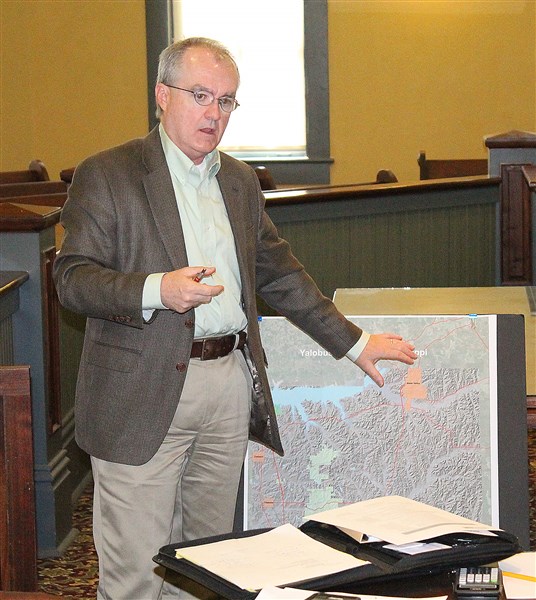
Planner Bob Barber outlined the steps ahead to implement a long-term comprehensive plan for Yalobusha County in a supervisor meeting last Thursday
By David Howell
Editor
COFFEEVILLE – The four-step process to implement a long-range comprehensive plan for the county that will likely include land use regulations and zoning was outlined by planner Bob Barber at last Thursday’s Board of Supervisor meeting at the Coffeeville courthouse.
Barber is employed as a planner with Orion Planning+Design, the company hired last month in a 4-1 vote by supervisors to implement a plan to help guide future growth in the county. At last week’s meeting, Barber stressed one goal of the land use plan would be to preserve the quality of life in Yalobusha County without putting a burden on the residents. The implementation of the plan is expected to take six to eight months.
Barber opened comments explaining that the project is currently in the discovery phase, which includes studying and gathering information. This phase will utilize existing information, including mapping available for the county.
Phase two will be the public engagement process, with meetings scheduled in Water Valley and Coffeeville for public input. Barber said the meetings could be scheduled in July or early August.
“Once we get that information, we will begin to create the plan,” Barber told supervisors about the third phase of the project.
“The final phase will be the implementation. We have not prejudged the implementation at all,” Barber added.
“We will be looking for the appropriate solutions to the issues that Yalobusha County faces,” Barber told county officials.
Barber also explained that he will be looking at current building practices that are working in the county and what are the “not-so-good ones.”
“What are the issues we are trying to solve?” Barber continued, as he stressed that the plan will be unique to the county.
One abnormality Barber mentioned was the huge swath of federal-owned land that includes Holly Springs National Forest and U.S. Corps of Engineer land around Enid and Grenada lakes.
“This is a massive influence in Yalobusha County,” Barber explained make-up of the county that will impact the long-range plan.
“We also know on the front end that wastewater is a big deal,” Barber added about his early observations on the plan before opening the floor for questions from county officials.
Input From Supervisors
“I want protection for the folks who go out and do the right thing and make a big investment in their property, either with a home, pasture or farm,” District 3 Supervisor Lee McMinn explained. “I want protection for them, that what ever happens next to them doesn’t devalue their property. That is what I want.”
“The thing is, there are 3,700 homesteads in this county. Almost 56 percent of them are over the age of 65. A lot of people are doing the best they can,” explained District 5 Supervisor Gaylon Gray, who cast the lone vote against hiring Orion Planning+Design.
“We are a poor county,” Gray continued, citing his biggest concern is how to pay for the plan, along with implementing and enforcing it. “And hurting somebody who has an acre and live on a fixed income,” he added about his objection to adding regulations in the county.
Gray added that if the county was growing like Lafayette, he would not be against the plan.
“We don’t have anything to be against yet,” Barber said, who added that basic living conditions are not costly. “It doesn’t cost a thing to be clean, to be not junky. “
“If you look at it on the other hand, it’s a tremendous cost to your economic development prospects and quality of life to allow the environment to degrade,” Barber added. “It’s an economic cost for everybody.”
“I don’t think it is our intent to put an undue burden on anybody,” Board President Cayce Washington added. “To preserve is the key word. The thing that makes Yalobusha County so great is that combination of everything that makes it what it is,” Washington continued. “To preserve that and to maintain that is our goal.”
Immediate Questions
The discussion then shifted to how to handle potential development that could surface during the next six to eight months before the plan is adopted, specifically development that could be adverse to the long-range goals identified in the new county plan.
One specific example cited in last week’s meeting was the proposed mobile home park development on the south end of Water Valley. In January, the Herald reported that four Oxford men – Hayden Alexander, Josh Matthews, Turner Barnes and Dr. Andrew Ross –purchased an existing mobile home park on Gore Circle in Water Valley. The men also purchased adjoining property in the county and confirmed long-range plans to expand the trailer park in the county where, outside of flood plain regulations, there are no county regulations for property development.
Washington said he had been contacted by one of the men questioning the impact of the proposed long-range plan on developing the property.
“I told them, since we are moving forward with implementing a plan, you are going to have to come see us before you do any development,” Washington explained,
McMinn also noted in last Thursday’s meeting that there are several other potential developers looking at property on the north end of the county that could also be affected by the pending plan.
Both McMinn and Washington then noted that it is important for anyone considering purchasing property for development or developing property they already own to be aware that land use regulations will likely be adopted.
The topic came to a close following a brief discussion on the possibility of issuing temporary restrictions for development in the county while work continues on the county plan. The matter will be back on the agenda at the June 5 meeting.