
Stewardship Yalobusha: Planning For The Future

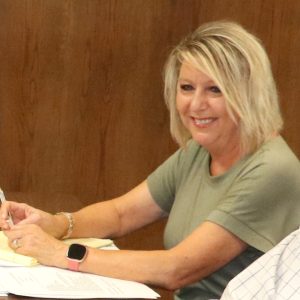
Mississippi State’s Stennis Institute of Government representative Joe Fratesi provided a basic overview of community planning during a public meeting held last Tuesday at the Water Valley courthouse. An estimated 40 people attended the meeting in anticipation of the implementation of a long-range comprehensive plan that will guide future growth and development in the county. Officials are calling the plan Stewardship Yalobusha. – Photo by David Howell
By David Howell
Editor
WATER VALLEY – Officials from Mississippi State University’s Stennis Institute of Government provided a basic overview of community planning during a visit to Water Valley last Tuesday.
Stennis officials Joe Fratesi and Jeremy Murdock shared time at the podium during the hour-long public meeting following an introduction from Bob Barber, head of Orion Planning+ Design, the Hernando company hired by supervisors back in April to help chart the future of the county. Barber opened the meeting explaining that the Board of Supervisors initiated a planning process to take a systematic look at the future of the county. The county plan will be called Stewardship Yalobusha.
“It’s a planning process, it is a standard process that occurs in many places all over the country,” Barber explained. Next he outlined the four-steps involved in making the plan a reality – discovery, goal setting/community engagement, crafting the plan and implementing it.
Barber added that the second step of the process gets underway next week with three public meetings scheduled across the county – Coffeeville courthouse on Sept. 11, Water Valley courthouse on Sept. 12 and Oakland Town Hall on Sept. 14, all starting at 7 p.m.
“We want folks to come and tell us what they love about Yalobusha County and what are their cares and concerns,” Barber explained. “Out of that will come goals and objections to form the target that the plan will address.”
Barber also cautioned that it is too early to speculate on the third and fourth steps of the process.
“I don’t know what they are going to be. We haven’t heard from the citizens of Yalobusha County, we don’t know what it is we are trying to achieve,” Barber explained. “What comes out on the back end will target what people in Yalobusha County will want for stewardship.”
Stennis Input
“Communities can be shaped by choice or shaped by chance”
Following the introduction and overview, Fratesi identified common problems many communities face including population loss, haphazard growth in commercial corridors or new growth encroaching on rural areas.
Fratesi also answered the most common question about the issue – why should we care about planning or development regulations, using a house as a comparison where specific rooms are used for certain things.
“The kitchen is used for cooking the bedroom is used for sleeping. We are keen to this,” he explained. “Would we have a grill in our master bedroom or a toilet in our dining room?” he asked. “It would be expensive to install plumbing for a toilet in a dining room, where it didn’t belong anyway. This idea is similar in counties. There are places that are better suited for certain things,” he continued with the comparison.
“If we understand this for our house and things we do every day, why in our cities, counties and regions, are we allowing to let the chips just fall where they may… that is essentially what we are doing. We are basically saying, whatever happens out there is what we are going to take,” Fratesi continued.
He also cautioned that there is not a one-size-fits-all-approach to implementing a plan.
“That goes for cities or counties. What is right for Water Valley may not be the same thing for Coffeeville,” Fratesi stressed.
Tools For Planning
Murdock spoke next, again speaking in general terms about planning. He identified tools used by cities and counties to help chart the future.
The tools include the plan, which is a comprehensive look at the long-term vision for a county or city; ordinances, which are rules and regulations that help implement that vision; and building codes, which are standards for construction.
“A comprehensive plan usually looks 20 years ahead,” Murdock continued, explaining that this is a technical document that looks at infrastructure, roadways, economic development and all of the different pieces it takes to run a county or city.
Citing specific examples that could be addressed in a plan for Yalobusha, Murdock pointed to area of the county closest to Oxford where growth could come.
“If that area starts to grow at some point, we can plan for that. Some rural roads right now, 20 years from now may look entirely different,” Murdock explained.
Ordinances, Murdock continued, are rules and regulations to implement the vision in the plan and can include land use regulations, subdivision requirements or zoning.
Murdock closed with identifying key issues in order to be successful.
• Elected officials must have political will to enforce the rules
• Citizens must understand why
• Staff must understand intent of rules
• Developers must understand expectations.
“Everybody is going to complain, developers are going to complain, citizens are going to complain. We are trying to mitigate that,” Murdock explained, pointing to educating the public on the front end about challenges that will surface.
“Change is hard, be prepared for that, especially for elected officials. Because they hear from all ends of the spectrum,” Murdock continued.
Supervisor
Input
Board President Cayce Washington provided final comments during the meeting, first explaining that zoning and ordinances should not be confused with too much government oversight.
“This is not to tell you how to cut your grass, we want a future vision for growth,” Washington explained. “We have a lot of assets in our federal properties. We have the lakes with some of the best crappie fishing in the entire southeast. We want to preserve that and we want to take care of that,” the supervisor continued.
Washington also stressed the importance of being proactive and planning for the future of the entire county.
“We are not trying to tell people how to live, we are just trying to improve our county to welcome the next generation behind us and to welcome those that want to come here because of the beauty of what we have . We don’t want to take away from the guy who has the family farm. We want to preserve it,” Washington continued.
Washington also urged the public to attend next week’s meetings in Water Valley, Coffeeville and Oakland.
“This is not the supervisors’ plan, this is the communities’ plan. I want to convey that, if nothing else is communicated tonight, this is the taxpayer’s plan for our future and that is what this is about,” Washington said in closing.

This article is from 2017. I would like an update please.