Supervisors Field More Input For County Plan

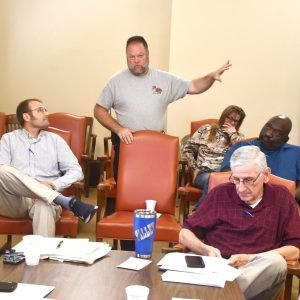
Among questions fielded at last Thursday’s public meeting for input on a proposed county plan to guide future conservation and development was potential agriculture exemptions. Catherine McLeod (standing) asked for more information about the ag exemptions, which include no regulation for basic farm operations under the current proposal. The moderator for the meeting, Bob Barber, explained that state law already exempts most agriculture activities. But Barber also explained that the county plan could address intensive feeding operations such as pig farms. – Photo by David Howell
By David Howell
Editor
WATER VALLEY – Public participation increased in the second of three public meetings scheduled this month for input on a proposed county plan to help guide future conservation and development in the county. Over 30 people attended the 90-minute meeting last Thursday at the Water Valley courthouse.
The first meeting was held on July 10 in Coffeeville and only one person attended who was not a member of the press or an elected official. The third meeting is scheduled Thursday, July 26, at 6 p.m. in Oakland City Hall and will be the final opportunity for input before the plan is finalized.
Supervisors hired Orion Planning and Development in April, 2017, to oversee the efforts which have included an earlier round of public meetings and input from county officials. Orion planner Bob Barber (FAICP) moderated the meetings, which include an overview of the year-long effort to analyze history, trends and potential growth in the county – data that will help determine likely steps to define the long-range plan.
Also discussed in the public meetings are implementation options, or the range of tools available to supervisors for the enforcement portion of the plan. Barber noted there are three tiers of regulation options, starting with basic land development standards to ensure adequate lot sizes for septic systems, adequate access to public roads, especially for school buses and emergency vehicles, as well as standards for private roads and drives. The second tier, enhanced land standards, add another layer of regulations with standards to regulate manufactured home parks, recreational vehicle parks, gravel mining, salvage yards, multi-family housing developments and auto repair shops.
The third tier is stricter land use controls, or zoning, an option Barber is not recommending for the county.
Enforcement
“I think this is a good thing… it needed to be done 20 years ago,” Jerry Wilbourn noted at the meeting before questioning how the county will enforce the regulations, a question that surfaced multiple times in the meeting.
Board President Cayce Washington cited work in recent years by all five supervisors to crack down on delinquent garbage accounts as an example for enforcement.
“It’s the only thing we have to go by, in enforcement, and your five supervisors are doing it,” Washington explained, pointing to their duties to step up collection for past due garbage bills that could also be extended to include enforcement with the new land standard regulations. Washington also said the county’s environmental officer or 911 officer could also assist with the new regulations.
“I don’t know if that would happen, that would be the decision of the board,” Washington added about the options.
“It’s a great question, we want it to work, so what you are asking is very important, the execution of it is critical,” Barber added. “There are various ways we can do it, we haven’t fully fleshed that out yet. We are just trying to make sure we are headed in the right direction,” he continued.
Citing state law, Barber also explained that the county’s first task is to adopt the plan.
“You have to have a plan first, the board needs to adopt the ideal and the idea first,” Barber continued. He explained that once the plan is adopted, work will begin to write the nitty-gritty details for implementation of the rules.
“Before we get into too much detail with enforcement, we have to make sure we have the plan done,” Barber reiterated. “But the second piece is critical, the implementation and enforcement,” he added as details about the steps ahead were defined.
After Thursday’s public hearing in Oakland, supervisors plan to have work sessions to finalize details of the plan. Barber added that 70 percent of the plan is written, as the remainder will be completed following this latest round of public input.