City Seeks To Expand Proposed Micro Solar Farm
PROTECTED CONTENT
If you’re a current subscriber, log in below. If you would like to subscribe, please click the subscribe tab above.
Username and Password Help
Please enter your email and we will send you a password reset link.

Yalobusha County Economic Development District CEO Kagan Coughlin traveled to the White House last month as community leaders from across the nation gathered to share ideas, challenges and successes during the last two years in connection with the USDA’s Rural Partnership Network.
WATER VALLEY – The proposed construction of a multi-million dollar micro solar farm in the city continues to gain momentum. Reporting to county supervisors during the June 3 meeting, Yalobusha County Economic Development District CEO Kagan Coughlin said the project could be expanded if the city can purchase approximately three acres owned by the county that is adjacent to the proposed site.
Last month, city officials inked a deal with Renewvia Energy to build the solar farm on city property located on Hwy. 32, across from Solero Technologies.
The development would be comprised of solar panels that harness energy from the sun and transforming it into energy that would be transmitted to the electric grid. The solar panels will generate approximately 15 percent of the city’s electricity consumption and the terms of the agreement would allow the city to purchase power generated at the solar farm at a lower rate than electricity purchased from Tennessee Valley Authority (TVA). Mayor
Tommy Reynolds reported the city will save $87,000 annually during the 30-year contract.
“If the city is allowed to expand the project with three additional acres, it will save the city an additional $30,000 annually,” Coughlin told supervisors.
The county property is located behind the Yalobusha County Detention Center and adjacent to city-owned property where the proposed solar site is located. The county purchased a total of five acres in 2014 to build the new jail and sheriff’s department at a cost of $10,000 per acre. The jail and sheriff’s department utilizes approximately two acres of the tract, and the remaining three acres are in row crop.
“My initial thought, the bare minimum is what we have in it,” Board President Cayce Washington recommended about a possible price for the three acres. “And then we start from there to see what the city is thinking. We can’t sell it at a loss.”
“Should we sell it and be done with it?” District 5 Supervisor Gaylon Gray asked.
“That is the easiest way to do it,” Board Attorney Shannon Crow answered.
The city applied through the USDA’s PACE (Powering Affordable Clean Energy) program for funding that will incentivize the four to five million dollar cost of the solar installation.
The PACE program allows small, rural communities to parter with a solar company to build solar farms.
Coughlin also said that it is essential for construction to start as soon as possible on the project.
“We have some federal risks with the election coming, not only for this project but for funding for solar energy,” he told supervisors. “This project is benefiting from a USDA grant, they are going to offset some of the cost of this project. Come next spring, I don’t think anybody knows what will be going on. We would like to have this thing in the ground,” Coughlin said.
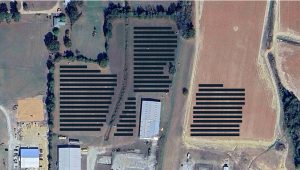
The proposed site for the micro solar farm is just north of Hwy. 32, on the opposite side of the highway from Solero Technologies. The horizontal black lines represent the locations of the solar panels. The lines on the right side of the map are on property currently owned by Yalobusha County behind the county jail. The lines in the center and left side of the map are on city-owned property just north of Allied Industries.
Coughlin also provided an update on other potential projects in the county including:
• The county is soliciting bids from engineering firms to develop a county-wide road safety plan. The U.S. Department of Transportation will fund 80 percent of the cost, and the county will provide $30,000 in matching funds. Coughlin explained that the purpose of the plan is to identify ways to lower fatality rates on all roads in the county.
“I imagine they are going to come back with a recommendation to four-lane Highway 7,” Coughlin explained.
He also explained that options identified in the road safety plan can be funded by the U.S. Department of Transportation’s Safe Streets and Roads (SS4A) Grant Program.
“You don’t get to ask SS4A for money until it is officially in a road safety plan that they helped design,” Coughlin added.
• Reported officials with Tennessee Valley Authority (TVA) conducted at site visit on June 4 at the W.C. Gardiner Industrial Park in Water Valley. TVA officials traveled to the site in a helicopter, landing at the industrial park. The visit comes after the county submitted an application for a $500,000 grant from TVA. If approved the funding would be allocated for site preparation along a new road that will be constructed access the industrial park from Hwy. 7.
Coughlin previously reported that a funding package totaling $1.15 million has been secured to build a new access road into the industrial park. The new third-of-a-mile access road will come off of Hwy. 7 and connect with the existing road in the industrial park.
“If this $500,000 grant is approved, it will allow us to do extra site preparation around that new access road,” Coughlin told supervisors.
• County officials are in preliminary discussions with a business person interested in building a small poultry processing operation on county-owned property located on Hwy. 51, north of Oakland near Ajimomoto Foods. Coughlin reported that District Four Supervisor Eddie Harris traveled to the property with the business person and engineers.
“She is looking for three or four acres to put in a micro processor that could employee 10 to 15 workers,” Coughlin added.
He also noted that the county property could be feasible for the small processing plant as the county already has a well that provides water for Ajimomoto Foods, and a lagoon for treating wastewater. Coughlin said engineers are working on estimates for water usage and wastewater requirements.
“The county will have to decide what to sell the three or four acres for,” Coughlin noted about determining a price if the project moves forward.
• A developer will visit the site at the long-abandoned Oakland school that includes classrooms, a gym and surrounding 12 acres.
The prospect of selling the old school building and adjacent acreage follows more than a year of conversation among county officials to address housing shortages in the county.
The plan is to sell the county-owned property to a developer to refurbish the old school building for use as apartment units.
Coughlin asked supervisors to determine a price point to sell the property.
“It will be really helpful to have a ballpark number as well as what the county expects,” Coughlin told supervisors.
He also said stipulation could be added to the potential sale, including a requirement for the minimum investment for the property development, what it will be used for and a timeline for construction.
“It has an opportunity to become housing, which the county desperately needs,” Coughlin added. “Housing units would also create a tax revenue for the county,” he said.
Coughlin’s request for a price generated discussion around the table. One option discussed by supervisors was putting the property up for bid with a minimum price as a starting point.
The property is located in Eddie Harris’ district and he came up with a potential price.
“I am thinking $300,000,” Harris said. “Throw that price out there and see what happens.”
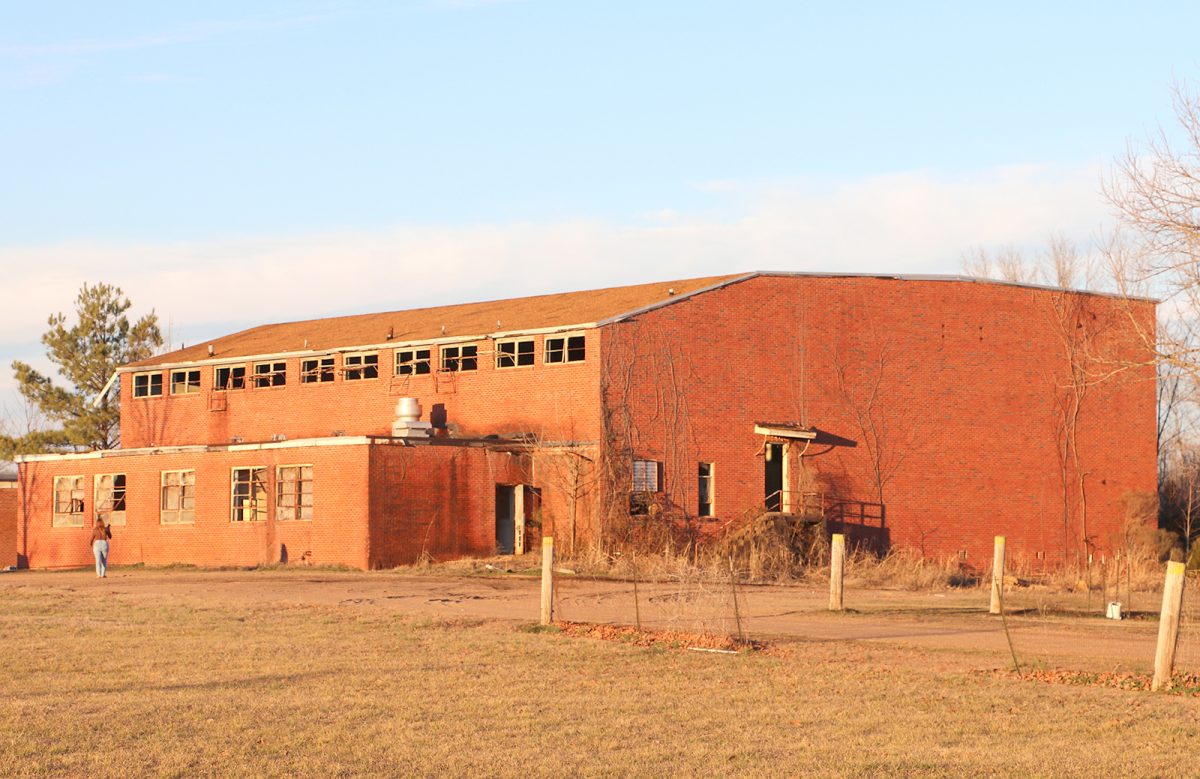
The gym is located on the south end of the old Oakland school.