Commission Approves Work-Order Tracking, Accelerates Final Meter Upgrades
PROTECTED CONTENT
If you’re a current subscriber, log in below. If you would like to subscribe, please click the subscribe tab above.
Username and Password Help
Please enter your email and we will send you a password reset link.
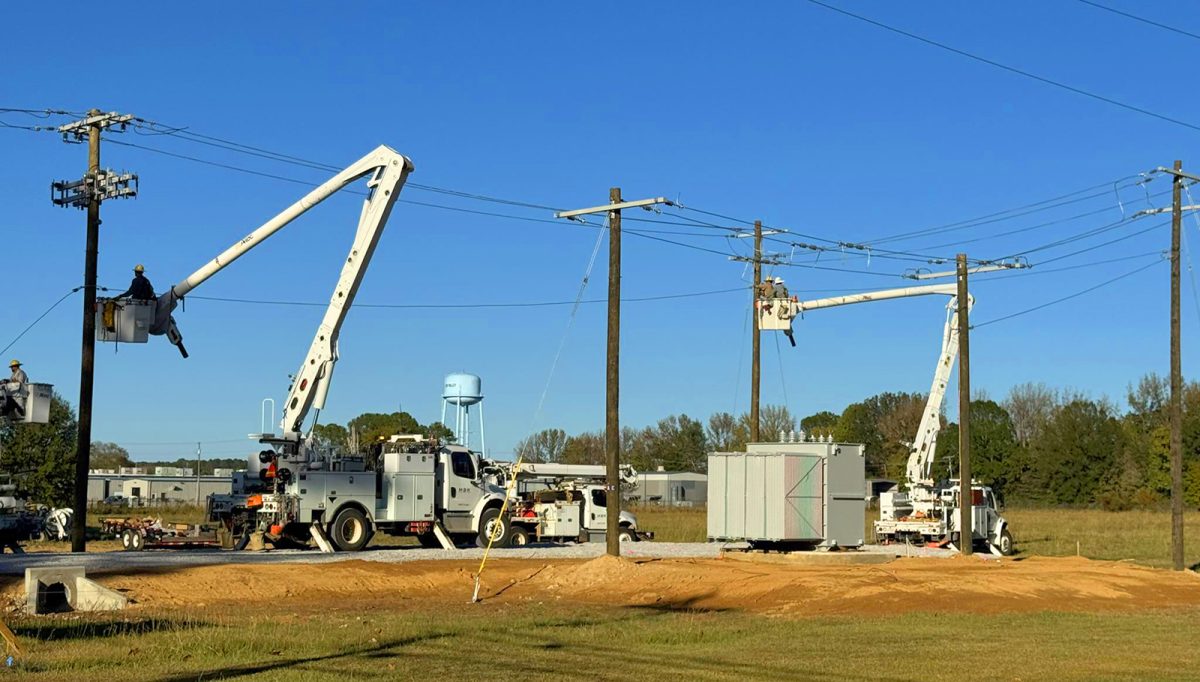
Crews complete final connection work on new transformers installed for the city’s emergency backup power system. The units, located near Solero Technologies and Yalobusha General Hospital, can supply electricity to the entire city during a major outage.
WATER VALLEY — The Water Valley Electric Commission continued its push to modernize the city’s utility system during a meeting Thursday night, approving an electronic work-order tracking system, authorizing bids to finish replacing the last outdated smart meters, and setting new standards for customer service and staff training.
The latest modernization comes as commissioners voted to add a new feature to the city’s HomeTown Grid software — an electronic system that logs every customer complaint or service request.
“Right now the department has been using a spiral notebook,” Chairman Brandon Presley said. “This will modernize that complaint system so we can properly track the issues customers are facing, whether it’s a security light being out or another problem that requires staff to go out and work. We can assure ourselves that customer complaints are being handled in a timely manner.”
The system will cost about $50 a month and will allow the commission to see how many complaints were received each month and how long they took to resolve. Requests will still be made by phone or in person, but every intake will now be entered and tracked electronically.
The HomeTown Grid service, approved by the commission in September, already serves as the backbone for the city’s electric outage management. It works automatically through smart meters that send alerts when service is interrupted. Customers can also call or text the new 833-262-3985 number to report an outage or receive updates, and outage reports appear instantly on a live map at hometowngrid.com/watervalley, which shows the extent of service interruptions across the city. Presley reported that approximately 80 percent of Water Valley’s residential customers already have updated smart meters that automatically report outages, with the remaining 20 percent to be upgraded in the coming months.
Presley called HomeTown Grid “a game-changer for a small utility company,” adding that it “unlocks every modern tool for an electric department — and more importantly, for the customers.”
The commission also voted to seek quotes or bids from third-party contractors to finish converting the remaining 20 percent of outdated smart meters to new digital meters. “A third-party contractor could complete this in probably less than 10 days. It may be the best value for the taxpayer dollar,” Presley said.
He explained that completing the conversion will improve meter accuracy, reduce line loss, and allow HomeTown Grid to detect outages automatically across the entire grid. “Right now, 20 percent of our customers we still don’t know if their power is out until they call. This will completely change that and give us full entry into the 21st century.”
Commissioners also approved a $6,170 contract with Utility Management Services to test transformers installed under the Delta Regional Authority grant project. Backup transformers have been installed at two locations — Solero Technologies and Yalobusha General Hospital — that connect to the Tallahatchie Valley Electric Power Association substation. The backup power source can power the entire city if there is a major outage.
“That gives us a belt-and-suspenders assurance that those transformers will do what they’re supposed to do while we’re still in the warranty phase,” Presley said about the test.
Other actions included approving the lowest quote from Erby Company for $6,584 in pole-tagging supplies and moving forward with the city’s transition to the Fuel Man fuel-tracking program. The tagging project will bring poles and transformers into compliance with state law and give each pole a number so customers can easily report a street-light outage.
The commission adopted a seven-module employee training program through the Tennessee Valley Public Power Association. The first two sessions will be held within 45 days, on customer engagement and conflict resolution with additional modules after a new general manager is hired. “The whole thrust is to improve customer service and to train the staff, to see the world through the customer’s eyes.”
Presley said the board also took aim at a “nuisance fee” that had been charged by the department. Commissioners voted unanimously to eliminate the $1 fee previously charged when a customer visited the payment office without their bill.
“This fee was originally created to cover the time required for staff to look up account information,” Presley said. “These types of charges by public utilities are nothing more than a poke in the eye to their customers, period.”
He added that the commission’s mission is to “create a positive experience for every customer and remind everyone that at the end of the day, the customers own the system.”
In another step toward better service, the commission voted to send a separate second-notice letter before disconnecting any customer for non-payment. “Even absent the law mandating you to do it, good customer relations mean you send that second notice,” Presley said. “We know a lot of our customers struggle. We want to give them written notice — it’s the right thing to do.”
The commission’s nationwide search for a permanent general manager went live this week on the American Public Power Association job board. The deadline to apply is Friday, Nov. 21, and Presley said interest has already come from applicants “from Water Valley to Minnesota.” Interviews are expected to begin in mid-December, with a hire likely by early 2026.
“We’re going to take our time to make sure the next leader of this department moves it forward,” Presley said.