Calhoun Street Zoning Change Sparks Debate
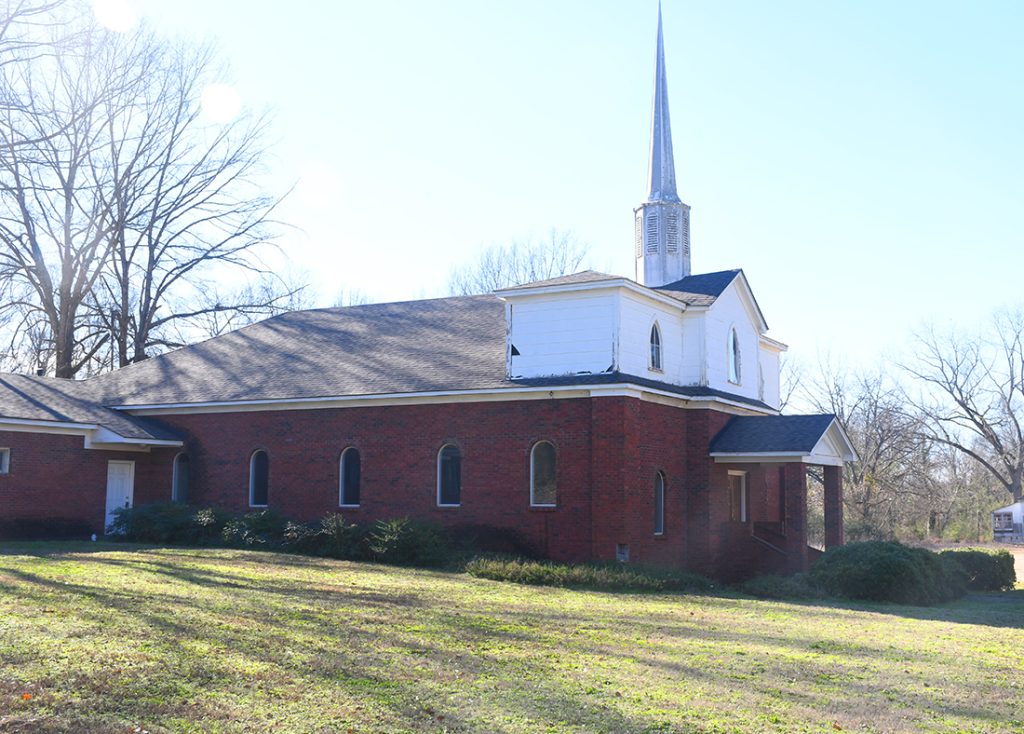
The former Everdale Church at 410 Calhoun St. was rezoned 4–1 by the Water Valley Board of Aldermen for transitional housing.
WATER VALLEY — A proposal to rezone a former church on Calhoun Street for use as transitional housing for women sparked concern before passing the Water Valley Board of Aldermen on a 4–1 vote during the board’s Jan. 6 meeting.
The board voted to amend the zoning of the former Everdale Church property at 410 Calhoun Street from R-2 Single Family Residential District to R-3 Multi-Family Residential District, allowing the property to be used for transitional housing that could accommodate up to 16 women.
Voting in favor of the rezoning were alderpersons Grant Thompson, Nicole Folson, Demetrius Ingram, and Herbie Rogers. Joe Magnuson voted against the request.
Magnuson opened the questioning, focusing on the proposed use, density and long-term implications of the rezoning.
“It is my understanding there is going to be one bathroom for 12 residents?” Magnuson asked.
“No sir, a minimum of two,” applicant Taylor McGlawn responded.
McGlawn said the project would not operate as a treatment facility.
“This is not a full-time treatment program,” McGlawn said. “This is simply a place where people sleep. That is all it is. This is an opportunity for people who have been in some type of challenging situation. Maybe someone who has suffered domestic violence.
Someone who has had addiction issues or mental issues.”
He said residents would live in a group setting, work during the day and return to the facility at night.
Magnuson said his concern was that rezoning the property without conditions could permanently change how the site could be used.
“My concern is that we get it rezoned,” Magnuson said. “Then… if this halfway house gets sold. Then it is zoned for high-density dwelling.”
Magnuson also asked whether McGlawn would operate the facility.
“We own the building, and we are going to rent it the same as if it was sitting any place else,” McGlawn said. “It is just a building being rezoned multi-family.”
Magnuson questioned whether the facility would be staffed.
“That is a misnomer that has been circulating,” McGlawn said. “There will be a manager, the same as any apartment complex.”
Public comment followed, including opposition from Planning and Zoning Commission member Izzy Thornton, who said she did not support the rezoning.
Thornton said the property sits within an R-2 residential enclave and rezoning it to R-3 would make it the only such parcel in the area. She also said zoning remains with the property regardless of ownership.
“If they were to sell it, the zoning sticks,” Thornton said. “The new owners could use the property in a way that would stand out from neighboring properties.”
Thornton said concerns about parking, density and compatibility with adjacent properties remained unresolved.
“While I have great admiration for the intentions here, I am not sure this property is suitable for the scale and type of use being proposed,” she said.
Planning and Zoning Commission member Meagan Backes said the property’s current classification complicates its reuse.
“It is currently public zoning, which is the highest density,” Backes said. “There is a church on public zoning with no parking lot. It can’t be a church anymore.”
Backes said the layout was not McGlawn’s fault and existed before he purchased the property, as the parking area for the former church is no longer connected to the property.
Next Calhoun Street resident Elizabeth Smith raised concerns about safety, supervision, parking and density.
“Is the director going to be living with these people?” Smith asked. “If this is transitional housing, transition to what if there is nobody to help them transition?”
Smith also noted the lack of sidewalks on Calhoun Street and questioned how residents would be monitored.
“How many people in the church?” Smith asked.
“Up to 16,” McGlawn replied.
“Sixteen women with two bathrooms?” Smith asked.
“I said at least two bathrooms,” McGlawn responded.
Smith said neighbors still had unanswered questions.
“There are more questions than answers right now,” she said. “There are a lot of concerned people on Calhoun Street.”
McGlawn later said residents would be placed through existing programs and would have support, including periodic visits from a social worker.
He said many residents would likely not own vehicles and would be working during the day.
After discussion concluded, Mayor Tommy Reynolds closed the public hearing.
“The hearing is at an end, and now the decision time is present,” Reynolds said.
The board then approved the rezoning on a 4–1 vote.
A second zoning request from McGlawn, involving property on Stephens Street to be rezoned from R-4 Special Single Family Residential District to R-3 Multi-Family Residential District, passed unanimously later in the meeting.
The zoning issues resurfaced indirectly later in the meeting, as Elizabeth Smith questioned city officials about the oath of office they took.
“I would like to bind each and every one of you to the oath of office to uphold the Constitution,” Smith said. “You do just the opposite. This is a perfect example, there was a public notice in the newspaper one time about this public notice for rezoning. This should have been in three consecutive papers just like every other public notice,” Smith said.
Smith shared a second concern, noting that a member of the city’s planning commission who voted on the rezoning while purchasing multiple properties in the area.
“You just voted on this rezoning of the church and you really don’t even have a clue what is going to happen there. Anymore than I do,” Smith added.