Warren, Gerson Featured In New ‘Real and Surreal’ Exhibit
PROTECTED CONTENT
If you’re a current subscriber, log in below. If you would like to subscribe, please click the subscribe tab above.
Username and Password Help
Please enter your email and we will send you a password reset link.
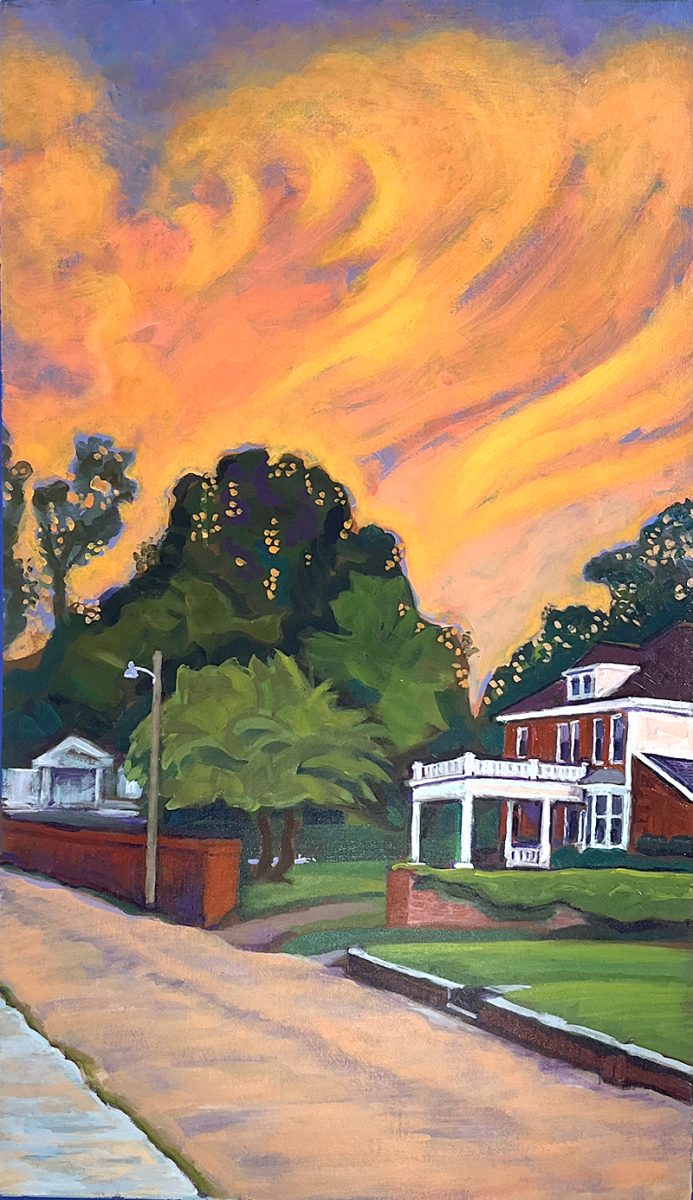
William Warren’s painting of the Henry Place on Panola Street reflects his use of bold color and expressive design.
Bozarts Gallery will open a new art exhibition Friday, April 17, from 6 to 9 p.m.
“Real and Surreal: Landscapes and Florals” will feature paintings by local artist William Warren and New Orleans artist Alan Gerson. This season’s spotlight wall will premiere work by Alan Arrivée.
William “Bill” Warren’s latest work features landscapes, historic houses and local landmarks. His paintings express a sense of place, history and nature. Through his use of heightened color and dramatic design, Warren seeks to convey the phantasmagorical elements of the natural world. Intense, vibrant colors and bold brush strokes emphasize emotion rather than realistic depictions of landscapes.
Visiting artist Alan Gerson will exhibit floral paintings. Gerson is known for his magical realism, with work that explores themes of memory and dreams. His floral pieces are intricately detailed close-ups that capture the surreal qualities of organic growth. His multilayered work combines aspects of the real world with an imagined universe. His paintings are included in the collections of the New Orleans Museum of Art, the Ogden Museum of Southern Art and numerous private collections.
The exhibition will run from April 17 through June 13. Also on view will be work by Bozarts Alliance artists and Alan Arrivée, who contributes intricate abstract pieces.
The opening reception will be held Friday, April 17, from 6 to 9 p.m. Lungs as Wings — Clay Jones and Marc Adamec — will provide ambient music. The event is free and open to the public.
For more information, call (662) 229-7602.
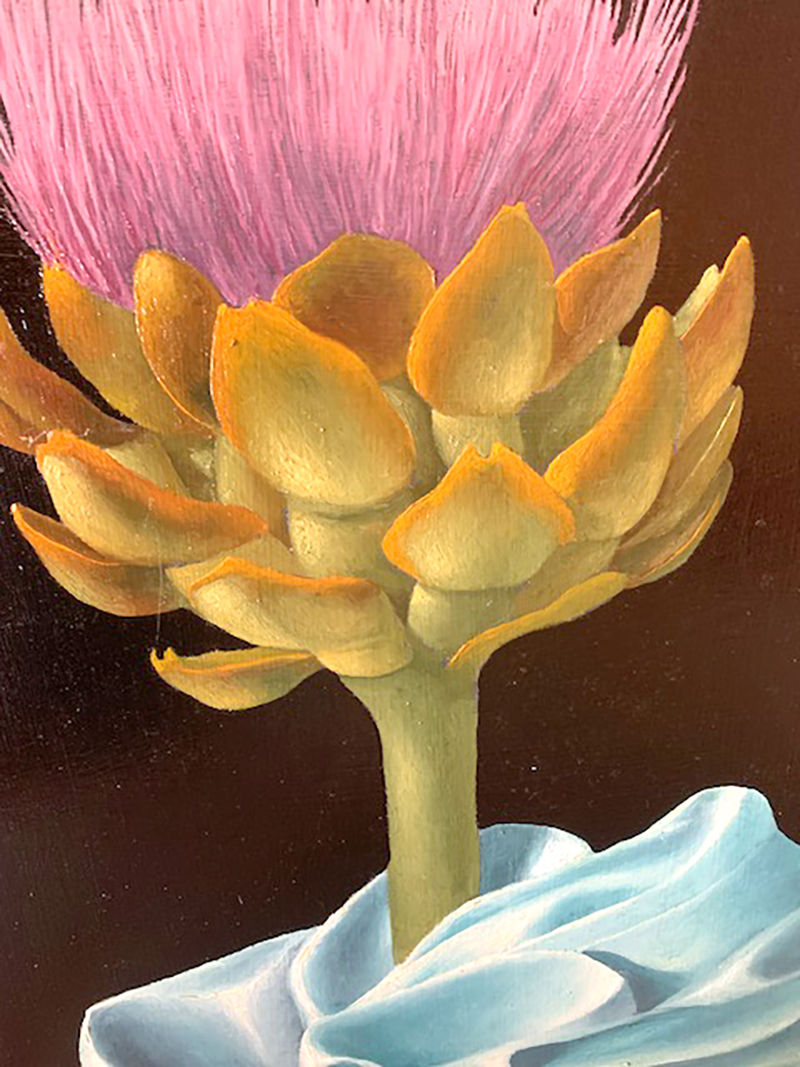
A close-up painting of a flowering artichoke by Alan Gerson showcases his detailed, layered style, blending realism with surreal elements.
William Warren: From Princeton To Water Valley
William Warren, also known as Bill Warren, was born in Princeton, New Jersey. In high school, under the tutelage of Arlean Smith of the Princeton Day School, he developed his interest in drawing and sculpture. Upon entering college at the Rhode Island School of Design, Warren became immersed in the expressive power of color using oil paint. After graduating from RISD, he worked at the Johnson Atelier of Sculpture in Princeton, where he learned the process of creating life-size sculptures that would be cast in bronze.
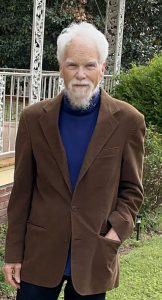
William Warren and his wife, Pati D’Amico, moved to Water Valley in 2008.
The next master teacher Warren studied with was Henry Henche, who ran the Cape Cod School of Art. Henche’s key lesson focused on how warm and cool colors create light and depth in a painting.
Following this, Warren returned to Providence, Rhode Island, to pursue his independent career as an artist. He started his first sign and mural company, featuring hand-painted signs with a vintage look.
During the late 1980s and early 1990s, Warren taught two-and three-dimensional design at Providence College and School One, a high school for the arts.
In 1996, Warren and his wife, Pati D’Amico, opened their gallery in downtown Providence called the Waiting Room Gallery. They focused on large-scale group shows and were instrumental in creating Providence Gallery Night, a monthly gallery tour.
During the 1980s and 1990s, Warren exhibited his large-scale surrealistic oil paintings at the Amos Eno Gallery in New York City.
In 1997, Warren and D’Amico made a major move to New Orleans, where they continued the Waiting Room Gallery in their double shotgun home in the Bywater. They lived in New Orleans for 11 years.
In 2008, after much consideration, the couple moved again. After visiting Oxford, they chose to settle in Water Valley, where they purchased a 108-year-old home on Panola Street. Warren turned his attention to the landscape of the hill country and the unusual imagery of kudzu formations.
Warren continues to explore the possibilities of painting today.