The Long Odds Of Growing Giants
PROTECTED CONTENT
If you’re a current subscriber, log in below. If you would like to subscribe, please click the subscribe tab above.
Username and Password Help
Please enter your email and we will send you a password reset link.
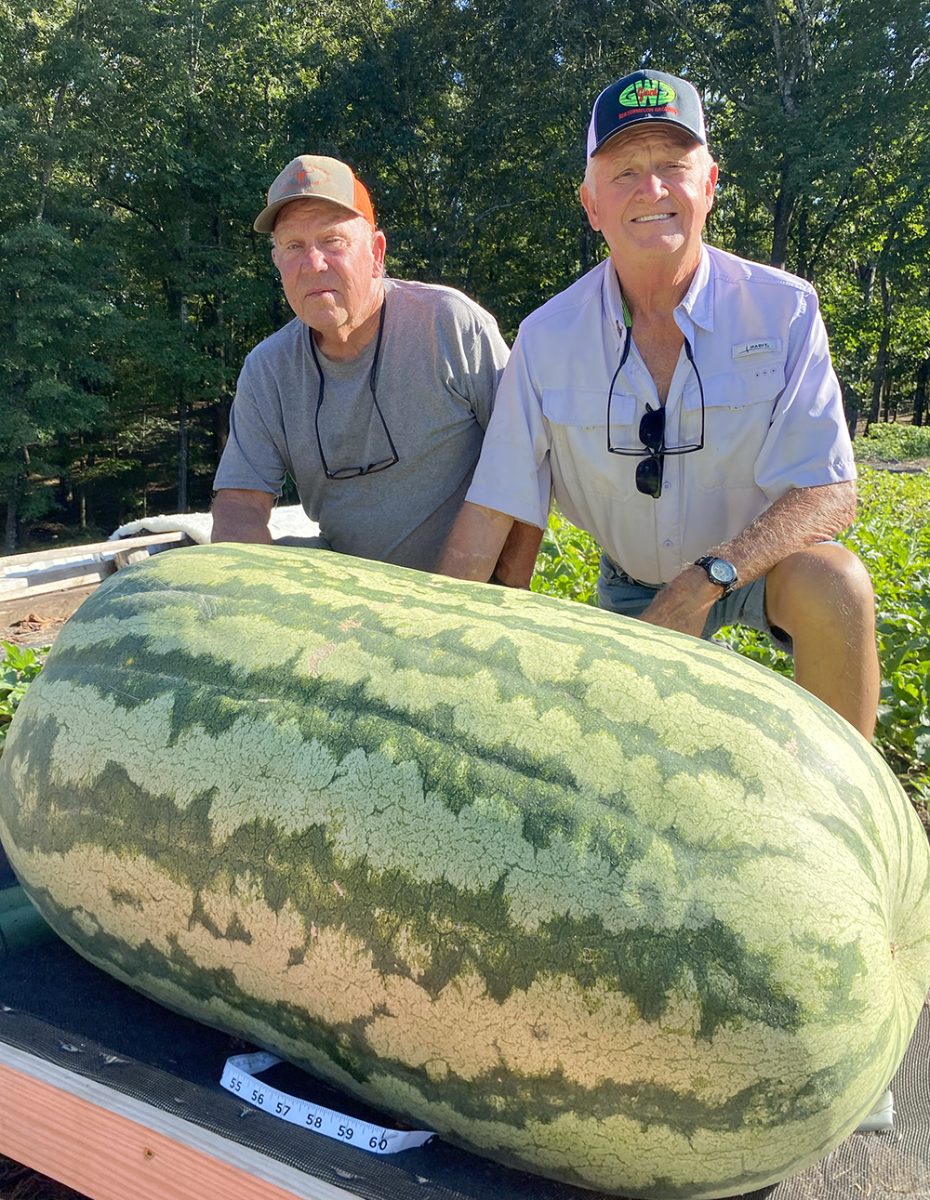
Allen Rogers with Josephine in 2024.
Allen Rogers has already grown the largest watermelon in Mississippi history. Now he believes an even bigger melon may be growing in his patch.
Tucked beneath a carefully constructed shade shelter in his Sylva Rena garden are two giant Carolina Cross watermelons that Rogers believes are farther along than any he has grown at this point in the season. If Mother Nature cooperates over the next few weeks, he believes one or both of them could surpass the 274-pound Mississippi record he set in 2024 with “Josephine.”
If that happens, it won’t happen at the Watermelon Carnival.
Like many serious giant-watermelon growers in the area, Rogers plans to leave his biggest melon on the vine weeks after the carnival concludes. Instead of heading downtown for the Largest Melon Contest, his top contender is destined for Hawesville, Ky., where some of the nation’s best growers will gather in September for a certified weigh-off.
His goal is to break his own state record.
His dream reaches even higher.
Someday, Rogers hopes to grow the largest watermelon in the world.
Ironically, that dream began with a hometown carnival and a competitive friend who brought Rogers to the game.
From Carnival Contest To National Stage
The Largest Melon Contest has always been one of the Watermelon Carnival’s signature events. Decades ago, growers hauled Cuban Queens, Cobb Gems, Jubilees and whatever happened to be growing in the garden to City Park, hoping their watermelon outweighed everyone else’s. Winning melons rarely tipped the scales anywhere close to 100 pounds.
Then everything changed.
The introduction of Carolina Cross genetics transformed the contest. Growers began chasing bigger and bigger watermelons, and with each passing year the competition became more sophisticated. Hand pollination replaced chance. Soil testing replaced guesswork. Elite genetics, grafting techniques and carefully managed irrigation became more common.
Today, Water Valley is home to the Mississippi state record holder. Local growers regularly produce carnival entries topping 150 and even 200 pounds. And, more importantly, the carnival no longer marks the end of the growing season. For serious growers like Allen and Hal Vaughn in previous years, it is simply another stop along the journey. Their biggest melons often remain in the patch for another month or more.
Ask Allen what makes this season different, and he doesn’t begin with the watermelon.
He starts with last fall.
“I prepared last year for this year,” he said.
Months before planting, Rogers was already building the soil that would support this year’s crop. Organic matter, nutrients and careful planning all became part of a process that continues nearly every day of the year.
Growing a giant watermelon has become part farming, part science and part obsession.
His competition plants are grafted onto bushel gourd rootstock, giving them a much larger root system capable of delivering more water and nutrients to the developing fruit. Each female bloom is hand pollinated using pollen from a selected male flower before the blossom is protected from unwanted pollination.
Once the fruit begins growing, every decision revolves around one objective — directing as much energy as possible into a single watermelon.
Competing melons are removed.
Secondary and tertiary vines are pruned.
Damaged leaves are clipped away.
Irrigation is adjusted almost daily depending on rainfall. The developing watermelon rests beneath a custom-built shade structure designed to keep the rind cool enough to continue stretching as it gains weight.
Looking across Rogers’ garden, it is immediately obvious these are not ordinary watermelon vines. Instead of sprawling randomly across the ground, each vine has been carefully trained into an orderly pattern. One main vine serves as the backbone while evenly spaced secondary vines branch away on either side. Every unnecessary shoot has been removed so the plant concentrates its energy on a single giant watermelon.
Even watering has changed.
Last year Rogers applied roughly 200 gallons of water during each irrigation for his competition melons. This year he has cut that to between 75