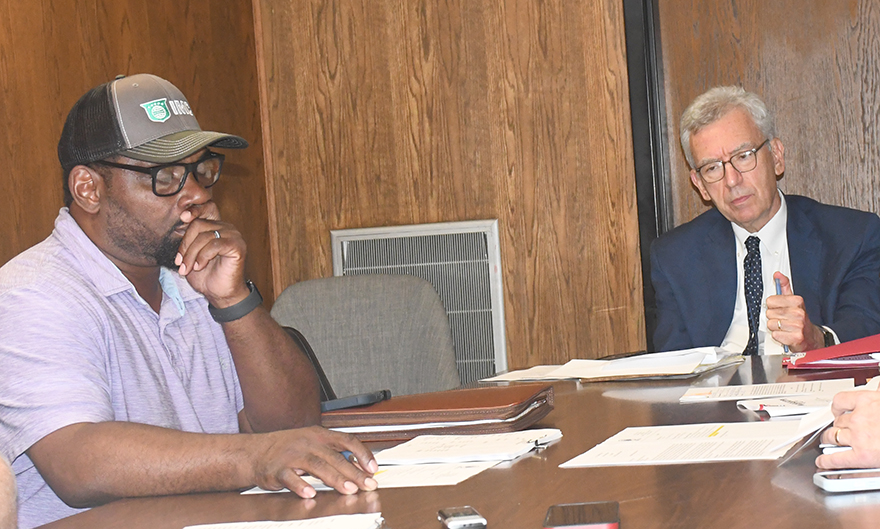
Water Valley Mayor Tommy Reynolds and Ward 2 Alderman Demetrius Ingram are pictured in the boardroom during Thursday’s meeting.
WATER VALLEY – The Water Valley Board of Aldermen voted 4-1 Thursday to accept a proposed cost-sharing agreement with the Water Valley Utilities Commission. Aldermen also voted to request additional revenue from the commission to help fund essential city services.
The vote came during an unusually busy week that began with the Water Valley Utilities Commission meeting Monday, Nov. 2, followed by Board of Aldermen meetings Tuesday, Nov. 3, and Thursday, Nov. 5.
The commission approved a proposal Monday to reimburse the city an estimated $258,974.57 annually for work performed by municipal employees benefiting the electric, water, sewer and sanitation systems.
Aldermen discussed the proposal Tuesday before voting Thursday to accept the cost-sharing agreement and request a total of $420,000 annually, closer to the amount the city had expected to receive through payments in lieu of taxes, commonly known as PILOT.
Reynolds repeatedly warned during the Tuesday and Thursday meetings that the proposed $258,974.57 reimbursement would not provide enough money to maintain city operations, particularly the police, fire and street departments. The mayor urged aldermen to recognize the consequences of accepting less money from the utilities.
“The worst thing that could happen is to begin the layoff of the fire and police and the dismantling of the vital services in the holiday season,” Reynolds said.
But the mayor’s warnings came amid continued uncertainty about the city’s financial condition.
City Clerk Joy Welch told aldermen she is still working to reconcile numerous accounts and determine the city’s actual financial position. She suggested there may be more money available than current reports indicate.
When Ward 1 Alderman Joe Magnuson questioned whether the city knew how much money it had, Welch acknowledged that she was still sorting through numerous accounts and determining how expenses and reimbursements had been recorded.
“No, because you’ve got too many funds just scattered in so many accounts,” Welch said about the city’s finances. “And I get it. It was like that for years. And so potentially, yes, I believe we have more money than we think we do.”
Welch, who assumed her duties Oct. 1, has been working to reconcile accounts and update financial reporting since taking office.
She explained that some expenses associated with utility operations, including sanitation, had been charged to the city’s general fund. Reimbursements from the utilities had not always been credited to the appropriate accounts, potentially making city expenses appear higher than they actually were.
“It’s just a matter of is it being recorded right?” Welch said.
Magnuson questioned the mayor’s repeated warnings about possible layoffs before the city had a clearer understanding of its finances.
“To say we will have to have mass layoffs when we don’t even know how much money we have. Let’s look at what our budget is when we get that information,” Magnuson said.
Reynolds countered that comparing the city’s monthly revenue with its operating expenses indicates a substantial shortfall requiring immediate attention.
“The longer you wait on making cuts and reductions, the greater the proposed cuts will be when the time comes,” Reynolds told aldermen.
The mayor pointed to monthly sales tax revenue of approximately $55,000 and annual property tax revenue of about $1.08 million, along with other smaller sources of income. He said those revenues, even with the utility reimbursements, would not be sufficient to maintain existing services.
The city has also obtained a $450,000 tax anticipation line of credit to cover expenses until property tax revenues begin arriving toward the end of the year. The loan is intended to ease the city’s cash flow problems but must be repaid from those revenues, leaving less money available for operations later in the fiscal year.
Storm Reimbursements Offer Little Relief
A separate discussion Thursday indicated that another potential source of financial relief would offer little help with the city’s operating expenses.
Susan Hartman, with ER Assist, the firm assisting Water Valley with its FEMA reimbursement claims from Winter Storm Fern, joined the meeting by telephone to explain the status of the city’s storm-related expenses.
Hartman said nine projects are expected to generate just over $1.5 million in FEMA payments. However, nearly all of that money is committed to expenses the city has already incurred or must still pay.
The city is also responsible for its share of eligible storm expenses, meaning the reimbursements are not expected to produce a significant surplus for general operations.
When Reynolds asked whether the city might at least break even on its storm expenses, Hartman said it would come close.
“You may not be at 100% in terms of breaking even, but you’ll come close,” she said.
Hartman explained that reimbursements are being processed through the Mississippi Emergency Management Agency and that some payments could begin arriving soon. Much of that money would have to be used to satisfy outstanding obligations to contractors and other storm-related expenses.
Reynolds said he wanted aldermen to understand that the city could not count on FEMA reimbursements to solve its operating budget problems.
State Funding Could Free Utility Money
Another possibility discussed Thursday involves a $1.2 million state legislative appropriation designated for the city’s electric system.
The local improvements project bill, Senate Bill 2189, designated $1.2 million to assist the City of Water Valley with maintenance, upgrades and repairs to its electric system.
Reynolds said the money could potentially cover eligible utility maintenance and improvement expenses already included in the commission’s budget.
Reynolds said that could free other utility revenues for additional payments to the city, provided the commission has sufficient funds and the payments comply with applicable requirements.
City Attorney Daniel Martin offered an example of how the arrangement might work.
“Or if they’ve (commission) budgeted $400,000 this year for poles, they can take that money out of the $1.2 million instead of their regular accounts,” Martin said.
Reynolds reiterated that the state funding could give the commission greater flexibility in its budget.
“If I were you, at least I would ask for something more than this,” Reynolds told aldermen about the $258,974.57 cost-sharing option.
Alderman Magnuson motioned to accept the cost-sharing proposal and ask for additional funds from the commission. The vote passed 4-1, with Alderman-at-large Herbie Rogers dissenting. Rogers state he was in favor of the receiving a PILOT payment from the commission.