Oakland Man Assists Annual Toad/Frog Census

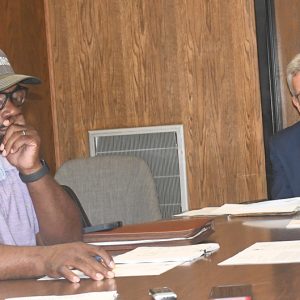
David Dunn of Oakland demostrates in daylight his frog counting technique that normally takes place after dark. Dunn is a volunteer in the North American Amphibian Monitoring Program. He and around 500 volunteers nationwide take America’s annual frog and toad census. – Photo by Jack Gurner
By Jack Gurner
Reporter
OAKLAND – If you see David Dunn standing along County Road 211, don’t stop and check on him. He’s just out counting frogs.
Dunn is a volunteer in the North American Amphibian Monitoring Program. He and around 500 other volunteers nationwide are taking America’s annual frog-and-toad census, run by the U.S. Geological Survey.
Volunteers contribute their time to help assess frog and toad population trends. Data is collected using a calling survey technique, in which volunteers identify local amphibian species by their unique breeding vocalizations, says the NAAMP website.
In plain English, they count frogs by listening to their calls.
“The way this thing works is you’ve got 15 miles and you stop at ten designated sites,” Dunn said of his 12-mile route between Coffeeville and Oakland on CR 211.
The stops along each route are located near a wetland, pond, stream or other water feature. Each stop is monitored for five minutes and all calls heard are recorded according to a calling index. Data is then entered online.
Dunn said that he got involved after reading an article in Mississippi Outdoors magazine about the Mississippi Amphibian Monitoring Program. He contacted State Director Kathy Shelton of the Mississippi Department of Wildlife, Fisheries and Parks and told her that he would like to participate.
He was directed to a website where he was tested on his ability to identify different species of frogs and toads. He had practiced by listening to “Mississippi Frog Songs,” a 30-minute audio album of the calls from 28 species and subspecies of frogs and toads.
“I listened to the CD a couple of times and said this will be a piece of cake,” said Dunn.
He failed the first time he took it. “That test is hard. They don’t give you one or two species. They give you five, six, or seven. And, they are in full chorus. You have to really, really listen,” he said.
After getting some tips from Shelton, Dunn took it again and made a 75, ten points above the required score of 65.
Dunn runs his route on weeknights after 9:30 p.m. to avoid traffic noise. “I learned you don’t go out on weekends. Just too much traffic. You can’t hear anything.”
“People stop and ask if I need help or they want to know what I am doing,” Dunn said. “Counting frogs for the government, I tell them.”
He adds that folks usually give him a funny look and take off quickly.
Dunn said there is a lot more to counting frogs than just adding up the numbers. “They want wind measurements, number of days since the last rainfall, moon light, snow cover, cloudy, fog, drizzle, and the noise index.”
“You can look at these charts,” he said as he displayed the complex four-page data entry sheet. “It’s definitely a government form.”
But, it is a worthwhile project, according to Dunn. Frogs are sensitive creatures that react quickly to changes in their environment. “These are creatures that live in water that we are going to drink eventually. If we have three-eyed frogs with five legs, something ain’t right. If we have a species that is prevalent one year and disappears the next, we’ve got to find out what happened.”
Volunteers Needed
In Mississippi there are 60 routes, each of which is supposed to be surveyed by a volunteer three times a year, in the late winter, spring, and summer. But, there aren’t enough people to fill all the routes.
“We need more volunteers,” he said. “There are still routes open over in the delta: Tallahatchie and Sunflower. We need all the help we can get.”
For information about becoming a volunteer contact State Director Kathy Shelton at krshelton64@gmail.com or call 601-528-5705. All MAMP volunteers must first pass the online NAAMP quiz.
Dunn said that he volunteered for the program because he is curious and interested in learning. And, now that the frog counting season is over for the year, he’s got some time on his hands.
“Now I’m in the Mississippi bat working group,” he said. “We go out and catch bats.”