Civic Organizations Offer Funds For Surveillance Equipment

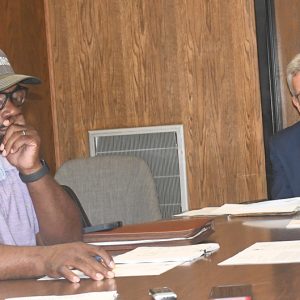
Bill Taylor, President of the Water Valley Main Street Association, and Bennett Hill, President of the Water Valley Chamber of Commerce, appeared before the District School Board Tuesday, Oct 19, to present the proposal for surveillance equipment.
By Jack Gurner
Reporter
WATER VALLEY – Video surveillance equipment will soon be installed in the high school with the help of the city‘s civic organizations.
Bill Taylor, President of the Water Valley Main Street Association, and Bennett Hill, President of the Water Valley Chamber of Commerce, appeared before the District School Board Tuesday, Oct 19, to present the proposal.
“We’re here representing all the civic organizations in Water Valley,” Hill told the Board.
Taylor said that representatives of several civic organizations and Water Valley Police met at the Main Street office on Oct. 14 to discuss a video monitoring system for the school. “We figured out really quickly that the money is not going to be a problem. Whatever y’all need, this community will raise.”
All funds from groups and individual givers will be accumulated at Main Street and then Main Street will purchase the system and donate it to the school. Installation costs would also be covered by the civic groups, Taylor added. “The main concern is that we do this right and we get you what you need.”
He explained that John Hernandez, a police officer who works with surveillance systems, would do a walk through of the high school to determine the best locations for the cameras.
The group is also looking at putting a similar system in the elementary school, but not right away. “We realize there is probably a bigger need here,” Taylor said of the high school campus.
He said there was some discussion about how the system was going to be used. “The initial thought was that we need this video system in case there is an emergency, some type of school shooter or something like that.”
But, he added, there are many more uses than just emergency response. “Many of us have kids up here and we hear about fights in the hall. It would be great to know who started it.”
He said that incidents of harassment or bullying could also be captured by the system. Other uses include recording contraband sales so that dealers can be identified and protection of teachers involved in incidents with students.
Taylor continued that there had been some burglaries at the school and the addition of exterior cameras should also be considered.
Video Surveillance Useful
Superintendent Dr. Deborah Moran agreed with Taylor that the video is very useful. “I’m coming from a situation where I even had surveillance in my office,” she said. “But, we are always going to err on the side of the student and their privacy.”
“We will have to train the teachers, train the administrators, because we still have to protect the privacy and the rights of our youth,” she continued.
Moran thanked Taylor and Hill for the presentation. “It will take us a little time. We will be comparing and contacting other districts that have that in place to make sure we have the most current, most legal policy to protect our students as well as our faculty and our community.”
Moran emphasized the “most legal policy” during her comments. “Parents get upset sometimes and they want to see that film. But, it’s just like the yearbook. We have to have permission.”
She explained that the parents of every child involved in an incident would have to sign an agreement allowing the school to display the video.
“That would be like Facebook. I don’t know that we want to become (like Facebook). And, I don’t want any of our information to be on Facebook, either. We will be looking very carefully at protecting the rights of our students, parents, families.”
Last year some in the community expressed concern after video of a fight between two female students at WVHS appeared on the website YouTube.com. The February 2009 incident was captured apparently by a student with a cell phone. The video was uploaded by the student and has around 2400 views.
According to a report by the University of Illinois, cameras can be used in places where staff or students lack a reasonable expectation of privacy. Examples are common areas like the hallway where the fight occurred, cafeterias, libraries, gymnasiums, and parking lots.
Places where surveillance is not allowed are private offices (without permission) and obvious locations such as restrooms and locker rooms, the report states.
Placement Of Cameras
Dr. Steve Edwards asked if Hernandez had already made an assessment for the placement of cameras. Taylor said that he had, but would be returning to the school for another look.
Edwards also suggested that Mario Weekly, Transportation Director and School Resource Officer, be involved.
“Mario was a big part of that meeting,” Taylor said. The police department also had representatives at the meeting.
“Our main purpose for being here is to say please go ahead with this project,” Taylor concluded. “When-ever you do it, the money will be there.