Landowners Question FSA Consolidation

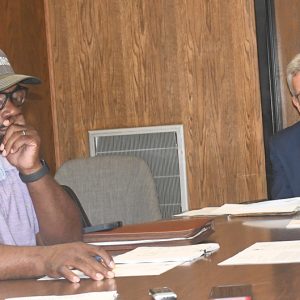
USDA State Executive Director Michael Sullivan (left) takes notes as Water Valley farmer Kevin Kimzey (standing) voices concerns about the proposal to close the Farm Service Agency in Coffeeville. Kimzey and others provided input during the public hearing last Thursday at the Multi-purpose Building in Coffeeville.
Editor
COFFEEVILLE – Although James Edwards’ odometer records the distance between the Farm Service Agency (FSA) offices in Grenada and Yalobusha counties as 22 miles, it was air miles that counted.
Edwards was one of more than two dozen farmers and land owners attending a public hearing regarding a proposal to consolidate the Coffeeville office with the Grenada office. The public meeting follows the U.S. Agricultural Department’s announcement on January 9 that the Coffeeville FSA office was one of 259 offices, labs and other facilities nationwide targeted for consolidation.
The distance was important, as the 2008 Farm Bill had a provision allowing offices to be included in the consolidation proposal if they were less than 20 miles apart and employed two or less permanent employees.
“These are air miles versus highway miles,” USDA State Executive Director Michael Sullivan explained.
“This is the situation Yalobusha County fell into. It fell under 20 miles,” Sullivan added.
Sullivan moderated the mid-afternoon meeting at the Multi-purpose building, providing information including the criteria in the Farm Bill. He also painted a bleak financial picture for the Farm Service Agency – a series of cuts that started in 2008.
“Many of you who do business in our office have noticed changes, lack of staff mainly. All of us have been asked to do less,” Sullivan explained.
Until now, much of the cuts were focused on employees, with attrition being the driving force, according to Sullivan.
Now his work, as explained during the hearing, was to meet statutory requirements required before the offices can be consolidated. This included the hearing, with emphasis placed on public comment.
Sullivan also explained the other changes, if the proposal becomes a reality, starting with the FSA county committees. Currently both Grenada and Yalobusha counties have separate committees. With the consolidation, new district lines will be drawn that divide the two counties into new districts.
“It will probably be a five-member county committee,” Sullivan added.
“After the selections are made, all the names go in a hat. The first name drawn out will serve a one year term, the second name a two-year term,” Sullivan said. This will stagger the terms, which is currently the procedure to keep the entire committee from being selected at one time.
“Yalobusha won’t be considered a secondary county,” Sullivan also stressed. The likely scenario would be for each county to have two districts, with the fifth district overlapping both counties.
Public Comment
Following Sullivan’s initial comments, each attendee was given three minutes for comments or questions about the proposed consolidation.
First to speak was Doyle Varner.
“My concern, are you taking into consideration the distance these farmers have to travel,” Varner asked. Citing national statistics from the USDA, he noted that the bulk of farms across the nation are small, family-owned and more than a quarter of the small farmers in the nation are 65 or older.
Next to speak was Edwards. “I talk so fast that I got things written down to slow me down,” the slow-talking farmer joked.
Edwards pointed out that the only savings would be for the actual building expense, because it will take the same workforce, if not more employees, to do the job.
He also noted the cost of traveling to Grenada.
“My odometer gives 22 miles, one way, we are talking about $3.30 gas and $3.70 diesel,” Edwards added.
Next was Janet Caulder, who asked if other options had been explored rather than closing down the office.
Missy Burney followed, and stressed the growers and landowners should have been a stronger factor in the decision, as opposed to the miles and number of employees at a FSA office.
Burney also cited statics that 20 percent of Yalobusha landowners are minority landowners, and the majority of these are older.
“They have trouble getting to offices. A lot of them depend on someone else to drive them. It is going to disenfranchise them, I’m afraid, if they are not able to get to the office. And it is not only going to be minority landowners,” she added.
Kevin Kimzey stressed that the office served the landowners who are a big part of the tax base in the county.
“That office is a service to the taxpayer. It was named Farm Service Agency. It should have been landowners service agency. Farm Service Agency kind of gives the impression it is only for farmers. But it is for land-owners. Landowners’ property taxes drive Yalobusha County and that is who is going to suffer, the taxpayers of Yalobusha County.
Kimzey also reiterated concerns voiced earlier in the meeting, noting that where the landowners receive their services, Grenada or possibly Lafayette county for Water Valley land owners, the remaining offices will need additional manpower.
Last to speak was Tyler Wortham, who said Yalo-busha has more cultivatable acres and land than Grenada County.
“That should be the emphasis,” Wortham added, referring to choosing the Yalobusha office over the Grenada office.
Sullivan addressed each concern and question afterwards, explaining he understood and agreed with many of the points.
Timeline
Sullivan also detailed a 90-day time-line that started ticking January 9 when the proposal became public. There is a 10-day window for written comments about the consolidation. The 10 day count started January 26, with the hearing in Coffeeville. Comments from the hearing, plus written comments will go to Washington.
“Basically 90 days after Jan. 9, the date of the announcement, the decision will be made. The proposal will either be put forward or shelved,” Sullivan said.
“After that we will start the process of consolidating the records… moving the maps and all the stuff we have to do,” Sullivan added, if the consolidation proposal moves forward.
This will be completed by mid-August, at the latest.
Although Grenada County will be the host county, producers can opt to move their records to other counties.
“It is up to the producer where they want their records housed… we have always had that option as producers and we will still have that option,” Sullivan explained.