Sweet Potato Acreage Is On The Rise

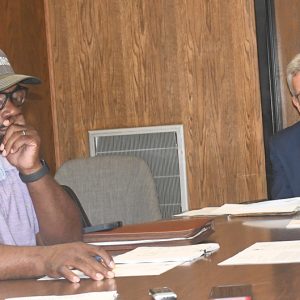
MSU Extension agent Bill Burdine outlined the pros and cons of sweet potato farming during a Water Valley Rotary meeting last Wednesday. – Photo by David Howell
Editor
WATER VALLEY – The profit margin for sweet potato acreage can be huge and the land dedicated to this crop, both in Mississippi and Yalobusha County, is on the rise.
But the risks that come with it are equally high, explained Bill Burdine, area sweet potato specialist with the Mississippi State University Extension Ser-vice, during a noon Rotary program last Tuesday in Water Valley.
Part of the risk associated with sweet potato farming is the production cost per acre, – labor, rent, plants, and pesticides.
“All of these things go into other crops, but it is more expensive,” Burdine explained “We may run a tractor six, seven, maybe even eight times before we even plant the crop.”
Burdine was introduced by Rotary member and Yalobusha supervisor Lee McMinn.
“We had a recent development with Kyle Jeffreys, who had some interest in a building down at Coffeeville storing sweet potatoes. That prompted a thought in my mind, we have several growers in the county,” McMinn told Rotarians about the lunch program.
In addition to Rotary members, Jeffreys and Mike Williamson, both sweet potato farmers, attended the meeting.
In 1989, Mississippi farmers grew only 3,000 acres of sweet potatoes but that number has increased 500 to 1,000 acres per year since then. Both Jeffreys and Williamson reported after the meeting they plan to double their acreage from 2011 to 2012.
Burdine attributed the success with the Beauregard variety as the driving factor for the upward trend.
“It’s been a great variety for us,” he explained.
Production costs typically range from $1,600 to $2,400 per acre. The returns range from the low side of $1,900 to $2,000 per acre to $8,000 on the top end.
“That is a range of $6,000, just high to low. We don’t know what we are going to get until after those potatoes are packed,” Burdine explained. “If you are looking at corn, cotton, soybeans, you pretty much know what you got by the time you harvest. Sweet potatoes, you don’t actually know until you run the harvesters.”
Weather, labor costs and diseases were among the three biggest factors identified by Burdine that can cut into the profit.
“In 2009 we left 60 percent of the crop in the field,” Burdine explained, referring to the extremely wet late-summer and fall that hampered the harvest.
When it comes to labor, migrant workers are a necessity in Mississippi, Burdine explained.
A migrant worker will actually cost more than an American worker, according to the expert.
Using an eight-row planter, it takes 16 workers on the planter, plus a tractor driver, someone bringing the slips to the planter and someone to plant the skips.
And when it comes to harvest times, many farmers use a “bucket crew,” workers who are paid for each bucket filled by hand.
“We have to house them, transport them and provide medical,” Burdine explained. Plus it also takes tons of record-keeping to stay in compliance with federal regulations.
Diseases and insects can also take a toll on the crop. An example, cited by Burdine, is a sweet potato weevil outbreak.
If one weevil is found in a field, the area is closely monitored for three days. If a second weevil is discovered, the field and adjacent fields within one mile will be totally destroyed.
One fairly new disease impacting local farmer is tip rot or end rot.
Williamson attested to the impact from this disease, reporting losses of 40 percent of his 2011 crop from tip rot.
Economics
Nine counties in Mississippi now boast sweet potato acreage, according to Burdine.
“It has branched out in Yalobusha, Grenada and Webster. Most of our growers all live in Calhoun and Chickasaw counties with the exception of a few new ones that have started over here,” he continued.
“One of the biggest things that hit the sweet potato industry is the ConAgra plant in Delhi, La.,” Burdine added.
This one year-old company produces sweet potato fries that are shipped across the country, and purchases almost half of their sweet potatoes for processing from Mississippi farmers. It currently employs 1,000 people, both in direct and indirect jobs. The company will continue to expand, and by the end of 2015, it will employ 2,300 people, Burdine told Rotarians.
Prior to the construction of ConAgra, a Mississippi sweet potato growers cooperative worked from 2002 to 2005 to build a food processing facility in neighboring Calhoun County. Unlike Conagra, this plant would be have been tooled to process multiple foods to coincide with the different harvest seasons.
Burdine cited high steel prices that escalated after bids were accepted as the primary reason the plant never materialized.
“A two-million dollar grant expired,” he said, which effectively killed the project.
During a question and answer session at the end of the program, Burdine speculated future plans for a Mississippi processing facility would only be feasible if it does not compete with Conagra.
“I don’t think we can hit the french fry market now, that is what they are doing,” Burdine explained.
But a processing facility producing other sweet potato products geared toward an institutional markets would be feasible in the state, he added.