City To Take Bids For Airport Hangar

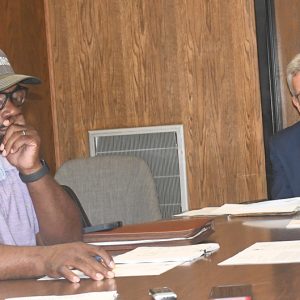
Aldermen and Mayor Larry Hart discuss the city-owned hanger.

Alderman Larry Bell questions the city’s investment in the airport hangar.

Mayor Larry Hart explained that the hangar had to have vents in the walls at floor level. “In case it did flood, there would be a way for the water to get out. MEMA signed off on Willis’ plans.”
Reporter
WATER VALLEY – City officials are moving forward with construction of a city-owned hangar at the municipal airport after receiving a flood plain “exception” from the Mississippi Emergency Management Agency.
When questioned by Alderman Larry Bell at a special called meeting Wednesday, May 23, to approve advertising for bids on the project, Mayor Larry Hart said that MEMA had given the city an exception in regard to the flood plain.
“We described the facility that was going out there,” Hart explained. “Willis (Willis Engineering, the city’s engineering firm) drew plans for it.”
The Mayor said that the hangar had to have vents in the walls at floor level. “In case it did flood, there would be a way for the water to get out. MEMA signed off on Willis’ plans.”
After giving an opinion of MEMA’s operations, Bell said, “Let’s tell the truth about this thing. Do we have any renters for it yet?”
“We’ve had inquiry,” Hart responded.
“Inquiry,” said Bell. “Have we got signed on the dotted line?”
“No,” Hart shot back. “Cause we haven’t been able to sign on the dotted line. But, we’ll get airplanes for the hangar. Rest assured.”
“We’re going to take $30,000 of our city money and invest in that thing out there,” Bell continued.
“Some part of the money,” said Hart. “We don’t know yet because we haven’t advertised.”
“Well, if you’ve got $300,000 at ten percent, it doesn’t take a Philadelphia lawyer to figure that out,” Bell commented on the 10 percent of the amount of the FAA grant that the city would have to provide.
Bell noted that he also wasn’t for the project because it was outside the city. The municipal airport is located on leased Corps of Engineers property about two miles west of the city limits.
After the discussion, Aldermen Bobby Cox, Donald Gray and Phillip Tallant approved advertising for bids on the city-owned hangar. Bell voted against the motion.
Hart then called for a motion to use the city’s engineering firm, Willis Engineering, as engineers on the project. Bell objected and said that the firm who won the bid could probably supply their own engineers at a lesser cost or as part of the bid.
Hart interrupted Bell and again asked for a motion to use Willis Engineering. After receiving a motion and a second, Hart then opened the floor for discussion.
Both the Mayor and Alderman-At-Large Donald Gray explained that an engineer was needed for projects using Federal Aviation Agency grant money.
Kathleen Bergen, Manager, Atlantic Media Relations for the FAA, said that the FAA requires plans and specifications be developed by a professional engineer with airport knowledge. “Airport sponsors typically hire engineering consulting firms with airport expertise. Federally-funded projects must be designed and built in accordance with FAA design standards, and city engineers usually do not have the technical expertise to design and supervise the construction of airport projects,” she told the Herald.
After the discussion, aldermen voted to use Willis Engineering for the project with Bell voting against.
Hangar History
The issue of a city-owned hanger at the airport first came up in public last December when Lafayette County businessman and Water Valley property owner Bill McGregor appeared before the board and asked for a ground lease to build a privately-owned 50 by 60 foot insulated and secure hangar.
At the end of McGregor’s request, Hart announced that “within a couple of weeks” he would have the details of the city’s hanger project ready to present to the board.
After a lengthy discussion of the merits of allowing private hangars versus building a city-owned hangar, Bell motioned to allow McGregor’s private hangar project to go forward. His motion died for lack of a second.
Then at the February board meeting, aldermen learned that there was an issue with the flood plain that might complicate any construction at the airport. Board attorney John Crow told the board members that flood insurance was only available if you build at the required elevation or above. “We’re four feet below where construction has got to start,” Crow said.
Gray added. “Until this is worked out…not only can we not build right now, no one else can build either.”
Earlier this month city officials learned they would be receiving $305,239 for the hangar project from the FAA. Since the first $58,750 was provided on May 4, 1966, the airport has been granted a total of $1,322,339.