Three Decades Mark Fiery Demise Of Landmark Main Street Hotel

M. B. (Snooky) Williams stands at the corner of Main and Panola Street across from the site of the Blackmur Hotel. He holds a sign that asked guests to refrain from using the hotel’s towels to buff their shoes. Williams and H. B. (Hershel) Howell owned the historic structure when it was severely damaged by fire in 1982. – Photo by Jack Gurner

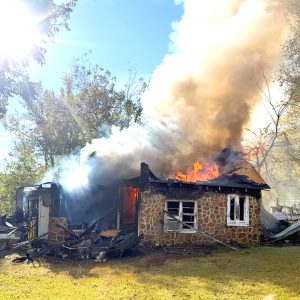
Firefighters pour water into the third story of the Blackmur Hotel on June 12, 1982. The fire was between the metal roof and the walls of the structure and was difficult to reach until the electric department bucket trucks were brought in. Coffeeville and Oxford fire departments were called and assisted in preventing the spread of the fire to adjacent buildings. Oxford firefighters, using protective gear and breathing devices, were able to enter the third floor and expose burning areas, which we

The above drawing from the 1893 Sanborn fire map shows the Herring Hotel. Note the same dimensions for he building as shown in the below drawing of the foundry building from the 1890 map.

Reporter
WATER VALLEY – Thirty years ago fire irreparably damaged one of the town’s landmark buildings.
Lightening is believed to have started a blaze that mortally wounded the Blackmur Hotel and left an empty place in Water Valley’s Main Street that can never be filled with just a building.
It was one of several losses that would forever change the character of downtown.
Around 9:30 Saturday morning, June 12, 1982, a passersby noticed smoke coming from the third floor of the old hotel. The structure, which is believed to have been built about 1869, had not been used as a dwelling in some five or six years.
The fire story that originally appeared in the June 17, 1982 Herald is reproduced below and in the “Look Back In Yalobusha History” column.
Not a lot is known about the history of the building other than it was once the Herring Hotel. The Sanborn insurance map of 1890 shows that corner of Main and Panola was occupied by the Baker and Fewell Foundry and Machine Shop. Three years later, the 1893 map shows the Herring Hotel on that corner.
The building could have been converted from the foundry to the hotel since the buildings appear very similar and the same types of businesses are shown occupying the retail spaces on the first floor. One difference is the third story that appears in drawings on the 1893 map.
W. E. (Eddie) Blackmur purchased the hotel in the 1920s and he sold it to H. B. (Hershel) Howell and M. B. (Snooky) Williams in the early 1960s.
Williams said that he was at an insurance convention on the Mississippi coast and was called out of a meeting to take a phone call. “They told me the hotel was on fire. There wasn’t anything that I could do and I went back into the meeting.”
He said that a fellow insurance agent, Water Valley native Van Hedges, came back to check on him concerned that something might have happened to someone in the family.
“I said, Van, I really need some insurance on the hotel. Van said, ‘Oh, yeah, I can insure it.’ Then he said, ‘Wait a minute. Why aren’t you insuring it?’ And I said, ‘because it’s on fire.’”
Williams said when he got back into town about two days later, “it was still smoking.”
The Purchase
Williams said that he was contacted by Blackmur, owner of the hotel and President of the Mechanics Bank, about purchasing the property. Williams got Howell to go in with him on the purchase.
After I bought it, I was walking down the street and this very nice lady – this genteel, Christian lady – stopped me and she said, ‘Snooky, is it true that you bought the hotel?’ and I said, ‘Yes, Ma’am,’” Williams recalled with a grin. “She said, ‘You poor child.’”
“She wasn’t being malicious at all,” he added. “She was sincere.”
Williams emphasized that he believes Blackmur was trying to be fair with the price he put on the hotel. “Thinking back, it was a long time paying for itself,” Williams said. “We were running a hotel and renting out part of it.”
Some of the rental space wasn’t very profitable. Williams used the office of Dr. French as one example. “He wasn’t paying any rent. So, we went to Dr. French and told him that we would paint it, but we’re going to have to start charging you rent. We’re furnishing you lights, water, heat, everything.”
“He said, ‘How much would you want to charge me?’ and I said, ‘thirty dollars a month.’ He said, ‘I’ll think about it.’”
Williams said that Dr. French called him to his office later. “He said, ‘I thought about it. I work twenty days a month and I’m going to give you twenty dollars.’”
A similar arrangement was made with Marvin Groves, long-time Blackmur Hotel barber. “I think we charged him $20 a month.”
The no-rent arrangement was not uncommon for services such as barbers and doctors who were considered an asset to hotels. “And, I think Mr. Eddie got his hair cut free,” Williams added.
The Managers
When Williams and Howell took over the hotel, it was being run by Miss Kate Johnsey, who also lived there. When she left, Miss Bertha Roark resided there and ran the office. After her, David Hale and his wife were live-in managers until the fire.
Williams noted that “Miss Bertha” ran a tight ship while she was at the hotel. He said that one of the residents came into his clothing store asking for his help after Roark kicked him out “for getting drunk too much.”
“I’ll gonna’ tell you what,” Williams told the man. “If Miss Bertha kicked you out, the only way you’re going to get back in there is to make peace with Miss Bertha.”
“When you get kicked out of the Blackmur Hotel, there aren’t many places you can go,” he added.
Williams had a long talk with the man and explained how to approach Roark with his request to be allowed to return. The man told her he would quit drinking, but if he did get drunk on a Saturday night, he wouldn’t come back to the hotel that night. “She let him back in.”
Another character that was an on-and-off resident of the Blackmur Hotel was Willie Hoskins, who washed windows and made small personal loans for a living. Williams said that during the winter, Hoskins lived in the boiler room at the hotel. “We never did figure out how Willie got in and out.”
Williams said they didn’t worry about Willie living in the boiler room since he more or less looked after the place while in residence.
The Demolition
“It needed to be torn down,” Williams said of the condition of the building after the fire, “If you had a bottomless pit full of money, you could have fixed it. I thought maybe we could make a two-story building out of it, but there wasn’t any way.”
When it came time to tear down the structure, Williams and Howell dealt with a man who took it down systematically saving the materials. “In other words, if he took two-by-fours off, he would put them in a stack and take them home later.”
Williams said that as part of the demolition deal he and Howell each got a portion of the bricks. “So, my front porch, my chimney, and my side porch are all brick from the hotel. It’s nice looking down on that porch and knowing it came out of the hotel.”
There were many other things in the hotel that weren’t destroyed in the fire, according to Williams, including the doors that are now in his office on Main Street. “Mine still have the room numbers on them.”
Williams said that the partners had a hard time selling the lot after the hotel was torn down. One Saturday morning he talked long-time buddy, Brownie Crawford, into participating in a prank to see “what excitement we can create on Main Street.”
Williams and Crawford took a measuring wheel and ran it around the lot while making notes of the dimensions. “People started showing up wanting to know what was going there.”
Williams and Howell finally sold the lot. “It ended up that we came out OK on the hotel.”
Lightening is thought to have started a fire that caused extensive damage to the historic Blackmur Hotel building early Saturday, June 12, 1982.
The fire was discovered about 9:30 Saturday morning when a passersby noticed smoke coming from the third story of the old hotel building.
The structure, which was built about 1869 and had not been used for a dwelling in some five or six years, but the bottom floor stores were occupied by Mitchell’s Drug Store, Pruitt’s Early Bird Donut Shop, Morgan Electronics and Village Flower Shoppe.
Stock and fixtures from Mitchell’s, Pruitt’s and Village Flower Shoppe suffered considerable water damage. Volunteers were able to remove some of the building’s contents, and all of the stock of Morgan Electronics was saved.
First known as the Herring Hotel, the building was purchased by the late W. E. Blackmur during the 1920s. H. B. Howell and M. B. (Snooky) Williams purchased the building in the early 1960s.
Firemen arriving on the scene began to cool the structure immediately, but the fire, contained between a wall and the tin-covered mansard roof, continued to blaze until two bucket trucks from the city electric department were brought in to get closer to the source of the fire.
Oxford and Coffeeville Fire Departments were called and responded quickly, aiding in preventing the fire’s spread to adjacent buildings. The Oxford firemen, using sophisticated protective gear and breathing devices, were able to enter the third floor and expose the burning areas, which were quickly extinguished.
Fire Chief Bob Ward said the lightening probably entered the building in the rear through an iron electrical conduit. Chief Ward said that severe lightening was reported in the area early Saturday morning and that the fire probably smoldered for several hours before breaking out, due to lack of oxygen in the confined spaces of the false wall between the second and third stories of the building in the rear. The flames spread upward and outward, finally involving the entire third story.
Chief Ward praised the work of the Water Valley Fire Department and expressed appreciation for the help given by the Oxford and Coffeeville departments. This was echoed by Mayor Hamric Henry who added, “Without their efforts we might have lost a whole block of Main Street. They helped avert a major disaster.”
M. B. (Snooky) Williams, one of the building’s owners, said that the loss, in excess of $100,000, was only partially covered by insurance. He said that engineers had inspected the structure and that rebuilding plans would be determined by their report. He felt that it might be feasible to remove the entire third story (which was not a part of the original structure) and build a shed-type roof over the entire second story.
“At this point, we just don’t know what we’re going to do,” said Williams. “but I believe there is a good chance the old building can be saved.”
All the firms formerly housed in the hotel plan to continue in business. Mitchell’s Drug Store is now located in the John Crow Law Building at the corner of Masonic (Henry Place) and Wagner Streets. Morgan’s Electronics has moved six doors down the street to the building last occupied by Deborah Kay Dance Studio. Village Flower Shoppe is in temporary quarters in the building last used by City Flower Shop on North Main Street across from City Park.
Larry Pruitt, owner of Pruitt’s Early Bird Donut Shop, has indicated that he intends to reopen, but has not yet found a suitable location.