Unit And Beat Government Discussed In Oct. 6 Meeting
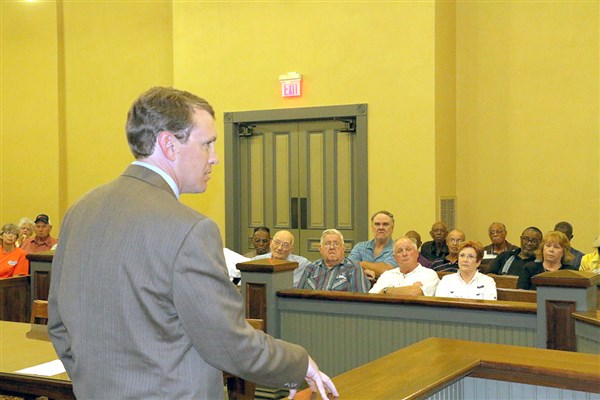
Sumner Davis moderated the meeting and even stepped in several times to keep tension from arising.
By David Howell
Editor
COFFEEVILLE – Sumner Davis moderated the two hour meeting held Oct. 6 weighing the pros and cons of the unit system and beat system in Mississippi. Davis is a Governmental Training Specialist with the Center for Governmental Training & Technology in the Mississippi State University Extension Service. The meeting was held at the Coffeeville Courthouse to provide information to the public on the two systems of county government in preparation for the Nov. 3 county vote.
Davis provided a general overview of the two systems, prefacing his comments by explaining that it is for the residents in the county to determine which method of government would best suit Yalobusha.
“I work all over the state. I see beat systems that work great. I see unit systems that work great, Davis explains. Conversely, he also said he see examples of both systems that aren’t operating efficiently.
“It depends on the folks that are in the place to make decisions,” Davis stressed at the meeting.
Davis explained that under the beat system under which the county currently operates, each supervisor receives a portion of the road and bridge money for the county. The supervisors manage their own road crew, their barn, their equipment, and make decisions on how to work the roads within their district. Davis also explained the entire board sets the budget from which each supervisor works.
“Y’all live here, you have seen it, you know how that works,” Davis explained.
Under the unit system, Davis noted that the major difference in the unit system is in road administration.
“Instead of the five districts and each supervisor having their crew, their equipment, working it, making those discretionary decisions – it goes to a more county-wide view, as decided by the board as a whole,” Davis continued.
This means road districts are eliminated and road work gets decided by the Board of Supervisors collectively by formulating a long-range road plan, he added.
Davis also explained that changing to the unit system mandates two new positions in the county, a road manager and county administrator.
The road manager, hired by the board, manages the day-to-day operation of the centralized, county-wide road crew.
“The Board of Supervisors pass a four-year road plan. They still pass policy, but the discretion of the day-to-day level falls on the county road manager instead of the entire board of supervisors,” Davis continued about road work.
Other points made during the meeting, some based on questions or input from the attendees included:
• Currently there are 45 unit systems in the state, compared to 37 beat systems.
• Potential conflicts for the road manager, who answers to five bosses.
While only briefly mentioned at the meeting, next month’s vote on the issue marks the second time voters will weigh in on the matter.
Yalobusha voters narrowly favored retaining the beat system in that 1988 election with less than 300 votes separating the issue. There were 2,590 in favor of the beat system, or 53 percent of the vote, and 2,294 voters favoring the unit system.
The catalyst for the 1988 vote mandated by legislators was the indictment of almost one-eighth of the state’s 410 supervisors following a sweeping FBI investigation of county purchasing activities across the state. Much of the corruption exposed in Operation Pretense centered on central and southern counties in the state, with only supervisors in three counties in north Mississippi counties – Panola, Pontotoc and Monroe – facing charges in the scandal.
The Mississippi Association of Supervisors spells out the duties in both the unit system and beat system in a publication, “County Government in Mississippi.”
Under the unit system, the county operates a centralized road department with one central road repair and maintenance facility for the county, with additional shops being established if the Board determines a need.
In the unit system, maintenance for the county’s roads and bridges would be overseen by a county road manager, hired by the Board. The unit system would also abolish the county’s five road districts and maintenance would be managed based on the needs of the entire county. All real and personal property from each of the county’s five beats would become the property of the countywide system.
Supervisors would adopt general policies to be followed by the administration of the county road department, including a four-year road plan for the construction and maintenance of county roads and bridges.
Under the unit system, the county would also be required to hire a county administrator, who could be the chancery clerk