Hunters Can Help Control CWD
PROTECTED CONTENT
If you’re a current subscriber, log in below. If you would like to subscribe, please click the subscribe tab above.
Username and Password Help
Please enter your email and we will send you a password reset link.
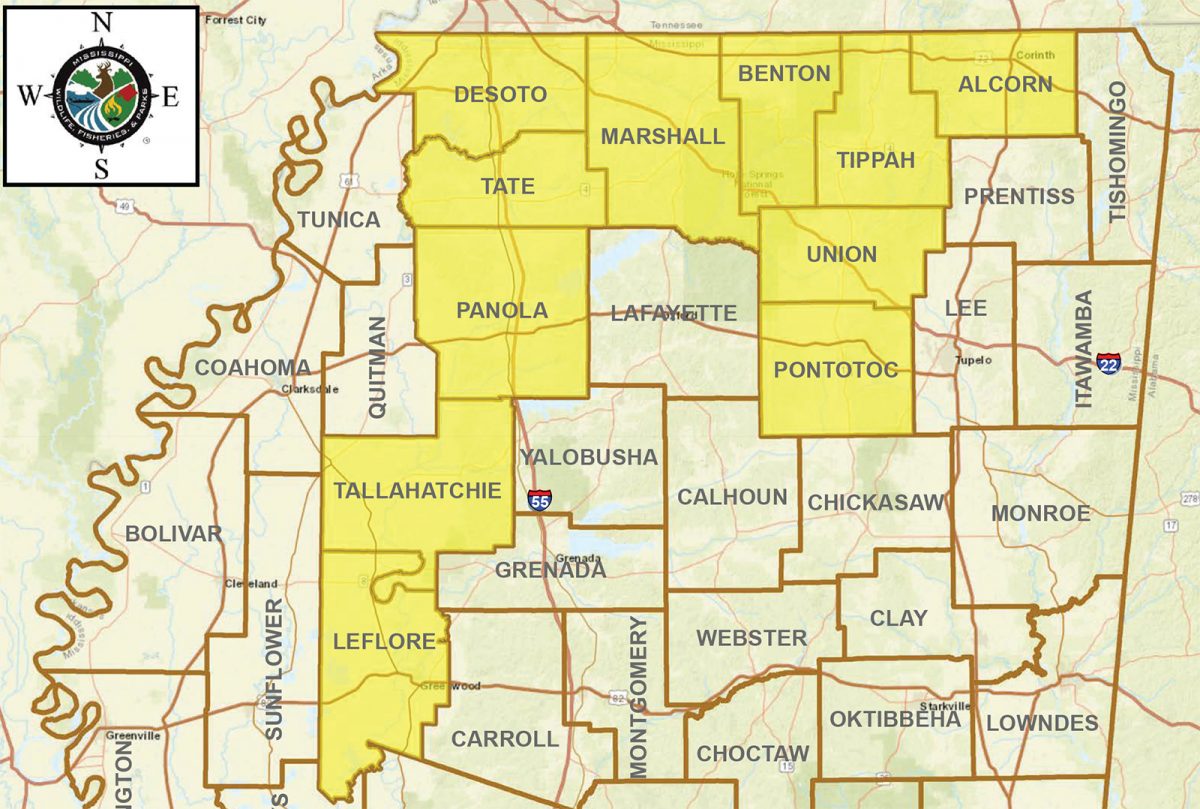
The Mississippi Department of Wildlife, Fisheries and Parks has designated the yellow counties (Desoto, Marshall, Benton, Tippah, Alcorn, Union, Pontotoc, Tate, Panola, Tallahatchie and Leflore) as 2021 CWD Zones. Portions of Sharkey, Issaquena and Warren counties in the Delta are also designated as CWD Zones.
Thousands of hunters will take to the woods across the state Saturday as the anticipated gun season for whitetail deer opens. The season marks the third since Chronic Wasting Disease (CWD) was first detected in Mississippi in February, 2018, bringing a change in regulations and concern for the risk of human consumption for deer that have it.
Since 2019 there have been 24,376 deer carcasses tested by the Mississippi Department of Wildlife, Fisheries and Parks (MDWFP), the vast majority coming from hunters. MDWFP also tests carcasses submitted from taxidermists, road kill deer and diseased deer. Most of the positive CWD cases in Mississippi have been in Benton County with 55 positives as the disease spread south from neighboring Fayette and Hardeman counties in Tennessee. Marshall County has also had 20 positives, while Alcorn, Pontotoc, Tallahatchie, Tippah and Panola counties have each had one positive. Issaquena County has also had two positives, including that first case back in 2018.
MDWFP has established a CWD Management Plan to implement strategies to prevent and mitigate the spread and transmission of the disease across the state. Management strategies are based on the best available science with input from a variety of subject matter experts. The nature of CWD mandates a long-term, adaptable approach to management, according to MDWFP. The current CWD Zones include the counties in north Mississippi where positive cases have been documented in north Mississippi as well as portions of Sharkey, Issaquena and Warren counties in the Delta. MDWFP has implemented additional regulations in these counties that include banning supplemental feeding (salt licks, mineral licks and feeders) and prohibiting carcasses to be transported outside of CWD Management Zones.
Although not recommended by MDWFP, supplemental feeding is allowed in counties not included in the CWD Zones which includes Yalobusha and neighboring Lafayette, Grenada and Calhoun counties. If there is a confirmed CWD case in an existing positive county or a new county, all counties within 10 miles of the confirmed case will be placed in a CWD Management Zone for a minimum of three years.
Danger To Humans?
CWD is a prion disease that affects deer, elk, reindeer, sika deer and moose according to the The Centers for Disease Control and Prevention (CDC). It has been found in portions of North American, including Canada and the United States, Norway and South Korea. It may take over a year before an infected animal develops symptoms, which can include drastic weight loss (wasting), stumbling, listlessness and other neurological symptoms. CWD can affect animals of all ages and some infected animals may die without ever developing the disease. CWD is fatal to animals and there are no treatments or vaccines.
The CDC reports that there have been no reported cases of CWD infection in people. However some animal studies suggest CWD poses a risk to certain types of non-humans, like monkeys, that east meat from CWD-infected animals or come in contact with brain or body fluids from infected deer or elk. The CDC notes that these studies raise concerns that there may also be a risk to people. Since 1997, the World Health Organization has recommended that it is important to keep the agents of all known prion disease from entering the human food chain.
Testing Sites
MDWFP reports hunters are vital to successfully managing CWD and ensuring healthy white-tailed deer herds for future generations. Hunters can assist by submitting the head of their harvest deer for testing. MDWFP continues to provide collection sites across the state for testings. Freezers are placed at each site to deposit the deer heads. Hunters should preserve the head with at least six inches of neck attached. Antlers may be removed before depositing the head. Harvested animal should remain cool until testing to reduce decomposition and provide accurate results.
There are two collection sites in Yalobusha County, one at the MDOT maintenance headquarters at 32950 Hwy. 32 in Tillatoba and the other at MDWFP’s North Region office at 457 County Road 36 (next to the fish hatchery off of I-55). There is also a collection site in Oxford at Fire Station Number 1 (401 McElroy Drive.)
General precautions recommended by MDWFP
• Inspect the body condition of each deer at the time of the harvest. Do not consume any part of animals exhibiting clinical symptoms of CWD, including extreme weight loss, excessive salivation or erratic behavior.
• Report any deer that appears to be diseased by completing a diseased report on the MDWFP app, at mdwfp.com/cwd or call 1-800-BE SMART.
• Avoid using natural deer urine attractants, as they may carry prions from infected deer. Hunters who prefer to use lures or attractants may wish to select an artificial or food based scent.
• To minimize direct contact with infectious prions it is recommended to not establish feeders, bait sites, mineral sites or otherwise cause unnatural concentration of deer.
Cleaning and Processing A Harvested Deer
Field Dressing
• Wear rubber or latex gloves when handling carcasses.
• When field dressing an animal, leave internal organs and inedible parts at the site of the harvest.
• Avoid sawing through bone, spinal cord, lymph nodes or the spleen.
• Sore all portions of the animal to be transported in a container such as a cooler, bin or bag that will not leak bodily fluids into the environment.
Meat Processing
• Do not process a deer that appears to be diseased.
• Process all deer individually, package separately and label uniquely.
• Debone meat from deer and remove all fat, connective tissue and lymph nodes.
• Avoid sawing through bone, spinal cord, lymph nodes or the
• Avoid eating/handling the eyes, brain, spinal cord, spleen and lymph nodes.
• Limit the amount of bodily fluids going to an area, such as a floor drain, that cannot be properly sanitized after each use.
Disposal
• Deer parts should not be rendered for use in feed for other animals, or used as compost.
• Recommended disposal methods for unwanted portions of carcasses (bones, organs, etc.) are:
– leave at the harvest site
– double bag and send to an approved, lined landfill
– deep burial (8 feet or deeper)
Equipment Cleaning
• Clean processing equipment between each deer.
• Thoroughly sanitize all equipment and workstations with a 50-50 solution of bleach and water.
• Soak tools for one hour in the bleach solution and then rinse thoroughly with hot water.