Veteran Physician Joins Odom Clinic
PROTECTED CONTENT
If you’re a current subscriber, log in below. If you would like to subscribe, please click the subscribe tab above.
Username and Password Help
Please enter your email and we will send you a password reset link.
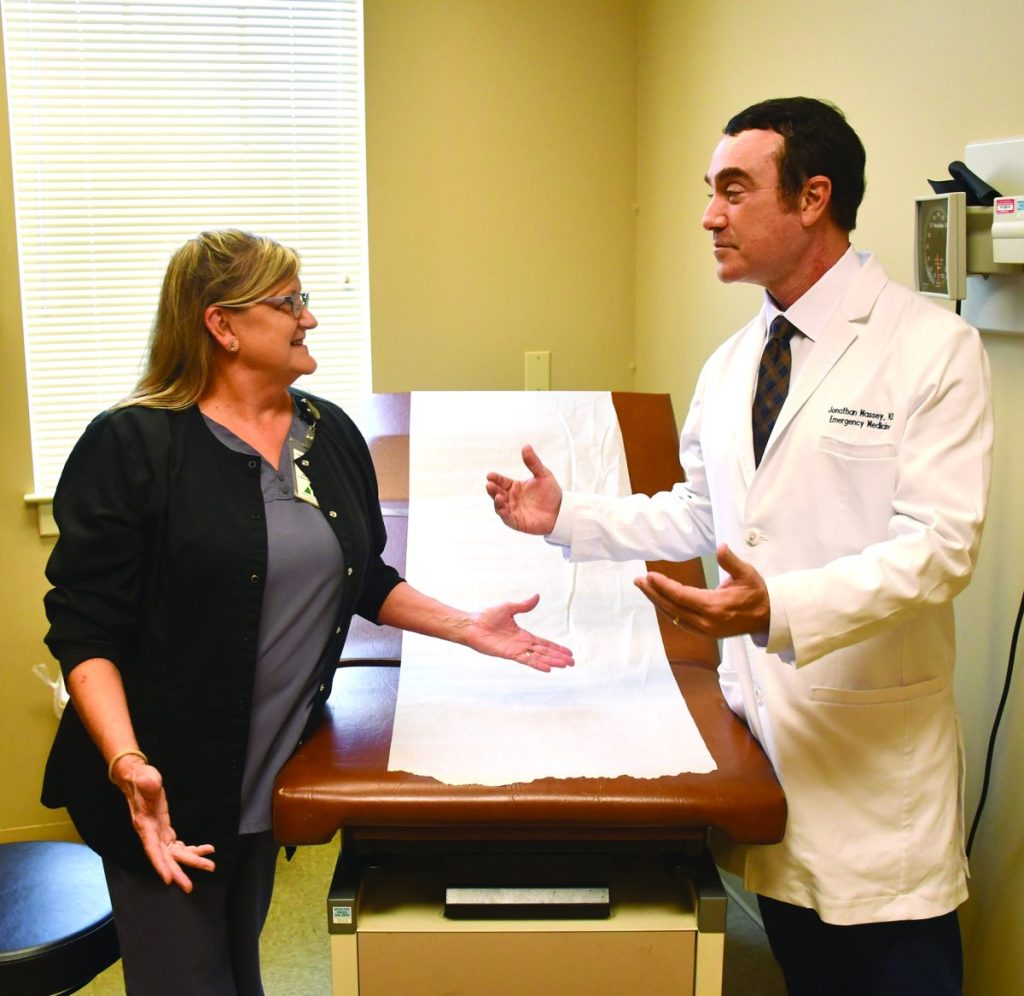
Dr. Jonathan Massey visits with his first patient at Odom Clinic, Tammy Hayles, who also works at Yalobusha Health Services. Hayles, who had known Massey for years, promised him in the hallway during his interview that she would be his first patient if he joined the clinic. She said she trusted him because of the compassionate care he had shown her late husband, describing Massey as “an excellent doctor who takes care of both his patients and their families.”
WATER VALLEY – After more than three decades practicing medicine, most of them spent in emergency rooms and another decade running a nephrology clinic, Dr. Jonathan Massey is beginning what he calls the final chapter of his career. At age 59, the veteran physician has joined Yalobusha Health Service’s Odom Rural Health Clinic in Water Valley, a move he describes as both unexpected and a blessing.
“This is my last job,” Massey said plainly. “I plan to finish my career right here. I’ve never had nights off, weekends off, and holidays off in 33 years.”
Massey’s career path has been steady and demanding. After graduating from medical school, he entered an internal medicine residency through the Methodist/UT system in Memphis and earned board certification in internal medicine, a designation he has maintained throughout his career. He began in emergency medicine, spending several years at Methodist Germantown before returning to UT Memphis for a nephrology fellowship.
The following spring he was recruited to Oxford, where the hospital did not have a full-time nephrologist at the time. He operated a nephrology practice there for the next decade before returning once again to emergency medicine — first with two years in Clarksdale, then a decade in Batesville, and most recently two years in Calhoun City.
Both roles were rewarding, he explained, but also exhausting in their own ways. What excites him about the move to Water Valley is the chance work a normal schedule and develop long-term relationships with patients.
The call to Water Valley came by chance. His name was passed along to YHS by a longtime acquaintance, who suggested him when the search started for a new physician.
“They called me up, and I thought, well, let’s talk about it,” he recalled.
The more he listened, the more appealing the offer became — a normal work week and hospital and nursing home coverage only one week a month. For the first time in his professional life, weekends and holidays would be a bigger part of the rhythm. “Even with call, you still get three weekends off each month,” he said. “That’s never happened in my career. I prayed about it, I crunched the numbers, and I knew this was the right move. Honestly, I feel like I’ve died and gone to heaven.”
The transition has been smooth. “The staff is wonderful, the patients have been so kind, and even the drive from Oxford is a pleasure,” he said. “It takes me 25 minutes to get here, and that’s a big change from years of commuting an hour or more each way. Everything about it just feels right.”
Bringing Experience Home
Years of training and practice give Massey a broad skill set that benefits patients in Water Valley. His nephrology background makes him especially focused on chronic illnesses like hypertension and diabetes, the two leading causes of kidney failure.
“High blood pressure can be controlled,” he explained. “You just have to figure out why it isn’t under control and get patients on the right medicines. Diabetes can be managed too, but it takes time and buy-in from the patient. When people feel like they’re part of the decision-making, the results are always better.”
He has also been impressed with the resources available at Odom Clinic. As a federally supported rural health clinic, it can provide services that most small-town practices cannot. “They can do almost everything here — lab work, x-rays, mammograms, ultrasounds, even minor procedures like stitching cuts, removing moles, or doing skin biopsies,” he said. “They also have staff dedicated to long-term care management. That’s rare in a clinic this size, and it makes a big difference. I’ve been very impressed.”
Massey acknowledged that nursing home care was never something he looked forward to during his career, largely because of the poor reputation many facilities carry. But his early experiences in Water Valley have shifted that perception. He has been impressed by the long-tenured staff — some with 10, 15, even 20 years of service — and the stability that brings to patient care. He also pointed to the facility’s wound-care program, which is strong enough that other nursing homes send patients there for treatment.
By his own admission, Massey has always been a workaholic. He started as an orderly at a hospital in Houston, Mississippi, when he was 16, and rarely slowed down afterward. “I’ve always worked, sometimes two or three jobs at a time,” he said.
Although he never developed many hobbies — he doesn’t hunt, fish or play golf, though he enjoys traveling and eating out — his career has been the constant focus of his life. That dedication, he believes, is one reason some of his former Oxford patients have already tracked him down at Odom Clinic. “That means a lot,” he said. “It tells me people trust me and want me to keep caring for them.”
He is quick to praise his new colleagues, including Dr. Heidi Pratt and Dr. George Abraham, as well as the tight-knit crew at the clinics, nursing home and hospital.
“They’ve gone out of their way to help me get settled,” he said. “They’re invested in this community, and that makes a difference.” Massey noted that leaders like YHS administrator Jessica Embry and others aren’t simply passing through or angling for bigger jobs in larger cities — they are committed to rural health care in Yalobusha County. “That kind of dedication is rare,” he added. “It gives me confidence about the future of this hospital system. Rural health care is tough everywhere, but I believe this system is strong. It’s where I want to finish my career.”